


Trade deficit widens to $11.55b in first half of FY26
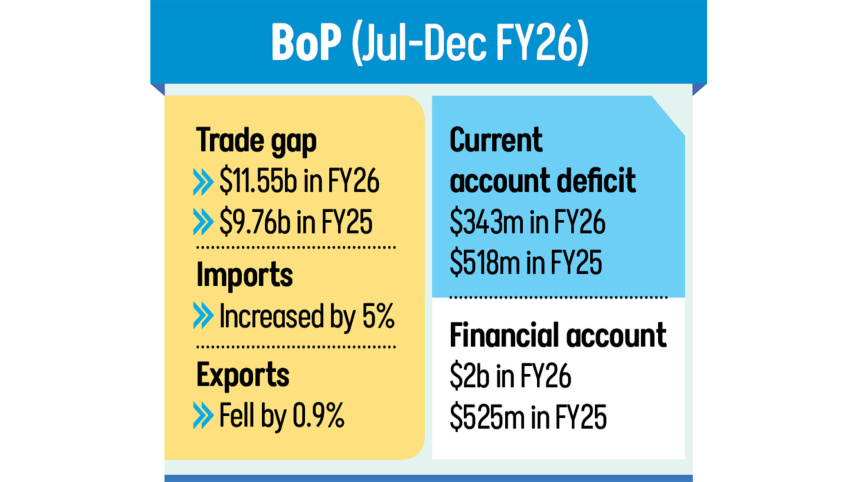
The gap between what Bangladesh buys and sells abroad, known as trade deficit, grew over 18 percent in the first half (H1) of the current fiscal year 2025-26, driven by rising imports and declining export earnings.
The country’s trade deficit ballooned to $11.55 billion in the six months through December 2025, up from $9.76 billion in the corresponding period a year earlier.

During the period, import bills rose 5 percent year-on-year to $33.67 billion, driven partly by pre-Ramadan purchasing, according to Balance of Payments (BoP) data released by the central bank.
Export earnings, meanwhile, slipped 0.9 percent to $22.12 billion.
Industry insiders expect the deficit to widen further in coming months as imports continue to rise while exports show no clear upward trend.
Global commodity prices remain stable for now, but any uptick would push import costs higher.
The solution, industry representatives argue, lies in diversifying into new export markets and products.
The broader balance of payments, however, shows a more encouraging trend. The current account deficit actually narrowed to $343 million from $518 million a year earlier.
The current account captures the net flow of funds into and out of the country, including payments for goods and services, income earned from overseas investments, and foreign aid. When imports exceed exports, or when outgoing payments for investment and aid are higher than incoming receipts, the account moves into deficit.
Meanwhile, the surplus in the financial account – which tracks cross-border flows related to investments, loans, aid, and other financial transactions – quadrupled to $2 billion from $525 million.
The surge in the financial account was buoyed by stronger net foreign direct investment, which climbed to $828 million from $553 million.
The net result is a $1.94 billion balance of payments surplus, reversing last year’s $467 million deficit.
 For all latest news, follow The Daily Star's Google News channel.
Comments