


Tea output edges up in 2025 despite export headwinds

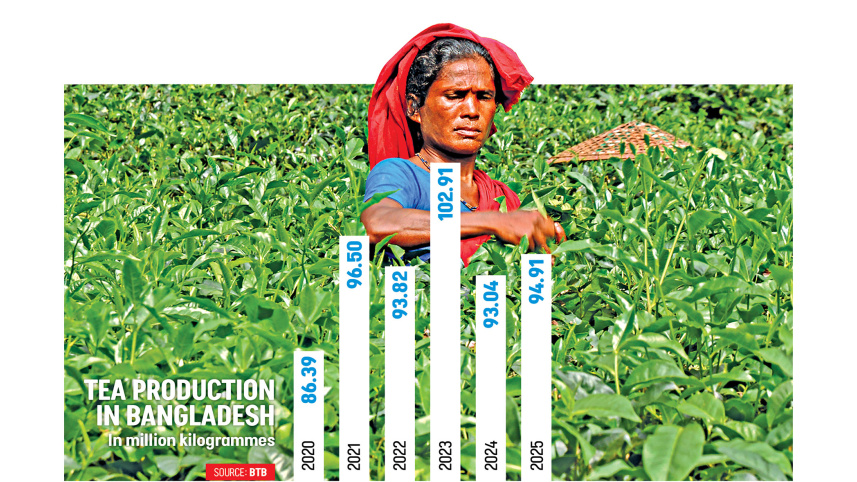
Bangladesh’s tea production recorded a 2.01 percent increase in 2025 compared with the previous year, data from the Bangladesh Tea Board (BTB) show.
Although favourable weather and better cultivation practices supported output growth, the industry remains under pressure from rising production costs and a slowdown in exports, though 2023 remains a record year for the industry.
 For all latest news, follow The Daily Star's Google News channel.
 The country produced 94.91 million kilogrammes (kg) of tea in 2025, up by 1.87 million kg compared to 2024.
Mohammed Moazzam Hossain, a member of the BTB, attributed the rise to timely rainfall, better seedling survival, higher leaf output, and proper use of fertilisers.
Despite the year-on-year increase, production remains below the 2023 peak of over 102 million kg. Hossain said that outdated land management, reliance on unpredictable weather, limited modern technology, poor irrigation, and seasonal droughts continue to hold back output.
“If underground water could be used for timely irrigation, production could rise significantly, but there is limited support for such initiatives,” he added.
Bangladesh’s tea industry has a 184-year history. Most gardens are located in the north-eastern region, while other northern districts have also increasingly taken up tea cultivation in recent years.
Golam Mostafa, chief operating officer of Ispahani Group’s tea estate operations, said production in 2025 was uneven due to regional weather differences. Areas such as Sylhet and Chattogram experienced irregular rainfall, reducing output in some gardens, while northern regions saw strong growth.
Despite these challenges, some northern gardens performed exceptionally well, leading in prices both by garden and by company, he added.
Luthful Kabir Shaheen, director of business development at City Group, which owns the Bengal Tea brand, said more seedlings survived in 2025, contributing to higher production. However, overall output remained below expectations due to insufficient rainfall during peak production months.
Shaheen stressed that timely and adequate rain is crucial for tea growth. While the eastern belt continues to produce premium-quality tea, northern regions are still developing and could see better yields over the next five to seven years.
Bangladesh has 169 tea gardens covering more than 280,000 acres. Of these, 90 are in Moulvibazar district, Sylhet, which accounts for about 55 percent of national output. Habiganj district, also in Sylhet region, contributes around 22 percent.
The peak tea season runs from June to November, and domestic demand now stands at 85-90 million kg annually, according to industry sources.
EXPORTS DECLINE AMID RISING COSTS
Tea exports fell in 2025, dropping to 1.64 million kg from 2.45 million kg in 2024.
Hossain said high production costs have made Bangladeshi tea less competitive internationally, especially against producers in Kenya and China. While premium varieties such as Orthodox and Green tea still find export markets, common teas struggle due to higher costs.
Shaheen said lower production and growing domestic consumption also contributed to the decline. Local tea consumption, including in stalls and restaurants, has risen by at least 1.5 times, reflecting stronger reliance on tea within the country.
Mostafa added that the fall in exports was partly due to the legally set floor price of Tk 210 to Tk 270 at auctions, which limited buyer participation.
An official from a leading tea company said that with less smuggled tea in the market, local demand rose, pushing average auction prices up by Tk 40 from 2024 to 2025, making local sales more attractive than exports.
Kamran Tanvirur Rahman, chairman of the Bangladesh Tea Association, said the country’s tea industry faces many challenges despite modest gains in production and prices.
He said the small increase in output “is not enough to ease the financial pressure on tea gardens,” adding that while a floor price has slightly improved prices, much tea remains unsold and is still sold at a loss.
Rahman highlighted rising costs, saying production expenses “continue to rise due to higher prices for fuel, electricity, gas, fertiliser, and labour,” while wages and operational expenses have increased, but tea prices have not kept pace.
“If prices do not rise further, it will be difficult for tea gardens to survive,” he warned, stressing the need for sustainable pricing to maintain profitability.
Discussing long-term trends, Rahman said the country’s tea production grew from around 30 million kg in 1972 to 102 million kg by 2023. In earlier decades, more than half of the output was exported, but over the past 8-10 years, exports have declined as domestic consumption has grown. Today, most of the country’s tea is consumed locally.
He added that while domestic demand has reduced reliance on exports, “the industry is now facing surplus production,” and expanding export markets for this surplus could benefit the sector.
Comments