


Skills gap costing Bangladesh its youth dividend

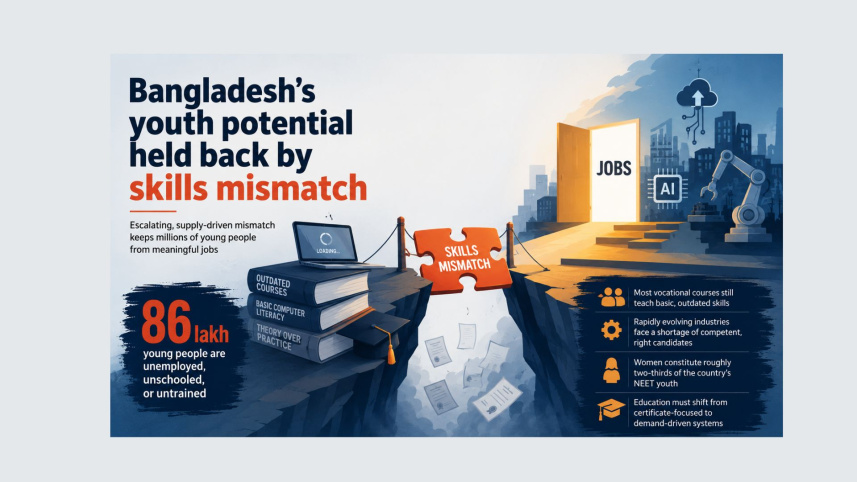
One in five young people in Bangladesh, nearly 86 lakh in all, is neither working, studying nor training for a job, the latest Labour Force Survey (LFS) 2024 shows.
The figures depict a measure of how far the country remains from cashing in on its long-promised demographic dividend as it observes the World Youth Skills Day 2026 today with the theme of “Skills for a Shared Future”.

Bangladesh has one of South Asia’s youngest populations, and has counted on that youth bulge to accelerate growth. Economists and employers say a gap between the skills young people have and what employers now need is widening.
Bangladesh Bureau of Statistics (BBS) data show 42 percent of all vocational training still goes toward basic computer literacy, even as industries adopt artificial intelligence (AI), automation and advanced digital tools.
“The labour market today faces two fundamental challenges: creating enough jobs, and creating decent jobs. Even when jobs are available, they often do not match workers’ skill levels, reflecting a persistent disconnect between education and industry,” said Sayema Haque Bidisha, a labour economist.
According to her, young people need practical digital and technology-oriented skills tied to actual industry demand, achieved through closer collaboration between institutions and industry.
A FAST-CHANGING LABOUR MARKET
Towfiqul Islam Khan, additional director (research) at the Centre for Policy Dialogue (CPD), said AI and digital disruption are as much an opportunity as a challenge, provided Bangladesh builds the right enabling conditions and strengthens the cognitive learning skills basic education is meant to instil.
He questioned whether the Technical and Vocational Education and Training (TVET) system is keeping pace with demand.
“Many trainees either fail to find employment or discover that the skills they acquired are already outdated. Technology, machinery and production systems are evolving quickly, but our training programmes are not being upgraded at the same pace,” he said.
He called for an industry-led TVET system with curricula and trainers updated continuously alongside industrial needs.
EMPLOYERS STRUGGLE TO FIND “RIGHT PEOPLE”
Employers, meanwhile, say while there are thousands of young jobseekers, it is difficult to find suitable candidates.
“The biggest challenge we face today is not a shortage of people but a shortage of the right people,” said Fazlee Ehsan Shamim, president of the Bangladesh Employers’ Federation (BEF). “We may receive 200 CVs against a post, but finding candidates with the ability to think critically, solve problems and learn quickly has become increasingly difficult.”
He said firms are forced to retrain recruits who lack practical competencies developed too late in the education system, and argued vocational courses should move beyond typing and Microsoft Word toward using digital tools to solve workplace problems.
WOMEN LEFT FURTHER BEHIND
Women make up roughly two-thirds of all NEET (Not in education, employment, or training) youth, despite Bangladesh’s progress in girls’ education.
Sayema Haque Bidisha, also a professor of economics at the University of Dhaka, said unpaid care work and a lack of childcare, safe housing and secure transport keep many educated women out of the labour force.
“We have achieved considerable gender parity in education, but that parity has not translated into employment,” she said.
M Niaz Asadullah, professor of economics at the University of Dhaka, said the NEET numbers expose a structural paradox even as Bangladesh champions its demographic dividend, and cautioned against treating STEM (science, technology, engineering, and mathematics) or IT training as a silver bullet.
 For all latest news, follow The Daily Star's Google News channel.
 “Two out of every five vocational trainees are still concentrated in basic computer courses. At the same time, Bangladesh produces at least three times more IT graduates every year than the number of IT jobs available,” he said.
He pointed to three weaknesses: a training system built around rote learning and certificates rather than labour market realities; the concentration of NEETs among women, who need flexible pathways beyond low-productivity trades; and a weak demand side, since job creation in high-value technical sectors lags the number of graduates.
“We need to shift from a supply-driven obsession with certificates to a demand-driven, industry-aligned education and training ecosystem that prepares young people for the jobs employers actually need to fill,” he said.
TIME FOR A RESET
Over the past decade, Bangladesh has invested billions in technical education and digital infrastructure.
Experts, however, point out that infrastructure is not enough to produce a future-ready workforce, the country also needs better teachers, updated curricula, closer industry-institution partnerships, and stronger reskilling opportunities.
Rizwanul Islam, former special adviser for the employment sector at the International Labour Office in Geneva, said persistently high NEET rates point to shortcomings in public policy, not just training design.
He said skills development should match specific demands of a diversifying economy rather than follow a one-size-fits-all model, and should support self-employment and entrepreneurship.
He, however, added that skills development alone cannot solve unemployment unless there are enough decent jobs.
According to the former ILO special adviser, responsibility for equipping young people with skills should be shared between the education system and technical and vocational training institutions.
He called for a broader range of training options, along with greater awareness among young people about the pathways available to them. Career counselling should play a larger role, he said, since many youths and their parents remain unaware of the education, training and career options open to them.
Comments