


Resin duty hike poses new challenge for plastic industry
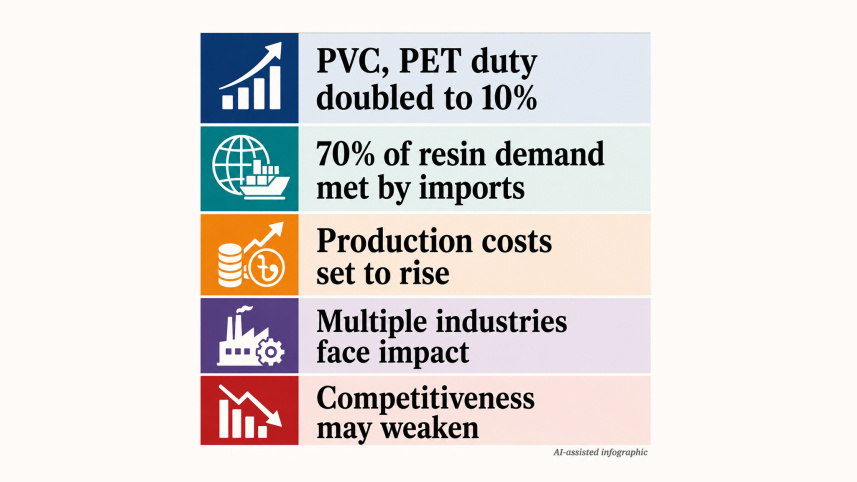
The hike in import duties on plastic resins in the proposed national budget for the fiscal year 2026-27 will create fresh challenges for Bangladesh’s plastic industry, raising production costs and affecting a wide range of downstream sectors, industry insiders say.
The government has proposed doubling the import duty on two key plastic raw materials -- PVC (polyvinyl chloride) and PET (polyethylene terephthalate) resins -- from 5 percent to 10 percent.

Stakeholders warn that the move will significantly increase production costs in the plastic, beverage, electrical, electronics, packaging, construction and automobile sectors, with the burden ultimately being passed on to consumers.
PVC resin, one of the most important raw materials used in Bangladesh’s plastic industry, is widely used in the production of pipes, fittings, water tanks, household products, flooring materials, electrical wire and cable insulation, synthetic leather, and shoe soles.
PET resin, meanwhile, is extensively used to manufacture beverage and food bottles, containers, packaging materials and various industrial products.
Considering their widespread use, the impact of the duty hike on these two materials will extend beyond the plastic industry, affecting the construction, packaging, electricity, healthcare, electronics and automobile industries.
Bangladesh’s annual demand for PVC resin is around 5 lakh tonnes, while demand for PET resin stands at approximately 3.5 lakh tonnes, bringing total annual demand to about 8.5 lakh tonnes.
In contrast, local production capacity stands at only about 1.5 lakh tonnes for PVC resin and 1 lakh tonnes for PET resin.
Consequently, around 70 percent of the country’s resin demand is met through imports, making the industry highly dependent on foreign supplies.
Given this reliance, higher import duties will directly raise production costs.
The plastic industry is currently growing at an annual rate of 8-10 percent, driven by low production costs, competitive labour costs, easy access to raw materials and rising domestic demand.
More than 5,000 plastic manufacturing enterprises operate in Bangladesh, around 98 percent of which are small and medium-sized enterprises (SMEs). Several large companies, including Pran-RFL Group, Bengal Plastics, Akij Plastics, National Polymer, Anwar Group and ACI Limited, play leading roles in the sector.
If the duty on imported resins is increased from 5 percent to 10 percent, import costs will rise significantly, increasing the production costs of pipes, fittings, water tanks, beverage bottles, packaging materials, electrical cable insulation, synthetic leather, footwear and various everyday products. This is likely to lead to higher market prices and additional pressure on consumers.
The industry is already facing challenges due to rising global resin prices caused by geopolitical uncertainties and conflicts in the Middle East. In such circumstances, the proposed increase in duties on key raw materials could place further strain on manufacturers.
Bangladesh’s plastic industry not only serves domestic demand but is also strengthening its position in international markets.
Plastic products from the country are currently exported to around 70 countries, and export earnings from the sector have been increasing steadily. However, the industry remains heavily dependent on imported raw materials.
Industry insiders argue that increasing import duties before achieving self-sufficiency in domestic resin production could weaken the competitiveness of local manufacturers. They also note that locally produced resin currently costs around Tk 10 more per kilogramme than imported resin, suggesting that policymakers should focus on addressing the factors behind the higher domestic prices.
Until Bangladesh achieves competitive pricing and greater self-sufficiency in resin production, industry stakeholders believe, the government should reconsider its decision to increase import duties on PVC and PET resins.
 For all latest news, follow The Daily Star's Google News channel.
Comments