


Quarterly VAT wins over businesses but stokes revenue fears

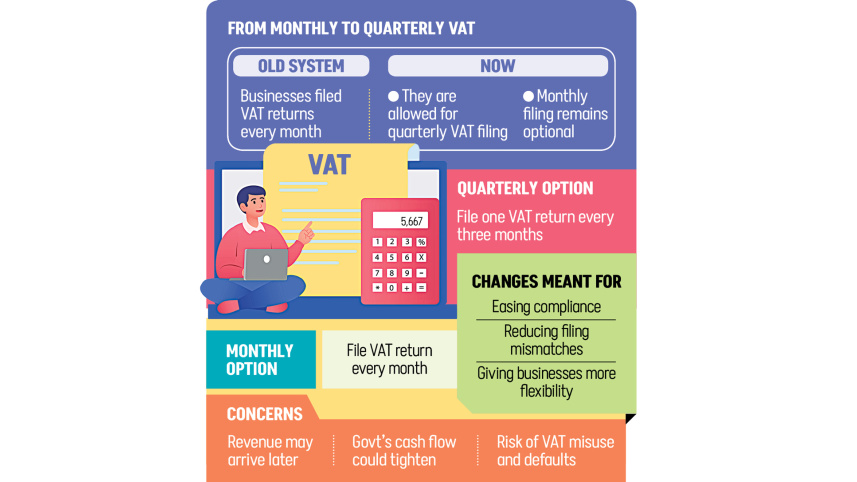
The government has allowed businesses to file value-added tax (VAT) returns and make payments every three months rather than monthly, marking one of the biggest changes to the country’s indirect tax system in decades.
The move has divided opinion. Businesses have welcomed the relief, and officials at the National Board of Revenue (NBR) say it will make compliance easier and reduce mismatches between VAT returns and payments.

However, tax practitioners and former revenue officials warn that the reform could strain the government’s cash flow at a time when revenue collection is already under pressure.
Under the previous system, businesses generally filed VAT returns every month. The Finance Act 2026 now allows VAT returns to be filed every three tax periods, or quarterly, within 15 days after the end of the third tax period. If the deadline falls on a government holiday, returns may be filed on the next working day.
The amendment does not abolish the monthly system. Businesses may continue to file and pay VAT every month if they choose.
The amendment therefore introduces quarterly VAT filing as an alternative rather than replacing the existing monthly regime.
BUSINESSES WELCOME
Businesses have welcomed the move, calling it “long overdue”.
Debabrata Roy Chowdhury, former tax and corporate affairs director of Nestlé Bangladesh PLC, said quarterly filing would reduce the compliance burden, improve working capital management, and give businesses greater financial flexibility at a time of high inflation.
He acknowledged that the government could face short-term cash flow pressure but said the benefits for businesses outweighed that concern.
While some fear businesses could use VAT funds for other purposes before the payment deadline, Debabrata said the risk of default exists under any filing system.
“The focus should be on ensuring compliance,” he said.
MA Razzaque, chairman of Research and Policy Integration for Development (RAPID), also said the change was unlikely to create a long-term liquidity problem, although it could cause some initial uncertainty.
“I don’t think the government will face a liquidity crisis as long as businesses submit their VAT returns properly every quarter,” he said.
Razzaque said the new provision gives businesses more flexibility rather than requiring them to delay payments.
“The government has not said that everyone must wait three months to pay VAT. It has simply given businesses more flexibility. Those that already pay VAT regularly can continue to do so, while those that need more time can choose the quarterly option,” he said.
REVENUE RISKS
Revenue experts, however, are less convinced.
Snehasish Barua, director of SMAC Advisory Services, said businesses have been paying VAT every month for the past 35 years.
“If businesses are allowed to keep VAT collections for three months, some may use the money for other purposes before the payment deadline,” he added.
 For all latest news, follow The Daily Star's Google News channel.
 He warned that this could increase the risk of default among financially troubled firms and slow the government’s revenue inflows.
A former NBR member shared the same concern, saying the proposal comes at a time when the government is struggling to raise revenue and meet rising expenditure.
“The government now needs to strengthen revenue collection, not delay it,” he said, warning that the reform could weaken revenue mobilisation without strong enforcement.
VAT is one of the government’s most reliable sources of revenue, collected throughout the year to fund salaries, pensions, interest payments and development projects. The timing of VAT receipts is especially important because the NBR is under heavy fiscal pressure and revenue collection has repeatedly fallen short of targets.
In FY26, the NBR collected nearly Tk 4.15 lakh crore, about Tk 1.39 lakh crore below its own target and around Tk 88,000 crore short of the government’s revised target.
If a large share of VAT receipts is delayed, the Treasury could face temporary cash-flow shortages even if total annual revenue remains unchanged. How serious the impact becomes will depend on the government’s cash reserves, borrowing capacity and business compliance.
Some specialists believe the government may have to rely more on short-term bank borrowing if quarterly VAT collections become uneven, according to the former NBR member.
Razzaque questioned whether the change was necessary, arguing that businesses should normally be able to determine their VAT liabilities within a month.
He also warned that a longer payment period could increase the risk of revenue leakage if businesses keep the money, underreport their liabilities or fail to pay the full amount later.
“If the government ultimately receives the same amount of revenue and the overall flow does not fall, there may be some initial disruption before the system adjusts,” Razzaque said.
“The concern about possible revenue leakage is valid, but it is too early to say whether it will happen or how serious it could be,” he added.


Comments