


Public projects must use local tiles, lifts: Ecnec

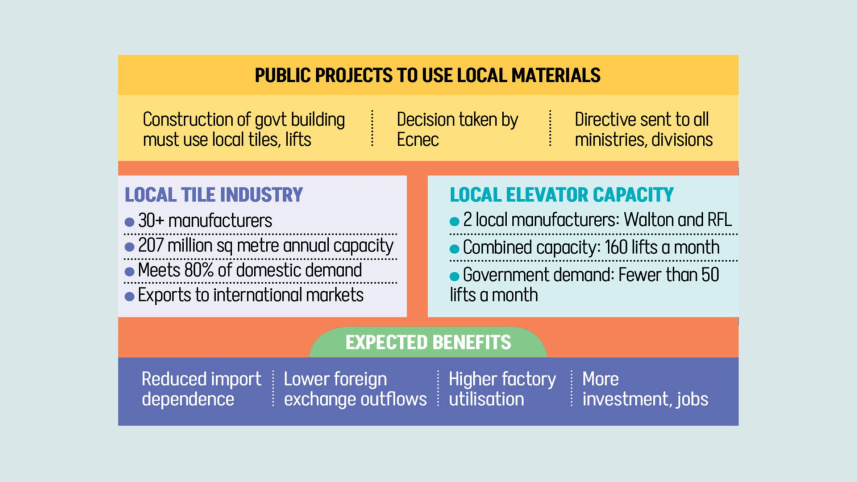
The government’s highest project reviewing body has made it compulsory to use locally made tiles and elevators in public building construction projects instead of imported alternatives.
The decision was taken at a meeting of the Executive Committee of the National Economic Council (Ecnec) in June, chaired by Prime Minister Tarique Rahman, according to Planning Commission documents seen by The Daily Star. The directive has already been sent to all ministries and divisions.

Manufacturers have welcomed the move, saying it will strengthen local industry.
Giving preference to local manufacturers in public procurement is not new. Existing rules already encourage government agencies to buy domestic materials. Local companies have supplied products for major projects such as the Padma Bridge and Dhaka metro rail.
However, the latest directive specifically targets lifts and tiles at a time when manufacturers in both sectors are struggling with weak demand and slow public development spending.
A senior Planning Commission official, speaking on condition of anonymity, said government procurement can play an important role in supporting domestic manufacturers, many of whom have invested heavily to expand capacity but continue to face sluggish demand and competition from imports.
The official cited the construction of Dhaka airport’s third terminal, where local companies supplied cement, steel, bricks and sand after meeting specifications set by the Japanese contractor.
If Bangladesh wants world-class infrastructure, it needs to tell local industries exactly what standards they have to meet, the official said. “If local manufacturers can produce to those standards, there is no reason to import. We should go abroad only when they cannot.”
The official also called for building domestic assembly capacity in high-value manufacturing rather than importing fully assembled lifts. “Bangladesh should import quality components and assemble them domestically, which could cut costs by about 50 percent. To achieve that, we need to adopt the technology, learn the process and build our own assembly capability. That is the objective.”
Major producers say they are more than capable of meeting government demand for lifts and other construction materials.
RN Paul, managing director of RFL Group, said his company currently has the capacity to produce about 100 lifts a month across all categories, including passenger and cargo lifts of different capacities.
Stating that Walton Hi-Tech Industries PLC has a monthly production capacity of about 60 units, he said the two companies can produce around 160 lifts a month, while public agencies require fewer than 50 lifts a month.
Locally manufactured lifts can reduce procurement costs by at least 20 percent while creating jobs and increasing local value addition, he added.
SM Mahbubul Alam, managing director of Walton Hi-Tech, said Walton-made lifts are already being exported to Sri Lanka.
“Using locally manufactured lifts, along with other construction materials such as cables, electrical accessories, VRF systems and chiller air conditioners, in government projects will strengthen the global reputation of these products and help open up new export opportunities,” he said.
Ceramic producers say the industry has grown into one of the country’s strongest manufacturing sectors, producing tiles, sanitary ware and tableware that several companies already export internationally.
According to them, quality is no longer a barrier, yet imported materials continue to dominate many public projects.
Md Mamunur Rashid, additional managing director of X Ceramic Group, said the government decision would boost demand for local tiles at a time when manufacturers, sitting on significant excess capacity, have had to compete aggressively on discounts and commissions just to cover loan repayments and operating costs.
He said locally manufactured tiles are better suited to Bangladesh’s climate and offer higher quality than many imported alternatives.
“This is good news for local producers,” he said. “If imports decline, demand for locally made tiles will increase,” he said about the directive.
 For all latest news, follow The Daily Star's Google News channel.
 Manufacturers of other construction materials also welcomed the Ecnec decision to reduce unnecessary imports of construction materials.
Md Rafiqul Islam Rony, director of marketing and sales at BRB Cable Industries Ltd, said, “If locally made products replace imports, the money will stay in the country, generate revenue, create jobs and help local industries grow.”
Bangladesh’s cable manufacturers can fully meet domestic demand, he said, adding that imported products are not necessarily better and can sometimes even be inferior to local alternatives.
Comments