


Post-larvae shortage leads to Bagerhat hatchery crackdown

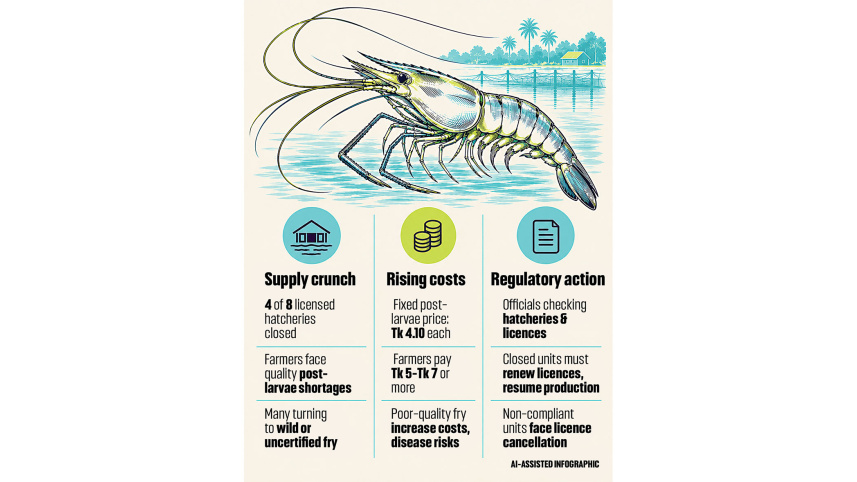
An acute shortage of post-larvae (PL) is disrupting Golda or freshwater prawn farming in the Khulna-Bagerhat region as several hatcheries and nurseries remain closed, prompting the Bagerhat Fisheries Department to threaten licence cancellations.
Four of the eight licensed Golda hatcheries in Bagerhat are currently closed, according to inspections by the district fisheries department.

The department has launched a drive against inactive prawn hatcheries and nurseries, serving notices on closed facilities and asking them to renew their licences and resume production. Failure to do so could result in permanent cancellation of their licences, officials said.
As part of the drive, department officials are inspecting licensed hatcheries and nurseries to check their operational status and licence validity. Several of the closed facilities have remained deserted for long periods, with weeds growing across their compounds.
“We have already served notices to the closed hatcheries instructing them to renew their licences and initiate activities. Failing this, their licences will be permanently revoked,” said Raj Kumar Biswas, district fisheries officer of Bagerhat.
As part of the drive, department officials are inspecting licensed hatcheries and nurseries to check their operational status and licence validity. Several of the closed facilities have remained deserted for long periods.
The inactive production units include BRAC Hatchery and Bagerhat Prawn Hatchery along the Bagerhat-Khulna highway, Rupa Golda Hatchery in Morrelganj and Rainbow Hatchery at Badhal union in Kachua upazila.
The department’s review also found administrative and operational lapses.
Brothers Lab, which obtained its licence in 2018, has applied for cancellation, while the licences of Rupa Golda Hatchery and Bagerhat Prawn Hatchery expired in 2025 and 2023, respectively. Ratna Nursery still holds a valid licence but has stopped operating following the death of its proprietor, officials said.
Officials said Golda hatcheries in the district had previously produced around 10 crore PL annually. However, they said it was too early to quantify the current production shortfall, as the registered production capacities of the affected hatcheries are still being examined.
The closures have left freshwater prawn farmers struggling to secure certified PL at the start of the farming season, forcing some to collect wild fry from open water bodies or buy uncertified supplies from unregulated vendors.
The shortage has also pushed up the price of PL, according to farmers. The Bagerhat district fisheries office said the government-fixed rate for Golda PL is Tk 4.10 per piece. Farmers, however, said they are paying Tk 5 to Tk 7 or more for uncertified fry, which often fail to meet expected quality standards.
“Farmers are struggling to obtain adequate quantities of quality fry,” said Abul Hossain Khan, 60, a grower from Sangdia village in Kachua upazila.
Gopal Das, 45, another grower from Sangdia, said a dependable supply of quality fry from local hatcheries was vital for families dependent on freshwater prawn cultivation.
Substandard fry increase production costs and raise the risk of disease outbreaks and poor survival rates, farmers also said.
The closures have also affected the wider local value chain, with skilled hatchery technicians left without work and nursery operators, transport workers and local traders seeing their incomes squeezed as hatchery activities have declined.
Fakir Mahitul Islam Sumon, president of the Shrimp Growers’ Association of Bagerhat, urged the government to take immediate steps to reopen viable hatcheries and stabilise the supply of quality fry.
Farmers said government intervention should go beyond serving administrative notices. They called for strict enforcement of biosecurity protocols, the supply of disease-free certified fry and regular field inspections after hatcheries resume operations.
 For all latest news, follow The Daily Star's Google News channel.
Comments