


Growth to stay below 4% until FY28 on energy, banking woes


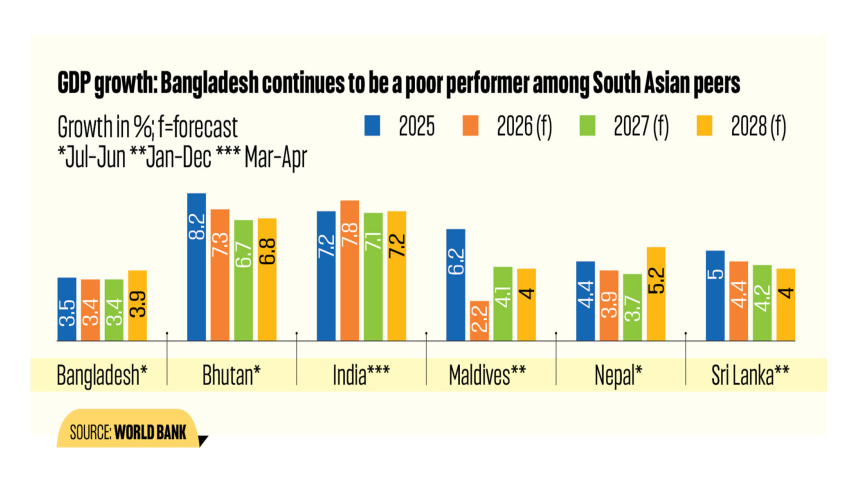
Bangladesh is yet again set to register weak economic growth of 3.4 percent in the current fiscal year, according to the World Bank, marking a fourth straight year of slowing growth amid a deepening energy crisis, financial sector vulnerabilities and global uncertainties.
The Washington-based lender expects only a slight recovery to 3.9 percent in fiscal year 2027-28, meaning Bangladesh is set to record the weakest growth among its South Asian neighbours in 2027, according to the World Bank’s latest economic update on Bangladesh and South Asia released yesterday.

The forecast is a further downgrade from the multilateral lender’s April estimate. It also marks a sharp break from past years when Bangladesh was seen as one of the region’s fastest-growing economies.
In the report, the World Bank said South Asia is forecast to accelerate from 6.8 percent in 2025 to 6.9 percent in 2026, after it revised up growth projections for most countries from its previous forecast.
According to the lender, higher energy prices have not interrupted the region’s momentum in consumption growth.
“The main exception is Bangladesh, whose forecast has been continually downgraded in recent years,” said the report.
Bangladesh’s gross domestic product (GDP) growth reached 7.1 percent in fiscal 2022 but began slowing the following year. Growth fell below 4 percent in FY25, and the World Bank now expects the weakness to continue until FY28.
The lender said the return of political stability was expected to support a rebound in economic activity. But that recovery has yet to materialise, prompting it to cut the FY27 growth forecast by 1.2 percentage points to 3.4 percent.
“This deterioration reflects a more protracted drag from energy shortages, banking sector weakness, subdued credit growth, and tighter fiscal constraints than previously anticipated. Export growth is expected to remain weak,” said the global lender.
The slowdown is particularly evident in industry. Industrial output grew by just 2 percent in FY2025-26, while the industrial sector contracted in the third quarter for the first time since the pandemic.
Private investment has also been held back by uncertainty over energy supplies and vulnerabilities in the banking sector.
Private sector credit growth fell to a 33-year low of 4.5 percent in June 2026, reflecting weak business confidence, banking sector vulnerabilities and disruptions to energy supplies.
Government investment has also fallen to a historic low amid acute fiscal constraints and implementation challenges, weighing on domestic demand in the short term and the economy’s longer-term growth potential, the report said.
The World Bank said the slowdown reflected deeper structural weaknesses that were affecting investment, employment and productivity.
“Longstanding vulnerabilities in the financial sector, chronic weaknesses in domestic revenue mobilisation, persistent energy sector bottlenecks, and declining public investment have reduced the economy’s resilience and constrained its growth potential,” said the World Bank.
ENERGY CRISIS
The energy shortage has become a major constraint on factories and businesses.
Domestic gas production has declined, while imported liquefied natural gas now meets about a third of gas demand. Failures at floating LNG import terminals in Maheshkhali reduced supplies, forcing many factories to operate below capacity or suspend production.
The gas shortages also contributed to widespread load-shedding. The government ordered shopping malls to close early to reduce peak electricity demand, while petroleum import bills more than doubled in FY2025-26.
The World Bank noted that the outlook remains vulnerable to further shocks.
 For all latest news, follow The Daily Star's Google News channel.
 “The outlook is subject to significant downside risks,” it said in its latest Bangladesh Development Update.
Banking sector vulnerabilities, it said, have intensified and pose growing systemic risks.
HIGH INFLATION
Inflation has eased from its peak but remains well above the Bangladesh Bank’s target.
Average headline inflation fell from 10 percent in FY25 to 8.7 percent in FY26 and eased further to 8.3 percent in August this year, mainly because of lower food inflation.
The World Bank expects inflation to average 8.6 percent in FY27, citing higher domestic energy prices, supply constraints and continued money supply growth.
Underlying price pressures remain elevated. Despite persistent inflationary pressures, the Bangladesh Bank reduced its policy rate for the first time in six years in July 2026 and introduced targeted liquidity support for industry.
Higher public sector credit growth and stronger foreign asset inflows also supported a recovery in broad money (M2) growth.
Real wages for low-paid workers are still falling, the World Bank said.
JOBS, EXPORTS UNDER PRESSURE
The weak economy has also hit the labour market. Conditions deteriorated further in FY26 as subdued demand and energy shortages constrained hiring, especially in industry.
Factories closed, laid off workers and reduced operating hours, while weaker industrial activity spilled over into the services and agriculture sectors.
Female labour force participation fell from 42.8 percent in 2022 to 38.4 percent in 2024, as women who lost jobs in industry and services largely left the labour force.
Exports also remain a weak point.
The World Bank said ready-made garment exports would be constrained in the short term by weak demand in the European Union and, over the longer term, by greater competition for market share.
Overall exports fell 0.2 percent in FY2025-26. A survey by the United States Fashion Industry Association, cited by the World Bank, showed that US buyers’ use of Bangladesh as a sourcing base had fallen to around 78 percent from 88 percent a year earlier.
The World Bank expects the current account deficit to widen to 0.9 percent of GDP in FY27.
Remittances, however, provided some support to the external sector.
They rose 17.3 percent in FY2025-26 to a record $35.6 billion, limiting the current account deficit to 0.3 percent of GDP and helping rebuild foreign exchange reserves to more than $32 billion by August. The taka was broadly stable.
AI OFFERS OPPORTUNITY
The World Bank’s broader South Asia outlook sees the region’s growth accelerating from 6.8 percent in 2025 to 6.9 percent in 2026, with higher energy prices yet to interrupt momentum in consumption growth.
The report also examines how artificial intelligence could create new sources of growth across the region.
AI adoption in South Asia is rising but remains well behind advanced economies.
Even so, firms are increasingly using the technology to find new markets, while governments are deploying it in areas such as weather forecasting for smallholder farmers in India and AI-assisted retinal screening in Bangladesh.
“The adoption of AI has the potential to transform South Asia’s development trajectory by boosting labour productivity, expanding export opportunities, and improving public service delivery,” said Franziska Ohnsorge, World Bank Group chief economist for Asia.
“But to reap these benefits, governments need to address the foundational gaps that hold back adoption,” she added.
Johannes Zutt, World Bank vice president for South Asia, said the region needs to develop new sources of growth to maintain momentum and create jobs.
“South Asia has demonstrated remarkable resilience in a challenging global environment. But the region needs to invest in new drivers of growth to sustain momentum and create more jobs,” he said.
Johannes added, “To seize the opportunity provided by rapidly-growing AI global value chains, countries should invest in the skills, infrastructure, and enabling environment that allow workers and businesses to harness AI’s potential.”
Comments