


Plastics sector at risk as supply chains falter
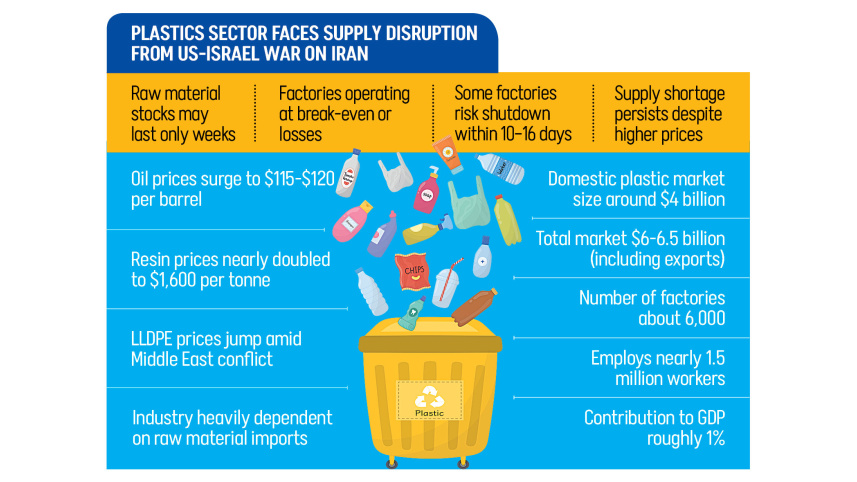
Bangladesh’s plastics industry is facing a severe disruption, as the ongoing US-Israel war on Iran rattles global energy and petrochemical markets, industry insiders say.
With oil flows and key shipping routes like the Strait of Hormuz under strain, raw material supply has tightened sharply.

Manufacturers in the country warn stocks may last only weeks, raising fears of production cuts, higher prices, and pressure on exports.
Resin, the key raw material for plastics, which used to cost around $900-$950 per tonne, is now selling at $1,500-$1,600, as crude oil prices have surged from about $60-$70 per barrel to $115-$120, sharply increasing production costs.
The pressure is already visible across factories.
“Some factories are facing shutdown within 10 to 16 days if supplies are not restored,” said Anisur Rahman, deputy executive director of Premiaflex Plastics Limited under ACI PLC.
“Some companies have stock for a week, others for a month or two. But beyond that, uncertainty is overwhelming,” he said.
Industry insiders noted that the core issue is a supply shortage rather than cost.
“Even if we offer Tk 100 to purchase something that used to cost Tk 10, suppliers cannot deliver,” Rahman said.
To cope, manufacturers are funnelling raw materials towards producing some selected products, aimed at a specific section of customers who are willing to accept higher prices, he said.
The situation has been further complicated by difficulties in opening and adjusting letters of credit (LCs), with many suppliers unable to fulfil orders or demanding revised terms.
Prices of LLDPE, a key packaging material, have risen from around $1,900 to $2,100-$2,200 per tonne following the Middle East conflict, while some LLDPE grades are now unavailable.
Rahman said his factory may continue operations for the next one to two months, but warned that prolonged instability could trigger widespread shutdowns.
The strain is not limited to a segment of the market, but has spread throughout.
RN Paul, managing director of RFL, said the company can continue operations for only about two more weeks using existing inventory amid ongoing supply constraints.
“We may be able to run for another 15 days with our old stock,” he said.
He added that raw material prices have risen by around 40 percent on average, with even steeper increases in some cases.
RFL requires about 10,000 tonnes of raw materials monthly, including PET, polypropylene (PP) and PVC, all of which have seen sharp price hikes.
PVC, used in pipe manufacturing, has surged from about $800 to around $1,600 per tonne.
The company now sources 60-70 percent of materials from the Middle East and 30 percent from China, reflecting a shift in global supply dynamics.
 For all latest news, follow The Daily Star's Google News channel.
 Paul warned that despite opening LCs, companies are receiving only partial volumes. “If we need 10,000 tonnes, we may get only a fraction,” he said, adding that the situation could shrink market activity by 30-40 percent.
ASM Kamal Uddin, managing director of Luna Polymer, has blamed tax complexities, banking irregularities and global supply disruptions for pushing the plastic manufacturing sector into a deep crisis.
He said that although the nominal import duty on raw materials is around 32 percent, customs assessments often inflate values, increasing the effective burden by an additional 30-40 percent.
Global factors have worsened the situation. Rising crude oil prices and supply disruptions have driven sharp increases in raw material costs.
Meanwhile, many Middle Eastern raw material suppliers have halted shipments, while others have raised prices due to higher freight costs.
Uddin said most manufacturers hold only one to one-and-a-half months of raw material inventory, making them highly vulnerable. His company requires about 500 tonnes monthly. He warned that prolonged instability will raise production costs, force price hikes and increase pressure on consumers.
Shamim Ahmed, president of the Bangladesh Plastic Goods Manufacturers and Exporters Association (BPGMEA), said prices of key raw materials, particularly resin, have nearly doubled in recent months, driven by global oil price volatility and geopolitical tensions.
He emphasised that the plastic sector is a critical linkage industry, supporting around 30,000 businesses, including food processing, pharmaceuticals, garments and consumer goods. “Without plastic packaging, many essential products cannot reach the market efficiently,” he added.
Despite some growth in domestic production, Bangladesh remains heavily reliant on imports. Annual demand for plastic resin is about 1.7 million tonnes, of which roughly 1.2–1.3 million tonnes are imported, while the rest comes from local production and recycling.
Ahmed warned that many factories are operating at break-even or shutting down, urging urgent policy support to stabilise the sector.
One of the key demands is a reduction or waiver of import duties on raw materials, which can go up to 32 percent when taxes and VAT are included.
“If the government reduces duties -- even by 50 percent -- it could significantly ease the pressure,” Ahmed said.
Comments