


The USTR's forced-labour import ban initiative: implications and options for Bangladesh

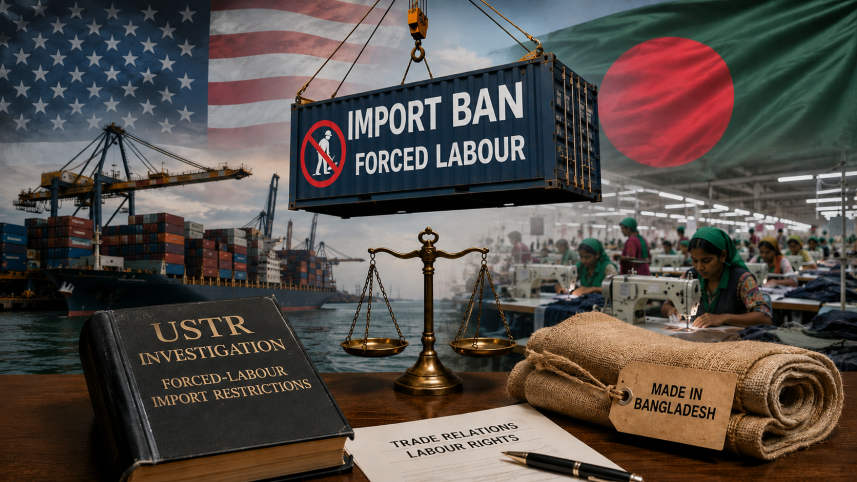
The latest USTR proposal on forced-labour-related import restrictions raises issues that go well beyond Bangladesh’s immediate export interests.
It is unfortunate that a universally legitimate objective—namely, the eradication of forced labour—is being pursued through a unilateral tariff-based process that seeks to establish a new regulatory norm without sufficient multilateral grounding.

Bangladesh should not dismiss the concern. Forced labour is unacceptable, and all countries should take effective measures against it. Yet it is equally important to distinguish between the obligation to prohibit forced labour and the much more specific requirement to maintain a dedicated “forced-labour import prohibition” at the border.
ILO conventions on forced labour require countries to eliminate forced or compulsory labour. They do not, however, prescribe a particular import-ban regime as the only acceptable policy instrument. Countries may address forced labour through labour laws, inspection systems, criminal sanctions, due diligence obligations, corporate accountability frameworks, customs cooperation, and international enforcement mechanisms. The USTR proposal, therefore, appears to move from a widely accepted principle to a specific US-preferred regulatory model. This is something that needs serious discussion at the multilateral level.
The fact that the USTR investigation covers economies such as the EU, Canada, Australia, Japan, the UK, Switzerland, Norway, and New Zealand suggests that the issue concerns a contested regulatory approach rather than a settled international norm.
Bangladesh should make this point firmly but constructively. It should reaffirm its commitment to eliminating forced labour while arguing that the absence of a specific import-prohibition regime should not automatically be treated as an unreasonable trade practice. The fact that the USTR action also covers several advanced economies suggests that this is not simply a case of weak compliance by developing countries. Rather, it reflects the contested status of a new regulatory instrument that has not yet become an established international standard.
At the same time, Bangladesh cannot afford a confrontation with the United States. The US remains a critical export market, particularly for apparel. Nor should Bangladesh simply give in to every demand, especially at a time when the proposed wider trade agreement with the United States is already generating considerable domestic debate because of its perceived asymmetry. Bangladesh’s response should therefore be calibrated: cooperative on labour rights, careful on legal commitments, and strategic on market access.
A practical starting point would be to review whether Bangladesh can introduce a narrowly designed legal provision prohibiting the importation of goods produced wholly or partly with forced labour. Such a provision need not damage Bangladesh’s economic interests if it is framed in a risk-based, evidence-led, and administratively feasible manner. The objective should not be to create an arbitrary trade-restrictive tool but to demonstrate that Bangladesh is willing to align with emerging concerns while preserving legitimate trade flows and avoiding excessive compliance burdens.
More broadly, Bangladesh should build a coalition with other affected economies. The country’s position would be stronger if framed alongside concerns from other developing and developed economies regarding proportionality, transition periods, technical assistance, administrative capacity, and consistency with the rules-based trading system. A purely defensive national response may be less effective than a broader argument that unilateral tariff threats should not become the default method for creating new trade-related regulatory norms.
The systemic concern is real. The USTR proposal reflects a growing tendency to use tariff threats to advance regulatory standards that have not been established through multilateral agreement. While combating forced labour is a legitimate and widely shared objective, making market access conditional on a specific national regulatory model risks weakening the MFN-based trading system and further fragmenting global trade governance.
Bangladesh’s response should therefore combine principle and pragmatism. It should challenge the conceptual and legal basis of treating a “forced-labour import prohibition” as a universal obligation. It should avoid unconditional acceptance of wider US trade demands. It should explore domestic legal reforms that are low-cost, credible, and consistent with its own development interests. And it should maintain an open negotiating channel with Washington, backed by a clear domestic action plan on labour standards, customs procedures, supply-chain due diligence, and institutional enforcement.
The objective should not be to resist reform. Bangladesh has every reason to strengthen labour governance and project itself as a responsible trading nation. But reform should be undertaken as part of a domestically owned strategy, not merely as a response to tariff pressure. A confident, rules-based, and carefully calibrated position would allow Bangladesh to support the fight against forced labour while defending its legitimate trade and development interests.
It is a matter of concern that the USTR proposal reflects a growing tendency to use tariff threats to advance regulatory norms that have not been established through multilateral agreement. While combating forced labour is a legitimate and widely shared objective, making market access conditional on a specific U.S.-preferred regulatory model risks weakening the MFN-based trading system and further fragmenting global trade governance.
The author is an economist who serves as chairman of the Research and Policy Integration for Development (RAPID). He can be reached at m.a.razzaque@gmail.com
 For all latest news, follow The Daily Star's Google News channel.
Comments