


NBR revises tariffs on 261 lines ahead of LDC graduation


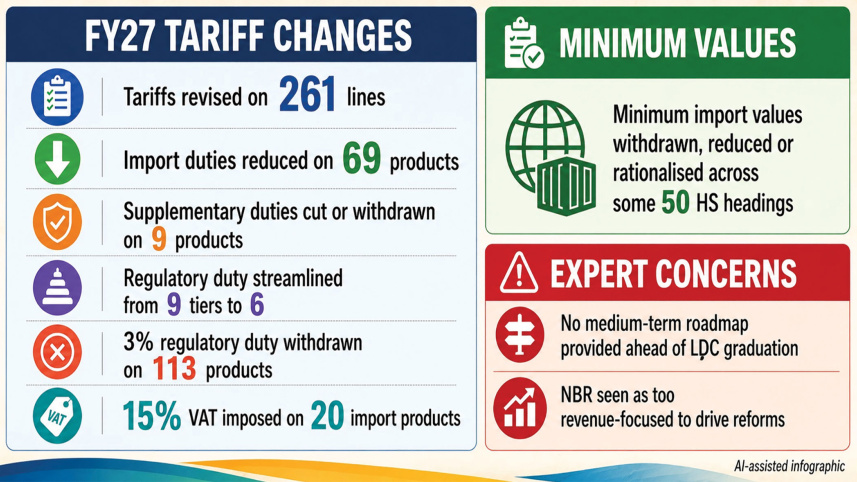
Bangladesh has introduced another round of tariff adjustments in the proposed budget for fiscal year 2026-27, revising duties, taxes and minimum import values across 261 tariff lines as part of broader efforts to strengthen the country’s competitiveness ahead of its graduation from least developed country status.
The measures include reductions in customs duties, changes to regulatory and supplementary duties on selected products, imposition of value-added tax on some imports, and revisions to the minimum value system. Finance Minister Amir Khosru Mahmud Chowdhury placed the proposals before parliament on June 11.

Bangladesh has formally requested a deferral of its LDC graduation by at least three years to allow time to implement key domestic reforms and ensure a smooth economic transition. Once graduation takes effect, the country will lose the preferential tariff treatment, duty-free and quota-free market access, and policy flexibilities it currently enjoys as an LDC.
The proposed changes are intended to strike a balance between protecting domestic industries, safeguarding revenue, and aligning Bangladesh’s tariff structure with its international trade obligations.
Under the proposals, import duties will be reduced on 69 products to fulfil commitments made to the World Trade Organisation. Supplementary duties will be reduced or withdrawn on nine products. The existing nine-tier regulatory duty structure will be streamlined into a six-tier structure -- with the lowest tier rising from 3 per cent to 5 percent and the highest tiers of 30 and 35 percent reduced to 25 percent.
Separately, the existing 3 percent regulatory duty on 113 products will be fully withdrawn.
A 15 percent VAT has also been proposed at the import stage on 20 products that currently bear no VAT.
The budget also introduces changes to the minimum value system -- a mechanism that sets floor prices for imports to prevent undervaluation and duty evasion -- which has long been viewed by trade experts as inconsistent with international practice.
Under the proposed changes, minimum values will be withdrawn for products under 14 HS headings, reduced for products under three HS headings, and rationalised for products under 27 HS headings. Besides, new minimum values will be introduced for products under four HS headings, bringing the total number of affected HS headings to around 50.
HS headings refer to internationally standardised product categories used in customs classification -- each heading covers a specific group of goods, such as a particular type of textile, chemical, or machinery.
Bangladesh currently maintains tariffs across 7,611 tariff lines. Its binding commitments at the WTO cover 955 tariff lines, including 763 agricultural and 192 non-agricultural products. Tariffs on 60 of these lines were higher than the bound rates set when Bangladesh joined the WTO in 1995.
The National Board of Revenue (NBR) has been implementing tariff rationalisation in phases since FY23, following recommendations from a committee formed to prepare the economy for LDC graduation. But economists and trade experts say the changes fall well short of what is needed.
Abdur Razzaque, chairman of Research and Policy Integration for Development (RAPID), said the budget did not provide a clear roadmap for tariff rationalisation ahead of graduation.
“Based on what we have been advocating for LDC graduation, the changes are not significant enough. Some supplementary duties have been adjusted, but it is not enough,” he said.
Razzaque acknowledged that Bangladesh could not replicate the sweeping tariff reforms undertaken by countries such as Pakistan, given the size and depth of its domestic manufacturing sector.
A more gradual approach was necessary, he said -- but it had to be structured.
“Given Bangladesh’s strong manufacturing sector, we need to move systematically. But we should have seen a roadmap showing how tariffs would be reduced over the next three or four years,” he said.
Without such a roadmap, he warned, future free trade agreement negotiations would become more complicated, and the risk of trade diversion would rise.
“If we maintain high tariff rates while negotiating future trade agreements, the risk of trade diversion will be much higher,” he said.
Razzaque also argued that the NBR’s tariff decisions remain too heavily driven by revenue considerations.
 For all latest news, follow The Daily Star's Google News channel.
 “The NBR is fundamentally revenue-oriented. It believes that reducing import tariffs will reduce revenue collection, so it tends to focus on protecting revenue rather than improving export competitiveness,” he said, adding that LDC graduation should have featured as one of the country’s top stated priorities in the budget.
While acknowledging that some sector-specific concessions were justified, Razzaque said political considerations often influence budget decisions.
“Those who can lobby more effectively often secure greater benefits. That is why budget-making needs clear objectives and a medium-term policy framework,” he said.
Trade expert Mostafa Abid Khan said the proposed budget did not signal any major shift in tariff policy, though it introduced incentives for a few selected sectors, including electric vehicles.
“I don’t see any major changes in the tariff policy. Some sectors have received support, but overall, there has not been any significant shift in direction,” he said.
Khan cautioned that sector-specific concessions were not a substitute for the broader tariff reform Bangladesh needed.
“Industries cannot remain under high protection indefinitely. Protection has to be reduced gradually, and regulatory duties need to be rationalised because, ultimately, we will not be able to retain them forever,” he said.
He added that while the budget provides targeted support for specific sectors, it falls short of outlining a clear roadmap for lowering trade protection and improving competitiveness in the post-LDC era.
“The broader direction towards tariff rationalisation is still not visible,” Khan said.
Comments