


Low occupancy, fewer foreign guests strain Dhaka’s luxury hotels
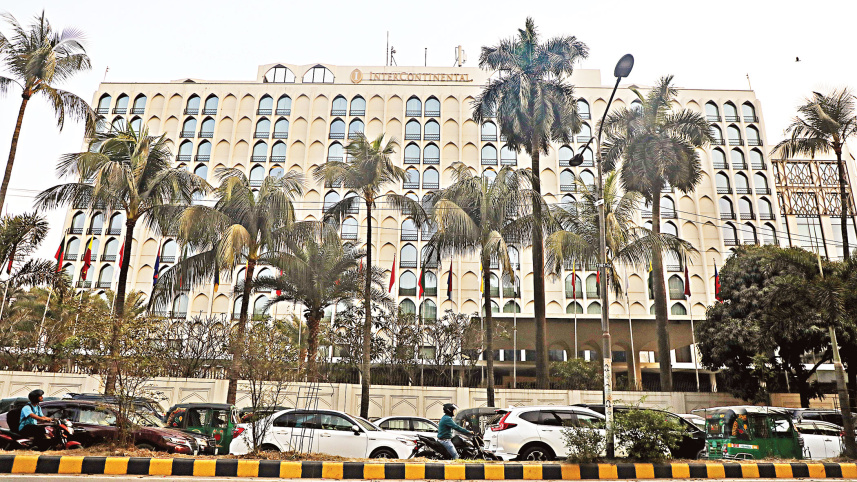
Despite a slight improvement toward the end of the year, Dhaka’s luxury hotel industry struggled through much of 2025 amid political uncertainty, economic slowdown and declining foreign tourist arrivals.
Occupancy remained below expectations, corporate travel weakened, and major events slowed. While most hotels avoided losses through diversified revenue streams, industry insiders described the year as one of survival rather than growth.

Business at Radisson Blu Water Garden Hotel, Dhaka has settled into what one senior executive described as a state of uneasy balance -- neither robust nor in decline.
Shamim Al Mamun, the hotel’s assistant director of sales, said the year has been stable but lacking the energy of a truly successful season. The hotel’s average occupancy rate has been around 60 percent, compared with nearly 80 percent during better times.
“In our industry, 60 percent is not considered good business,” Mamun said. “It allows us to run operations smoothly, but it does not leave much room for growth or expansion.”
Despite the slower pace, the hotel has managed to maintain financial stability, he said. A key reason behind this is its regular contracts with five international airlines, which provide a steady flow of guests and consistent revenue. These partnerships have helped offset weaker demand from other segments, such as corporate events and conferences.
While the hotel continues to operate without major setbacks, management hopes to see occupancy return to stronger levels in the coming months, Mamun said.
Laila Noor Chaity, public relations officer at Pan Pacific Sonargaon Dhaka, said the hotel operated with an average occupancy of around 60 percent in 2025.
“At 60 percent occupancy, business runs,” she said. “But for real growth, we need at least 70 to 80 percent.”
Despite a challenging year marked by political uncertainty and slower foreign tourist arrivals, the hotel managed to meet its operational targets, she said. Visiting international cricket and football teams provided a steady stream of bookings, helping offset weaknesses in other segments.
Foreign guest numbers, however, fell compared to previous years. Corporate and business travel also slowed, reflecting broader economic conditions and uncertainty ahead of the political transition, Chaity said, pointing to expectations of greater stability under the new government.
Even during the tense May-June period -- when several large political gatherings took place on major holidays -- the Sonargaon managed to host scheduled events and maintain comparatively stronger guest turnout than some competitors, though not at previous peak levels, she said.
Taking everything into consideration, Chaity said, while 2025 was not a high-growth year, careful management and diversified guest segments helped the hotel navigate a difficult environment.
Mahmud Hassan, director of sales and marketing at Dhaka Regency Hotel & Resort Limited, said 2025 was a challenging and uncertain year for the hospitality sector.
He said the country’s overall economic slowdown had a direct impact on the hotel business. “It would not be correct to say that 2025 was a good year,” he noted. “The economy was slow, and that affected us.”
According to Hassan, the toughest period was between May and July, when business dropped significantly. Although conditions improved slightly ahead of the national election, the recovery was gradual.
Corporate travel -- one of the hotel’s main revenue sources -- declined sharply. New investments slowed, and fewer development projects meant fewer business travellers. Delays in major infrastructure projects further reduced the flow of corporate guests.
Regional markets were also affected. While the number of Chinese guests remained relatively stable, the number of Indian and Japanese visitors declined. Indian guests traditionally make up a significant share of the Asian market, and the decline in their arrival had a noticeable impact on business.
All in all, Hassan said corporate events, foreign guest arrivals and outlet activity all decreased, making 2025 a difficult year for the hotel industry.
AR Ashik, associate director of sales and marketing at Holiday Inn Dhaka City Centre, said political uncertainty and a weak economy significantly affected the five-star hotel segment in 2025.
 For all latest news, follow The Daily Star's Google News channel.
 “Of course, there was an impact,” he said, citing geopolitical tensions, strained international relations and visa restrictions that reduced foreign guest arrivals. He estimated that overall business fell 30 to 40 percent below expectations, with the sharpest drop seen in room occupancy.
The 187-room hotel recorded an average occupancy of just 37 to 40 percent throughout the year -- far below the 50 to 60 percent considered necessary for stable operations.
However, the hotel avoided total losses as stronger revenue from food and beverage, banquets and events helped offset weak room sales.
An official of Bangladesh Services Limited, which operates InterContinental Dhaka, said the hotel’s business performance improved in 2025 despite political unrest and various agitation programmes over the past one and a half years.
Comments