


Liberalise imports to fight inflation

Between fiscal year 1995-96 and fiscal year 2021-22, Bangladesh experienced an average inflation rate of 6.3 percent over the 26 years. There were episodic divergences during FY2012 and FY2013 from this long-term trend, but they were corrected quickly. This stability of the price level has been a big win for Bangladesh, playing a major role in boosting investment and protecting the incomes of the poor and lower-income groups.
By contrast, Bangladesh has experienced an average inflation rate of 9.3 percent over the past four years, from FY2023 to FY2026, and the inflation rate remains stubbornly high. This unusually high pace of inflation has hurt investment and the incomes of the poor and lower-income groups. Even the middle class is now feeling the pain of rising prices that continue to outstrip income growth for most households. Inflation control is arguably the biggest economic challenge facing the government today.

When the current episode of inflationary pressure first emerged in FY2023, most people believed it was a temporary phenomenon caused by the combined effects of Covid-19-related disruption to global supply chains and the trade disruption caused by the Ukraine war. There was therefore a belief that this external-shock-related inflationary episode would pass once the world adjusted to these events and the surge in global commodity prices and global inflation subsided. While global commodity prices have normalised and the global inflation rate has sharply declined, inflation in Bangladesh remains stubbornly high. Indeed, the average inflation rate in most countries has come down, including in India, Thailand, Malaysia, Indonesia and Vietnam, but not in Bangladesh.
Many explanations have been provided for why the inflation rate remains persistently high, including holding profiteers and syndicates responsible. In my own write-ups, I have argued that the inflationary spiral was ignited by Covid-19-related expansionary monetary and fiscal policies and then accentuated by a deep supply shock resulting from a sharp fall in the GDP growth rate, especially in the manufacturing sector, and unprecedented import cutbacks. Unfortunately, the inflationary effect of the supply crunch is not yet well understood or adequately reflected in policymaking. In particular, the adverse effects of the import crunch on domestic prices are still not well appreciated.
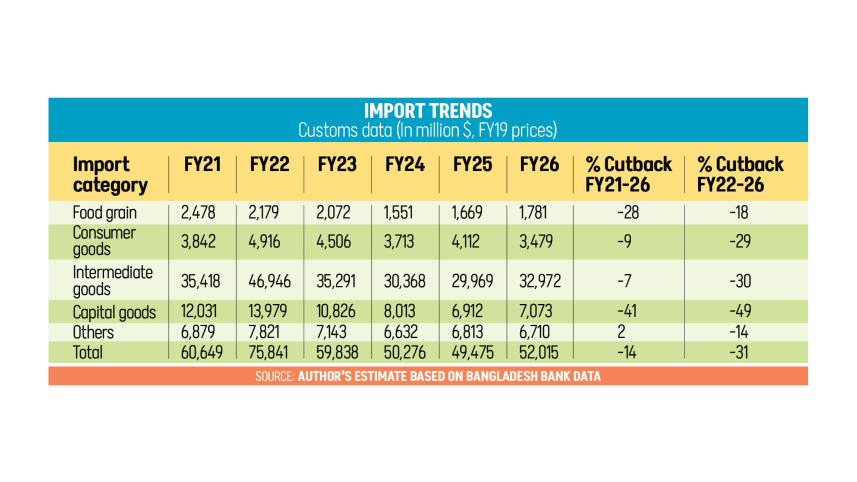
The country’s total import volume has fallen by 31 percent since FY2022. This is the outcome of trade and exchange restrictions and the fall in import demand for capital goods owing to the sharp slide in public and private investment rates. Some researchers may argue that FY2022 was an abnormal year. The cutbacks remain deep if, instead, the base-year values of FY2021 are used. Imports fell by 14 percent between FY2021 and FY2026. The import cutbacks were broad-based, although the deepest reduction happened in capital goods, which fell by 41 percent. Intermediate goods and consumer goods also saw substantial cutbacks, declining by 7 percent and 9 percent respectively.
With an average GDP growth rate of 5 percent and an empirically verified income elasticity of demand of 1, imports should have grown by 25 percent between FY2021 and FY2026 instead of falling by 14 percent. The import supply shock is obvious. Additionally, given the crunch in domestic supply, reflected in the sharp slowdown of GDP growth, especially in the manufacturing sector, the adverse effects of the import cutbacks on domestic prices and inflation are magnified.
The axe on imports is the bluntest instrument that policymakers tend to use to respond to a balance of payments crisis. Its temporary use is understandable to avoid an unsustainable run on reserves. But import control is a poor instrument for achieving a sustainable balance of payments position over the longer term. It is also inconsistent with GDP growth and price stability objectives.
Moving forward, to manage inflation, the government must pursue policy reforms that help increase both domestic and import supply. Since recovery of the domestic economy will take time in view of the deep-seated problems plaguing the Bangladesh economy, including the fragile banking sector, the crisis in the energy sector and the severe fiscal constraint, the fastest way of lowering the inflation rate is to allow a rapid recovery of imports, especially consumer goods, including food items. All import restrictions in terms of margin and licensing requirements must be eased. Import duties, including supplementary and regulatory duties, must be cut to the maximum extent possible, at least for a limited duration until domestic supply recovers and inflation is brought down to the 4-5 percent level.
The adverse BoP effects of rising imports should be tackled through export diversification and greater mobilisation of remittances. The exchange rate should be fully flexible and market-based, without intervention from Bangladesh Bank. A fully flexible, market-based exchange rate is essential to diversify and boost exports and mobilise remittances without the need for fiscal subsidies, which are in any case unsustainable in an environment of severe fiscal constraint.
Sadiq Ahmed is vice-chairperson of the Policy Research Institute of Bangladesh (PRI). He can be reached at sadiqahmed1952@gmail.com.
 For all latest news, follow The Daily Star's Google News channel.
Comments