


Keep climate change issue in project plans: Mannan
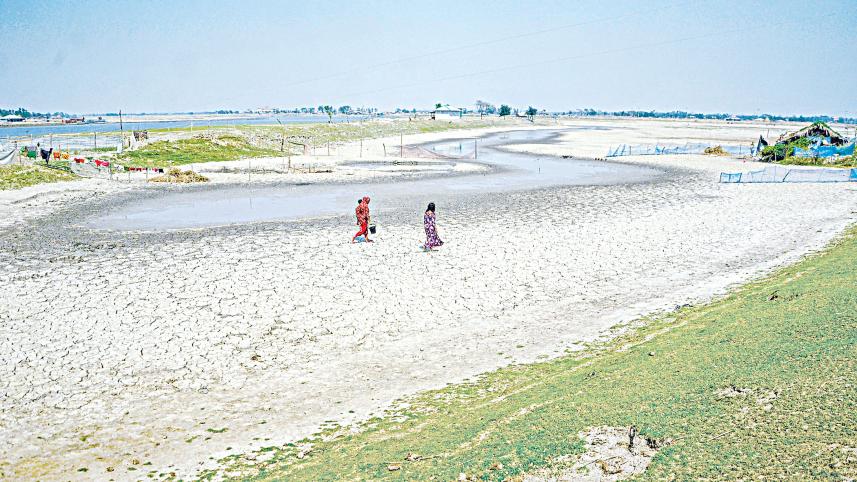
The climate change issue will have to be incorporated in the detailed project plan (DPP) of all development projects to properly implement the national adaptation plan (NAP), according to the planning minister.
The government is formulating the NAP with a focus on medium to long term adaptation investment and enhancing the national capacity for integration of the climate change issue in planning, budgeting and financial tracking processes.

According to experts, Bangladesh would need $84 billion for adapting the climate change issue in the next 30 years.
"From now, officials of the planning commission will have to incorporate the climate change issue during meetings of the project evaluation committee (PEC)," said Planning Minister MA Mannan.
Mannan was speaking at a national level dialogue on "Formulation and advancement of the of NAP process in Bangladesh" organised by the Ministry of Environment, Forest and Climate Change at InterContinental Dhaka yesterday.
Referring to a decision of the commission, he said the government took a decision on November 24, 2020 to integrate the climate change issue in all projects.
He alleged that the government formulated the policy and rules but it does not follow them properly in the implementation stage.
The planning minister then asked the secretary of the planning ministry to issue a circular in this regard to strictly follow guidelines.
Ainun Nishat, a water resource and climate change specialist, suggested enacting a law regarding climate change so that all ministries and divisions would follow it to address the issue within legal bindings.
He stressed on the incorporation of the issue in all development plans and monitoring systems.
"If all ministries and divisions are not be serious about addressing the climate issue, no plan will be implemented," Nishat said.
"We need resources as well as accountability to implement the plan for addressing climate change and for this reason, a related act is required," he added.
"If we want to mobilise funds, we will need to improve implementation capacity," the water resource and climate change specialist remarked.
He also recommended involving the private sector to implement the plan.
According to Nishat, it is not a headache for Bangladesh to mitigate the impact of climate change as the country is not responsible for carbon emission.
Habibun Nahar, deputy minister of the environment ministry, said if government officials carry out their duties responsibly, the NAP will be implemented properly.
According to her, the NAP will be the weapon to get rid of climate change impact.
She believes that this plan will help Bangladesh go ahead and become a developed country.
Fatima Yasmin, secretary of the Economic Relations Division, said Bangladesh cannot avoid the impact of climate change in all sectors.
She said the NAP is not only responsible for implementation, rather it is a job for all ministries.
 For all latest news, follow The Daily Star's Google News channel.
 Yasmin also said it would be easy to mobilise funds to implement the plan to address climate change as the development partners are interested in this regard.
Sudipto Mukerjee, resident representative of the United Nations Development Programme, said he noticed that there was a lack of available information during his stay in the country for the last five years.
"There is barely any available data on any sector, whether it be old or not updated," he said.
He suggested forming a strong collaboration between government organisations and entities to address the NAP.
Mukerjee also stressed the need for private sector engagement to play their due role in this regard.
Md Mostafa Kamal, secretary of the environment ministry, said the suggestions would be incorporated in the NAP as they have yet to finalise the draft.
Comments