


Japanese big three pick up speed in flat bike market
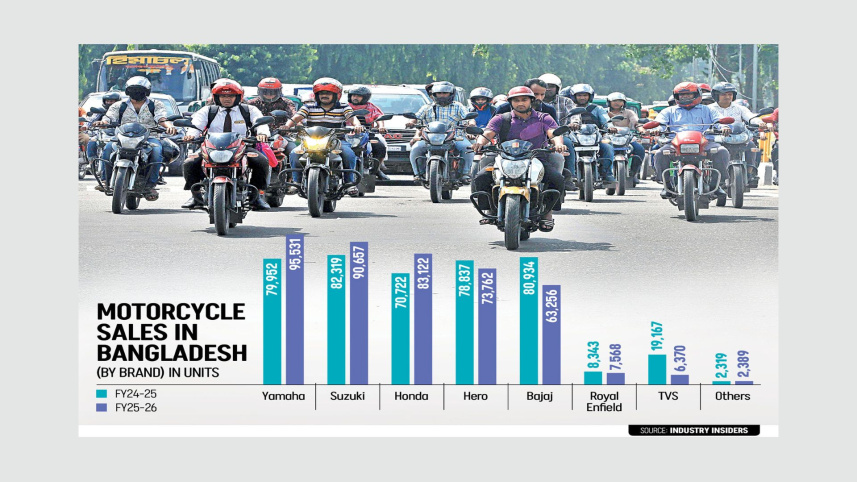
For the local bike market, the recently concluded fiscal year was dull, as retail sales were almost unchanged from the previous year, due mainly to weak economic conditions, sluggish farming activity and fuel price shocks.
Even in the subdued market, Japanese brands posted double-digit sales growth, while their Indian rivals struggled.

Sellers said the demand for Japanese motorcycles in the entry and mid-segment was strong, driven by fuel efficiency, low running costs, competitive pricing and practical features.
In contrast, Indian brands said the absence of new product launches in FY26 eventually hurt their sales.
Industry data showed that 422,655 motorcycles were sold in FY26, almost unchanged from 422,593 units in the previous fiscal year. Companies blamed weak demand for the stagnant market.
“The industry should have reached annual sales of 700,000 to 800,000 motorcycles by now, but remained below 500,000 units, discouraging deeper localisation and investment in domestic component manufacturing,” said Subrata Ranjan Das, deputy managing director of ACI Motors.
ACI Motors is the sole distributor of Japanese brand Yamaha in Bangladesh.
He said the market had failed to realise its potential because weak economic conditions, sluggish agricultural activity in the northern region and policy uncertainty curbed demand.
Yamaha retained its position as the country’s best-selling motorcycle brand after retail sales rose 19 percent year-on-year to 95,531 units, giving it a 23 percent market share.
Another Japanese brand Suzuki ranked second with sales of 90,657 units, up 10 percent, while Honda recorded the fastest growth among these three Japanese brands. Its sales jumped 18 percent to 83,122 units, lifting its market share to 20 percent.
Together, the three brands accounted for nearly two-thirds of all motorcycles sold in Bangladesh during the last fiscal year.
Several competitors, particularly Indian manufacturers, struggled to maintain their position.
Hero’s sales fell 6 percent to 73,762 units, although it remained the fourth-largest player with a 17 percent market share. Bajaj posted a steeper decline of 22 percent to 63,256 units, while Royal Enfield’s sales slipped 9 percent to 7,568 units.
TVS recorded the sharpest decline among the major manufacturers, with sales plunging 67 percent to 6,370 units from 19,167 a year earlier.
Sales by smaller brands grouped under the “Others” category edged up 3 percent to 2,389 units.
Industry executives said weak economic conditions, policy uncertainty and subdued consumer spending continued to weigh on the market despite strong performances by a handful of brands.
“At the current volume, it is difficult to justify deep manufacturing or build a competitive vendor base. We need a market of at least 10 lakh units,” Subrata Ranjan Das of ACI said.
He noted that Pakistan’s motorcycle market stands at around 25 lakh units despite having a population only slightly larger than Bangladesh’s.
Das also said Bangladesh remains one of the least-penetrated motorcycle markets in South Asia, with roughly one motorcycle for every 80 people, compared with about one for every two people in India.
 For all latest news, follow The Daily Star's Google News channel.
 He attributed Yamaha’s continued market leadership to the company’s customer-centric approach, strong after-sales service, reliable braking performance, fuel efficiency and high resale value.
He also credited regular customer engagement and follow-up services with helping build long-term trust and customer loyalty.
TVS Auto Bangladesh Chief Executive Officer Biplob Kumar Roy said the absence of new product launches, coupled with weak economic conditions, had hurt the company’s performance.
“We could not introduce any new products, so our business did not perform as expected,” he said.
He added that the broader economic slowdown and prolonged uncertainty had further dampened consumer demand.
“The industry could not grow the way it was expected to,” Biplob said, adding that the sector still has significant growth potential, but subdued consumer sentiment has prevented it from reaching that trajectory.
Honda, however, bucked the broader market trend.
Shah Muhammad Ashequr Rahman, chief marketing officer at Bangladesh Honda Private Limited (BHL), attributed the company’s sales growth to strong demand for its entry and mid-segment motorcycles, particularly the 110cc and 125cc models.
Popular commuter models such as the Dream 110, Shine 100, Shine 100 DX and SP 125 have continued to attract buyers because of their fuel efficiency, low running costs, competitive pricing and practical features, said Ashequr.
“We are resolving customer issues much faster than before. Our motorcycles offer advanced technology at competitive prices with low running costs,” he said.
He added that Honda’s strengthened brand image had also contributed to the company’s improved sales performance.
Comments