


Islamic banks’ remittance receipts fall 27% in June
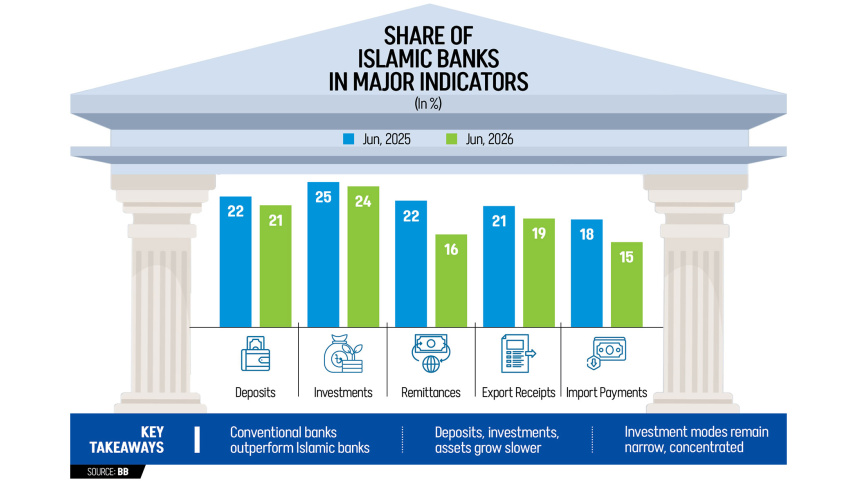
Remittances channelled through Islamic banks fell 27 percent year-on-year to $448 million in June 2026, according to a Bangladesh Bank (BB) report.
Islamic banks’ share of total remittances received through the banking system stood at 16 percent that month, down from 22 percent a year earlier. In May, the previous month, the share was 19 percent, the BB said in its monthly Islamic Banking and Finance Statistics report for June.

By contrast, conventional banks’ remittance receipts rose 7.25 percent year-on-year to $2.37 billion in June, even as they recorded a month-on-month fall of 15 percent from $2.78 billion in May.
The BB said that despite Islamic banks’ early-year performance, their inability to retain their share of workers’ remittances helped conventional banks’ remittances grow in contrast. “However, recent experience of Islamic banks losing market share highlights an unstable situation in the Islamic banking sector,” it said.
Workers’ remittance receipts play a vital role in building a bank’s foreign currency reserve base, which ultimately helps in settling foreign currency transactions, and Islamic banks may need to pursue reforms with regard to the factors that influence depositors’ confidence in Islamic banks, the report states.
The month-on-month decrease in workers’ remittances in June 2026 may be due to the exceptionally high remittance inflow recorded in May 2026 ahead of Eid-ul-Azha.
Additionally, geopolitical uncertainties in the Middle East, including the Iran crisis, may also have affected remittance inflow patterns, it added.
DEPOSIT, INVESTMENT GROWTH
The BB report said Islamic banks recorded increased deposits in June compared with the same month a year earlier, though deposit growth was much higher at conventional banks in comparison.
As a result, the share of Islamic banks in total banking deposits stood at 21 percent in June 2026, down from over 22 percent a year earlier, while conventional banks’ share increased.
Depositors are gradually shifting towards Islamic banking as they regain confidence, the BB said, following measures taken by the central bank, including increased surveillance in terms of liquidity support, identification of banks’ weaknesses, and recruitment of administrators to improve management capacity.
The share of shariah-based banks in investment remained steady in comparison with conventional banks. At the end of June, conventional banks accounted for three-fourths of total investments, while Islamic banks accounted for the rest.
The report said combined investments by conventional banks stood at Tk 19.25 lakh crore in June this year, registering a 12 percent increase year-on-year.
By contrast, investments by shariah-based banks grew 7 percent year-on-year to Tk 6.12 lakh crore in June 2026.
“The moderate monthly increase reflects a prudent investment strategy, while the year-on-year growth indicates gradual expansion, driven by rising demand for Islamic financing products, particularly profit-and-loss sharing modes,” the BB report said.
The BB said conventional banks were cautious in lending and investment amid macroeconomic challenges, including inflationary pressures, exchange rate volatility, and tighter regulatory oversight in Bangladesh.
According to the BB report, Islamic banks’ share in handling export receipts declined to around 19 percent in June 2026, from 21 percent a year earlier. By contrast, the share of conventional banks in this segment grew, and they accounted for more than 81 percent of export handling.
On the import side, Islamic banks accounted for 15 percent of total import payments processed through the banking system in June 2026, against 85 percent for conventional banks.
 For all latest news, follow The Daily Star's Google News channel.
Comments