


Govt clears path for first free trade zones

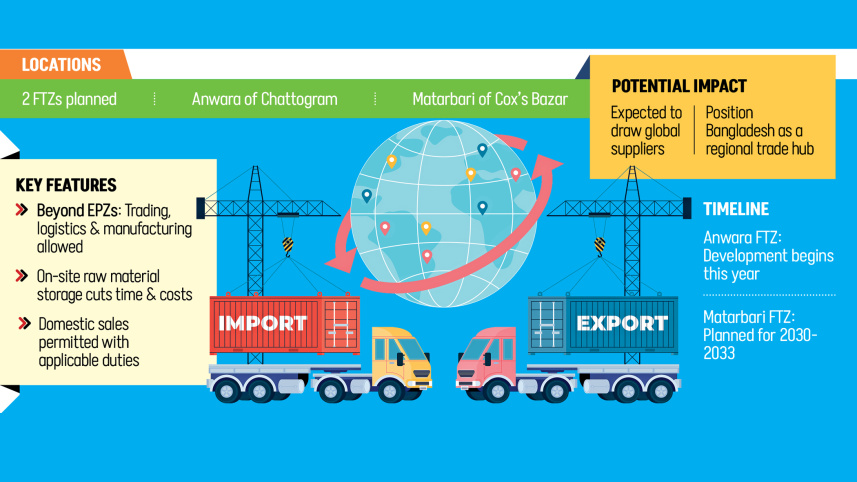
Bangladesh is planning to establish its first free trade zones (FTZs), with the government positioning the initiative as a transformative trade strategy that could slash export lead times, attract foreign suppliers and turn the country into a regional logistics hub.
The Cabinet Committee on Economic Affairs yesterday gave in-principle approval to the establishment of FTZs near the Matarbari deep-sea port in Cox’s Bazar and in Anwara, near Chattogram Port, Cabinet Secretary Md Nasimul Gani said.

According to officials familiar with the matter, the zones will cover around 600 acres. Development of the Anwara zone is expected to begin this year. The Matarbari FTZ is slated for 2030–2033, alongside expansion of the deep-sea port.
Gani said the FTZs are expected to facilitate trade, logistics and manufacturing, attract investment and strengthen Bangladesh’s position as a regional trade hub. He added that the initiative was part of a long-term policy effort.
“This is the most successful (trade zone) model yet,” said Ashik Chowdhury, executive chairman of the Bangladesh Investment Development Authority (Bida). “Nearly 37 percent of Dubai’s trade comes from FTZs. Given our country’s geopolitical position, it has become critical for us.”
Unlike conventional economic zones or export processing zones (EPZs), the proposed FTZs will allow both local and foreign investors to engage in a broader range of trading, logistics and manufacturing activities.
Chowdhury described the FTZ as an “EPZ++” -- a more advanced evolution of the EPZ model introduced in the 1980s. “Global trade has evolved a lot since then. Under the current global trade structure, FTZs give you a very different proposition,” he said, adding that EPZs would continue to operate alongside the new zones.
The core proposition of the FTZ model is that the zones will function outside Bangladesh’s customs territory. Investors can import raw materials and machinery duty-free, undertake value addition and re-export finished goods. Products may also enter the domestic market upon payment of applicable duties.
“You have to think of it as not part of Bangladesh. It is an overseas system,” Chowdhury said.
Warehousing is expected to be the primary revenue driver. Foreign suppliers will be able to stock raw materials inside the zones and supply both Bangladeshi exporters and buyers across the region on demand. Under the current system, importers pay duties upfront and seek refunds later, a process long criticised as cumbersome.
“If we have raw materials in a warehouse near to us, it will reduce lead times for our exports,” Chowdhury said. “We can also start tapping exporters from neighbouring countries. The ambition is that big suppliers can use our zones as a secondary location to supply materials across the region.”
The model follows the blueprint of globally successful hubs including Dubai’s Jebel Ali Free Zone, and mirrors systems already in place in Vietnam and Thailand -- countries Chowdhury acknowledged as competitors Bangladesh has been slow to match. “We are a bit late on this,” he said.
The initiative follows recommendations by a Bangladesh Economic Zones Authority (Beza) committee that reviewed international FTZ models. Officials expect the zones to attract light manufacturing, logistics operators, warehousing businesses, regional distribution centres and multinational firms seeking supply-chain bases in South Asia.
Moinul Islam, former economics professor at the University of Chittagong, said the proposal had been under discussion for over two decades. “The FTZs would not only attract fresh investment but also create a platform where suppliers and agents of industrial raw materials could stock and trade their products closer to export-oriented manufacturers.”
Economists view the Matarbari FTZ as potentially the more transformative of the two. As Bangladesh’s first deep-sea port capable of handling large-draft vessels, Matarbari is expected to cut shipping costs, shorten transit times and improve connectivity with global shipping routes.
“These are exactly the factors multinational investors consider when selecting production and distribution locations,” said M Masrur Reaz, chairman and CEO of Policy Exchange Bangladesh.
He added that the Anwara site’s proximity to Chattogram port, the Karnaphuli Tunnel, Shah Amanat International Airport and three existing EPZs made it an equally strong draw for foreign investors.
Business leaders have also welcomed the move as an opportunity to diversify investment beyond garments.
Mohammed Amirul Haque, president of the Chittagong Chamber of Commerce and Industry, said the zones could attract electronics, light engineering, consumer goods, packaging and regional distribution operations.
 For all latest news, follow The Daily Star's Google News channel.
 However, he cautioned that infrastructure must keep pace, calling for an urgent upgrade of the Dhaka-Chattogram highway from four to ten lanes.
Bida’s Chowdhury said the government was working to amend seven provisions of law and regulation to operationalise the zones. “We will try to start one of the zones by next year. It will depend on how fast we can change the laws.”
Comments