


Good harvest, heavy losses


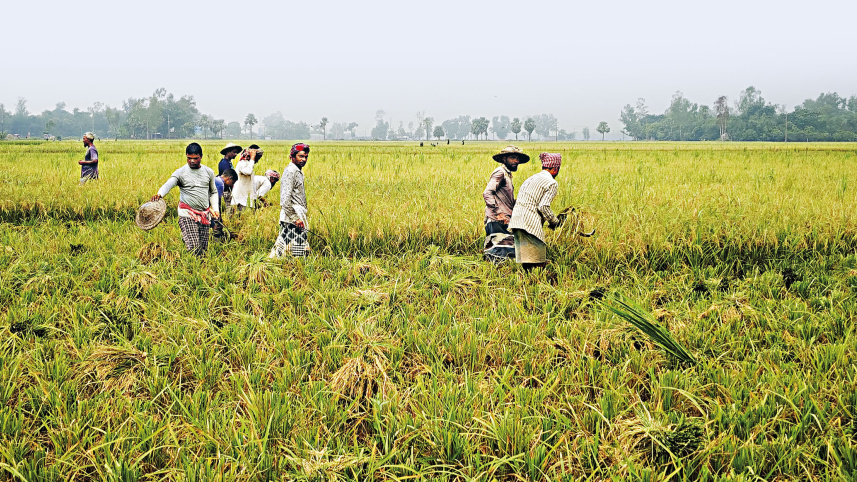
For Rasel Hossain, this year’s Aus harvest should have been a source of relief. Instead, the farmer from Uttargram village in Naogaon’s Mohadevpur upazila is counting his losses.
Rasel cultivated Aus on about 11 bighas of land this year, spending Tk 14,000 to Tk 15,000 per bigha. His yield ranged from 12 to 16 maunds per bigha (1 maund = 37.32 kg).

At the current average market price of Tk 725 per maund, his earnings would be around Tk 11,000 per bigha.
“At this rate, I am incurring a loss of Tk 4,000 to Tk 5,000 per bigha,” he said.
Like Rasel, Aus paddy farmers across Bangladesh are facing losses despite a good harvest, with prices falling by Tk 300 to Tk 400 per maund from a year ago while production costs remain high.
Farmers say the low prices are making it difficult to cover their costs, with some selling wet paddy at half price to repay loans taken for fertiliser, pesticides and irrigation.
Rice millers blame weak demand on large stocks built up following excess rice imports during the interim government’s tenure. Ministry of Food data show food grain stocks rose to 23.41 lakh tonnes on September 12, 2026, from 18.67 lakh tonnes a year earlier.
Meanwhile, Directorate General of Food data show that the country imported a total of 12.68 lakh tonnes of rice in fiscal year 2025-26.
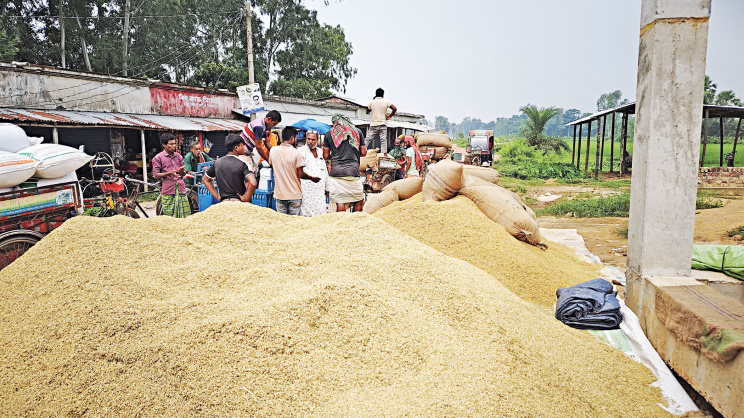
A visit to local markets in Naogaon’s Mohadevpur upazila found Aus paddy selling for Tk 650 to Tk 750 per maund, compared with Tk 1,000 to Tk 1,200 during the same period last year.
Shamsur Rahman, a seasonal paddy trader in Mohadevpur, said, “Last year, Aus sales started at Tk 1,000 per maund and later climbed to Tk 1,200 to Tk 1,300. This year, I am buying it at only Tk 700 to Tk 750 per maund.”
Explaining the low prices, Shamsur added, “Major mill owners are not purchasing paddy right now, and the government stopped procurement in the last few months. That is driving prices down.”
Nurul Islam, a mill owner visiting Mohadevpur from Bogura’s Sherpur upazila, said a large stock remains unsold in his warehouse.
“Also, a lack of sunlight has made it difficult to dry paddy.”
Acknowledging the high costs and low market prices, Naogaon District Agricultural Marketing Officer Sohag Sarkar said production costs for Aus paddy reached Tk 26 to Tk 27 per kg this year, causing farmers to suffer losses at current selling prices.
“We report the production costs to the government and submit weekly market price updates. However, we cannot fix local prices independently without government intervention,” Sohag added.
Farmer Sukanta Paul of Boalmari upazila in Faridpur district said the production cost of Aus paddy was at least Tk 1,000 per maund, while he sold his paddy for Tk 950 to Tk 1,100 per maund.
He said high fertiliser costs, unreliable electricity and expensive irrigation are among the major challenges he faces as a farmer.
Sirajul Islam, additional director of the Department of Agricultural Extension’s Rangpur regional office, said farmers could not make much profit from Aus cultivation this year as production costs had increased.
Department of Agricultural Extension data show that nationwide Aus cultivation covered 11.59 lakh hectares in FY2021-22, yielding 45 lakh tonnes of paddy.
The area fell to 10.61 lakh hectares in FY2022-23, when production stood at 43.5 lakh tonnes. By FY2024-25, cultivation covered 959,000 hectares, producing 41.91 lakh tonnes.
 For all latest news, follow The Daily Star's Google News channel.
 For FY2025-26, acreage fell further, standing at 945,000 hectares, with a production target of approximately 40 lakh tonnes.
Over the last five years, Aus acreage has declined by 214,000 hectares, reducing production by 500,000 tonnes.
DAE officials said the main Aus varieties in Bangladesh are BRRI dhan-48, BRRI dhan-56, BRRI dhan-65 and BINA dhan-19, with an average yield of 3.15 tonnes per hectare.
Agricultural economist Jahangir Alam Khan suggested that the government’s grain imports should take domestic harvest cycles and market supply into account.
Economist Abdul Bayes, former vice-chancellor of Jahangirnagar University, said increasing Aus paddy production is difficult because of high production costs, limited market demand and low yields.
Bayes stressed that promoting Aus is important for maintaining ecological balance and reducing pressure on groundwater. Excessive Boro cultivation has contributed to groundwater depletion, he said, particularly in regions such as the Barind tract in Rajshahi.
He recommended that the government introduce a procurement price for Aus farmers while increasing investment in research and development.
[Our Rangpur correspondents S Dilip Roy and Jhenaidah correspondents Omar Ali Shohag contributed to this report]
Comments