


CAAB issues Air Navigation Order ahead of int’l audit

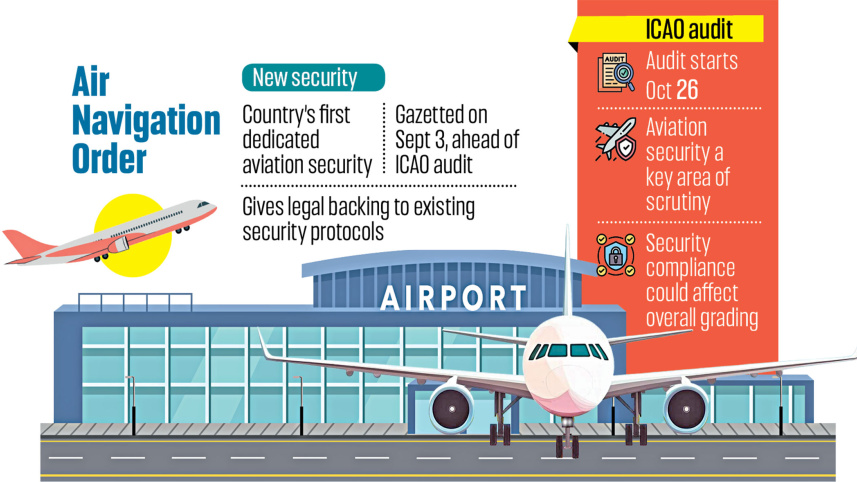
Bangladesh has issued its first dedicated Air Navigation Order (ANO) on aviation security as the country moves to strengthen its civil aviation rules ahead of an International Civil Aviation Organization (ICAO) audit next month.
The audit is scheduled to begin on October 26, and the dedicated aviation security ANO is one of the major issues auditors will examine, said Air Commodore Md Asif Iqbal, member (security) of the Civil Aviation Authority of Bangladesh (CAAB).

“If I cannot answer that question, I lose marks, and that affects the overall grading,” he told The Daily Star.
The ANO is a legal instrument issued by CAAB under the Civil Aviation Act, 2017, that sets out binding rules and procedures for a specific area of aviation operations. Violations of the order will be treated as offences punishable under the Act.
The security-specific ANO was gazetted on September 3 and came into force the same day. It sets out security responsibilities for airports, aircraft operators, passengers and other stakeholders and gives effect to standards and recommended practices.
The order does not, however, bring major changes to security measures already being followed.
Asif said the National Civil Aviation Security Programme (NCASP) contains detailed security requirements but cannot be made public because it includes sensitive information.
The ANO, he said, is essentially a generalised, publicly available version of the NCASP with classified information removed. “It’s not new.”
Group Captain SM Ragib Samad, executive director of Hazrat Shahjalal International Airport, also said no new passenger screening measures had been introduced following the issuance of the order.
“We are following the existing protocols,” he said.
Screening before entry into airside or security-restricted areas, for instance, was already in practice, he said, but had previously existed through other instructions rather than in the form of a navigation order. “This has basically given it a legal basis through the ANO.”
The order brings together a wide range of requirements concerning passengers, airport staff, baggage, aircraft and cargo.
It classifies disruptive passenger behaviour into four levels, ranging from suspicious or verbally threatening behaviour to an attempted or actual breach of the flight crew compartment.
Under the order, airlines may halt check-in or deny boarding over a passenger’s condition or behaviour. If boarding is denied at the gate, hold baggage should be offloaded, the passenger escorted to the landside area, and their name removed from the flight manifest.
Serious cases may be referred to law enforcement.
The ANO also says liquids, aerosols and gels must be carried in containers not exceeding 100ml each and placed in a transparent, resealable plastic bag with a maximum capacity of 1 litre. Containers larger than 100ml will not be accepted even if only partly filled.
Passengers who refuse security searches or do not allow their cabin and hold baggage to be screened or searched will not be allowed to board.
The order also requires background checks for people implementing security controls, those with unescorted access to security-restricted areas and those with access to sensitive aviation security information. The Special Branch of Bangladesh Police is responsible for conducting the checks.
Asif acknowledged that CAAB still faces shortages of manpower and some security equipment.
“We have some human-resource shortages. Our recruitment process is ongoing,” he said.
 For all latest news, follow The Daily Star's Google News channel.
 He said the Armed Police Battalion had been given responsibility for landside security while recruitment continued. Once CAAB reaches its full staffing strength, it plans to take over those responsibilities itself.
There are also equipment shortages, although procurement is under way, he said.
CAAB recently received 25 explosive trace detectors from China, while dual-view baggage screening machines have also been procured. The authority has recently added four body scanners, Asif said.
He described improvements in manpower, equipment, infrastructure and facilities as a continuous process.
“Even if you reach 100 percent today, tomorrow you may see a new requirement,” he said.
More sophisticated and modern equipment will be available once the third terminal becomes operational, he added.
The publication of the ANO comes as the government moves to replace the Civil Aviation Rules, 1984, which have remained in force for more than four decades.
The new rules are intended to bring the country’s civil aviation regulatory framework in line with international standards and address shortcomings identified in previous assessments.
The upcoming ICAO audit will assess Bangladesh’s compliance with international standards and recommended practices, with the findings affecting the country’s overall audit grading.
Comments