


Fruit imports face curbs despite dollar relief


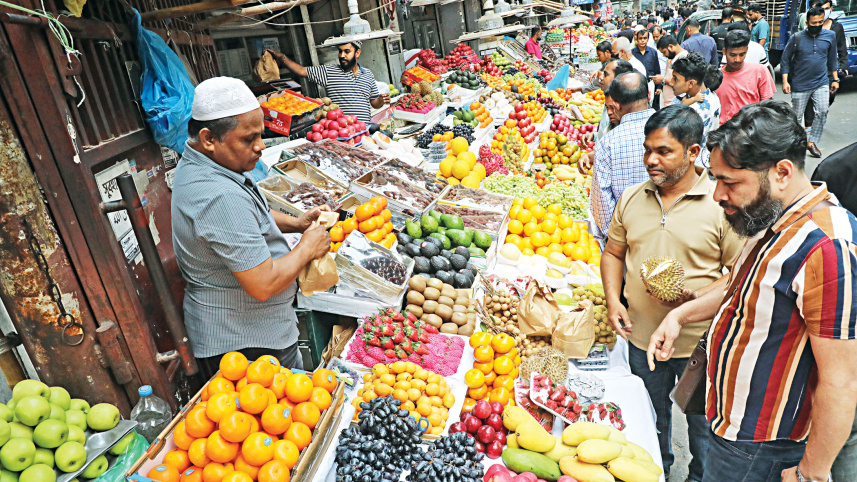
The dollar crisis has eased. Foreign exchange reserves have improved from the lows seen four years ago. But imported fruits still face a 100 percent cash margin for opening letters of credit (LCs).
The impact is visible at retail markets. A kilogramme of oranges now costs as much as Tk 330. Before the margin was raised in 2022, it was around Tk 180.

Before 2022, banks set margins based on their relationship with clients. Fruit importers could pay part of the value upfront and settle the rest later. Now they must deposit the full shipment value in cash when opening an LC.
That locks up capital. Importers scale back orders, which eventually tightens supply and pushes up prices.
The 100 percent cash margin for fruit imports was introduced as part of the central bank’s import tightening in the face of a fast-depleting foreign currency reserve. The move reduced fruit imports, but it also pushed up retail prices.
After the fall of the Awami League government in August 2024, the foreign exchange market became more liquid thanks to stronger remittance inflows and better export performances. But import curbs on fruits remain in force, letting consumers feel the pinch.
Rabeya Hasnat, a housewife in the capital, regularly buys apples, grapes, oranges and tangerines for her children, along with local fruits.
She said that prices have risen sharply over the past two to three years. The rates should now fall as the dollar situation improves.
Rabeya said she tries to switch to local produce, but taste and preference make it difficult to replace common items like apples or grapes.
The numbers tell the story. Apples now sell for Tk 280 to Tk 400 a kilogramme. In 2022, they were Tk 220 to Tk 280. Grapes cost Tk 450 to Tk 600, up from Tk 400 to Tk 450. Tangerines sell for around Tk 320, compared with Tk 250 to Tk 270 earlier.
Faria Lira, another Dhaka resident, felt the shock while shopping for iftar on the first day of this Ramadan. A seller asked Tk 280 for three oranges. She walked away and bought 10 dates for Tk 100 instead.
Rising fruit prices, she said, are making it harder for middle-income families to include healthier options in iftar. Many are turning to cheaper fried snacks.
IMPORTERS CHALLENGE LUXURY LABEL
Nuruddin Ahmed, general secretary of the Bangladesh Fresh Fruits Importers Association, said the 100 percent margin has placed a heavy financial burden on legitimate traders.
When importers must deposit the full value in cash, their business costs rise. Many smaller traders cannot participate. Shipment volumes fall. The market becomes tighter.
He said the association has written to the governor of the Bangladesh Bank, the chairman of the National Board of Revenue (NBR) and the Bangladesh Trade and Tariff Commission.
Classifying fruits as “luxury goods” is unjustified and does not reflect their importance as essential food items for people, he said.
The same 100 percent cash margin applies to motor cars, electronic appliances, gold and gold jewellery, precious metals and pearls, readymade garments, leather goods, jute products and furniture.
It also covers flowers, non-cereal food items, processed food and beverages, canned food, chocolates, biscuits, juice, coffee, soft drinks, alcoholic beverages, tobacco and tobacco substitutes.
Ahmed said fruits are essential commodities, not luxury items, and policymakers need to recognise this. “With the dollar situation improving, there is no justification for continuing such restrictive measures.”
 For all latest news, follow The Daily Star's Google News channel.
 ECONOMISTS FAVOUR CAUTIOUS EASING
Agricultural economist Jahangir Alam Khan said fruits are not luxury goods.
If the government wants to curb essential commodity prices, LC margins and duties on imported fruits should be withdrawn, especially ahead of Ramadan, as soaring prices have put them beyond the reach of ordinary people.
Fahmida Khatun, executive director of the Centre for Policy Dialogue (CPD), offered a more cautious view.
“Exports are struggling, while imports remain controlled. That combination has helped rebuild reserves,” she said.
She does not support fully lifting restrictions on luxury items, but favours selective relaxation on a case-by-case basis.
Fruits could be considered essential because of their health value, said Fahmida, though most people depend on local produce. With reserves still limited, each item should be assessed carefully.
“As the monthly import bill has fallen to $5 billion, some controls should remain, and any reopening must be gradual and cautious,” said the economist.
BANKERS WAIT FOR STRONGER RESERVES
About easing the cash margin on fruit imports, bankers are somewhat divided.
Mati ul Hasan, managing director of Mercantile Bank, told The Daily Star that the high margin on fruit imports should not be lifted immediately. The country needs to encourage the consumption of local fruits.
He also pointed to risks of trade-based money laundering through fruit imports, which is why, he said, such imports need to be strictly monitored.
Mirza Elias Uddin Ahmed, managing director of Jamuna Bank, said fruits are perishable goods. That increases risk for banks, making them reluctant to reduce LC margins.
However, he added that US dollars are now available in the market. If stability continues, the margin could be reduced or withdrawn.
Arief Hossain Khan, executive director and spokesperson of the Bangladesh Bank, said the central bank tightened import regulations in 2022 during the dollar crisis to prevent trade-based money laundering. That led to higher margins on fruit imports.
However, the central bank relaxed rules for date imports centring on Ramadan. Restrictions on other fruits remain.
“We are observing that the dollar market has now stabilised,” he said, adding that if forex market conditions improve further, the margin requirement on fruit imports will also be withdrawn.
Comments