


Farmers allege difficulties in availing after-sales services

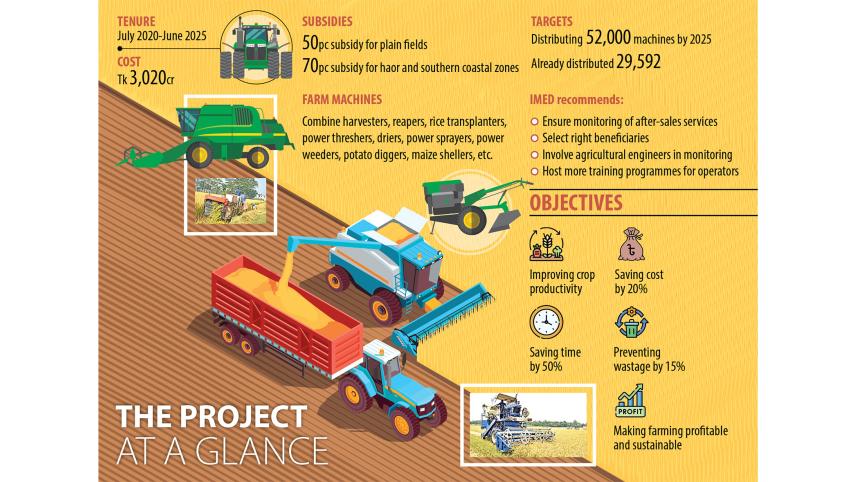
Farmers in Bangladesh are struggling to make the most of a government project that aims to expand farm mechanisation as they face difficulties in availing after-sales services, among other issues, according to a report by the Implementation Monitoring and Evaluation Division (IMED).
In July 2020, the government took up a five-year project involving Tk 3,020 crore for providing farmers with agricultural machinery at subsidised rates, thereby helping them improve crop productivity, save time and achieve profitability.

However, a recent study by the IMED shows that farmers are facing delays and other issues in availing after-sales service from local suppliers, who were contracted by the government to provide agricultural machinery at reduced prices.
Under the project, styled "Agriculture Mechanisation through Integrated Management", farmers who buy agricultural machinery from appointed suppliers are entitled to three years of after-sales service.
This includes a warranty for the first year and after-sales service, such as detection of faults and repairs, on the subsequent two years for the machinery, such as combine harvesters, power threshers and rice transplanter.
A total of 34 companies, including ACI Motors Ltd, Greenland Technologies Ltd and SQ Trading and Engineering, were appointed to provide agricultural machinery at subsidised rates under the project.
Farmers in haor and southern coastal areas of the country can buy agricultural machinery with 70 per cent subsidy while those in other regions can enjoy 50 per cent off on their purchase.
This is the third project that the government has undertaken since 2009 to subsidise purchases of agricultural machinery and therefore facilitate mechanised cultivation.
But as per the IMED's in-depth monitoring report, about 74 per cent of the farmers surveyed allege that they face difficulties in getting on the list of eligible beneficiaries for the subsidy.
In addition, some 43 per cent said they struggle to receive the machinery even after making payment while around 6 per cent claimed that they got sub-par equipment.
The report was prepared based on the feedback from 1,824 beneficiary farmers across 32 districts.
Mohammad Shawkat Ali, a beneficiary farmer in Tangail who bought a combine harvester in 2021 from Abedin Equipment Ltd, said his equipment worked well during the first season.
"But the performance of this high-value machine has been worsening since then," he added.
Ali also said that he is facing trouble in getting after-sales service, resulting in reduced productivity.
"If the machine breaks, I have to remain idle for at least two days as the supplier does not provide prompt service," he added.
Mostafizur Rahman, a farmer in Bogura who bought a combine harvester in 2017 under a similar government project, echoed the same.
"I bought the harvester from a local company for Tk 12.30 lakh, but it remains almost abandoned and has become a burden for me," he said.
However, Arafat Uddin Ahmed, deputy general manager of the Abedin Group, denied the allegation.
"Usually, farmers want their services immediately. But it takes some time to move from place to place in order to conduct repairs during the cultivating seasons," he said.
Subrata Ranjan Das, executive director of the ACI Motors Limited, said they are very confident about their after-sales service as they can respond to farmers' requests within six hours 90 per cent of the time.
 For all latest news, follow The Daily Star's Google News channel.
 ACI Motors has already sold around 3,000 machines under the project.
Das also said they have adjusted the General Packet Radio Services (GPRS) tracker system in machineries sold over the past two years so that they can trace any internal problems.
"Along with machinery, we have given the necessary mobile applications to farmers to get after-sales service promptly," he added.
On the other hand, Sadid Jamil, managing director of Metal Agritech Ltd, said there is some truth to the farmers' allegations.
"We are facing a shortage of skilled mechanics and trainers for repairing and maintenance," he added.
Jamil also said while it is true that they are currently unable to fully provide after-sales service, the facility will be developed gradually.
According to officials of the Department of Agricultural Extension (DAE), around 34 companies are supplying 12 types of agricultural machinery under the project.
Of these companies, 14 mainly import and retail combine harvesters.
Seeking anonymity, a senior official of a leading supplier of agricultural products, said some local companies are providing substandard products to farmers.
Besides, a number of them that do not provide quality products are still being contracted under the project thanks to some unscrupulous business practices, the official added.
As the implementing agency, the DAE has so far distributed around 30,000 agricultural machineries at subsidised rates, said Project Director Tarik Mahmudul Islam.
Asked about the farmers' allegations, Islam said they are facing some problems regarding the implementation of new technologies on a countrywide level.
During previous iterations of the project between 2009 and 2020, there were some problems related to supplying quality machineries.
"But the project is ongoing very successfully. In the last Aman and Boro seasons, the country saved some Tk 2,700 crore thanks to the farm mechanisation project through improved cultivation," Islam said.
"We are carefully trying to monitor the farmers' allegations against suppliers," he added, citing how they have already taken steps against some companies as per farmers' written complaints.
M Asaduzzaman, former research director of the Bangladesh Institute of Development Studies, said the government should ensure feasibility studies before taking such projects as influential groups may be the ones benefitting rather than farmers.
"When farmers purchase machines, they have to invest a huge amount on it. If they don't get sustainable services from the provider, they may face large economic losses," he added.
Comments