


Not everyone should get bank loans: PM’s adviser
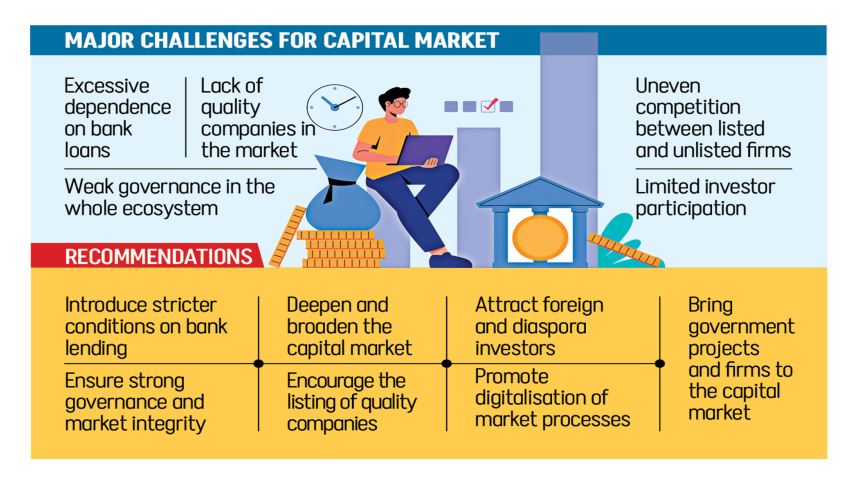
In order to ensure increased participation of citizens in the private sector and cut dependence on bank loans, conditions may be imposed to compel firms to raise capital from public, said Prof Rashed Al Mahmud Titumir, the prime minister’s adviser to the ministries of finance and planning.
The government may decide to finance infrastructure development by raising funds from the capital market, he said yesterday at a seminar organised by the Capital Market Journalists’ Forum (CMJF) on the challenges and necessary actions for the stock market under the new government, held at FARS Hotel & Resorts.
 For all latest news, follow The Daily Star's Google News channel.
 Raising funds from the capital market would ensure participation of ordinary people in both the public and private sectors, he said, reiterating BNP’s manifesto commitment regarding the capital market, which was to move from a loan-dependent economy to an ownership-based economy.
The next national budget will include reform measures in this regard, he said.
To transform the economy, it will be shifted from a consumption-driven and loan-dependent model to an investment-driven one, because the economy can never become sustainable without an investment-based structure, he said.
The capital market can play a major role in reducing loan dependency. However, the capital market currently accounts for only 12 percent of the country’s gross domestic product (GDP), which is quite low compared to regional peers, Titumir noted.
The new government intends to focus on improving this situation by making the capital market both deeper and broader.
“Our goal is to move from a frontier market to an emerging market,” he said.
Titumir added that the high incidence of default loans is partly due to the mismatch between short-term deposits and long-term lending. If banks accept deposits for short periods, they cannot sustainably provide long-term loans.
“Therefore, it must be determined which institutions will receive bank loans, for how long, and in what amount, and which institutions will be required to raise capital from the capital market.”
Not everyone should remain dependent on banks, he said.
The government also has several economic institutions and may, in the future, raise funds for development expenditure by issuing bonds or shares.
“Why should we buy aircraft using taxpayers’ money?” he asked.
Titumir also said that Bangladesh should have an Islamic stock exchange, where investors from Malaysia, Indonesia, and Gulf countries could come and trade. The government is considering creating an investment gateway so that expatriate Bangladeshis can also participate in such investments.
He also emphasised taking steps to ensure transparency and accountability in the work of auditors, credit rating agencies, and other market-based regulatory institutions.
“The success of a capital market regulator should not be judged solely on index performance. Rather, its key performance indicator (KPI) should be the development of the market,” said Khondoker Rashed Maqsood, chairman of the Bangladesh Securities and Exchange Commission (BSEC).
“Over the past 18 months, various legal reforms have been carried out. Multiple investigations have been conducted to ensure punishment for market manipulators. As a result, fines totalling Tk 1,488 crore have been imposed through punitive measures, of which about Tk 5.23 crore has been collected so far.”
Addressing questions about why only about Tk 5 crore had been collected from market manipulators despite fines of over Tk 1,400 crore, he said that anyone who is fined -- even if it is just Tk 100,000 -- gets around nine months across different legal stages to make the payment.
In addition, everyone has legal rights, and many are challenging the fines in court, he noted.
However, he expressed confidence that the entire amount will be deposited in the national exchequer in a year or two.
Maqsood also said that the BSEC has been working closely with the Bangladesh Bank and has jointly proposed a policy draft outline. It now needs to be finalised soon. The initiative includes both “push” and “pull” factors. Under the push factor, Bangladesh Bank may adopt policies requiring large borrowers to move away from bank loans and instead raise funds through bonds or equity. The BSEC will work with the Bangladesh Bank to accelerate this process, he added.
Tax incentives alone cannot guarantee a healthy market, said Md Abdur Rahman Khan, chairman of the National Board of Revenue (NBR), noting that tax incentives were already in place and yet failed to prevent stock market crashes in the past.
He also noted that in the past, many listed companies failed to provide dividends to investors. In the future, companies that cannot distribute dividends should not be approved for listing.
Khan admitted that this was an area where authorities had failed previously. At the same time, it must be ensured that no company can enter the market using false information.
Referring to incentives, he said the current tax gap between listed and non-listed companies is 7.5 percent, which is already significant and sufficient under current market conditions.
In the keynote paper, Md Moniruzzaman, senior vice-president of the DSE Brokers Association of Bangladesh, said that although many good companies conduct business in the country, they are reluctant to enter the capital market. One reason is that while listed companies properly pay VAT, many unlisted companies avoid it through manipulation, creating unequal competition.
In a balanced financial system, banks usually provide short- and medium-term financing, while the capital market supplies most of the long-term financing. However, in Bangladesh, banks are forced to provide both short- and long-term financing. This creates a mismatch between the maturity of assets and liabilities, increasing risks in the financial system, he said.
“Under such circumstances, private institutions should be given conditions requiring them to enter the capital market once they reach a certain size.”
Mominul Islam, chairman of the Dhaka Stock Exchange (DSE), said the root problem of the capital market is that over the past 15 years, the government has not given adequate importance to it.
However, the hopeful sign is that the current government is giving the sector more attention, he said, adding that bringing government institutions to the market requires inter-ministerial coordination, which had been lacking in the past.
Riad Mahmud, president of the Bangladesh Association of Publicly Listed Companies (BAPLC), said it is very important to introduce digital processes across all levels of the capital market, allowing statements and documents to be submitted digitally. He also said that additional listing fees are a major obstacle for companies seeking to launch IPOs.
Sumit Podder, general secretary of the Bangladesh Merchant Bankers Association (BMBA), said that no new company has entered the capital market over the past two years. Now is the season for IPOs, and even if incentives are needed, good companies should be encouraged to enter the market.
“It is not necessary to bring many companies to the market,” he said. “Even a few will be enough -- provided they are good companies.”
Md Saifuddin, commissioner of BSEC; AKM Habibur Rahman, president of CSE, and Md Munir Hossain, president of CMJF, also spoke at the event.


Comments