


Fake online loans lead borrowers into costly traps

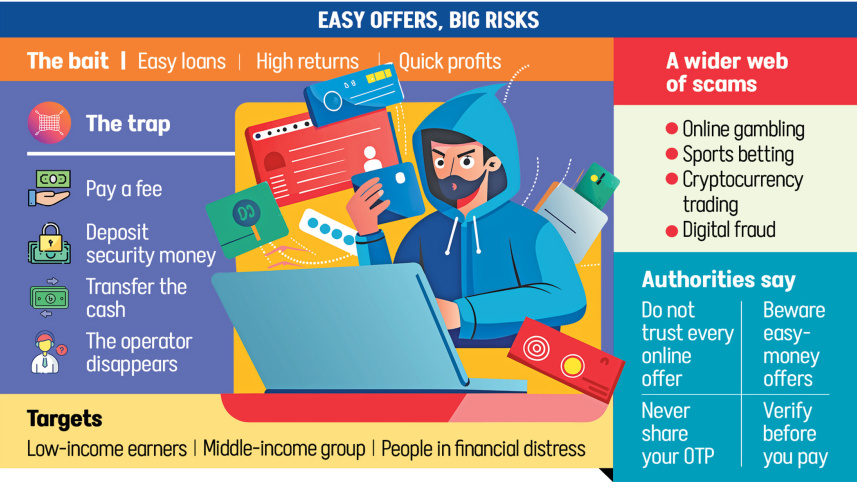
Scammers reach people in many ways, including phone calls, text messages and social media advertisements. But recent accounts from victims show that Facebook has become a favourite hunting ground, especially for lower and middle-income people facing financial difficulties and with little knowledge of cybercrime and fraud.
The bait is usually simple -- easy and cheap loans or high, quick returns on small investments.

Take Touhida Akter, a homemaker, who came across a Facebook page offering loans of between Tk 50,000 and Tk 5 lakh. The interest rate was just 5 percent, far below what banks charge now.
As the housewife was struggling financially and badly needed cash, she contacted the page, which identified itself as “Ashar Alo Foundation”. Touhida was asked to pay Tk 450 for a loan application form and stamp.
After making the payment, she was asked to deposit Tk 1 lakh as a refundable security deposit, which would be returned after she paid two instalments. Desperate to get a Tk 5 lakh loan, Touhida deposited her life savings.
“But after the money was transferred, the page stopped responding,” the housewife recounted to The Daily Star.
Embarrassed by what had happened, Touhida said she had not even told her family.
She is among many people who have fallen victim to online loan scams operating through social media platforms.
LOAN APPS HARVEST CASH, PRIVATE DATA
As with social media pages, scammers are also defrauding people through mobile phone applications.
Rabiul Alam, a private-sector employee and one of the victims, said some apps simply steal money, while others offer loans at extremely high interest rates, sometimes as high as 800 percent.
During the installation of those apps, scammers get control of borrowers’ private information, including contacts, photos and videos, from their phones.
When borrowers refuse to pay the inflated interest demanded by the scammers, they face cyber harassment and threats to make their private information public.
Rabiul was defrauded through an app called FinCash, which offered loans of up to Tk 30,000. Similar apps and websites include Money, PopKash, CashNow, Drutoloan, Fast Loan, Shathi Loan and Quickloan.
The Bangladesh Bank says such loan-offering apps are illegal.
ONLINE TRAPS SPREAD TO GAMBLING, CRYPTO
Loans are not the only bait of online scam. Numerous websites and social media pages offer gambling, betting and cryptocurrency trading, all of which are illegal in Bangladesh.
Law enforcement agencies say they have found some mobile financial service providers allegedly facilitating loan transactions and other unauthorised dealings during their investigations.
A Bangladesh Bank inspection found that Fasset, a UAE-based virtual asset platform established in 2019, operates in Bangladesh through its website, mobile app and social media channels.
The inspection report said the company is licensed by Dubai Virtual Assets Regulatory Authority (VARA), but is not authorised or licensed to operate in Bangladesh.
 For all latest news, follow The Daily Star's Google News channel.
 Although its primary markets include the UAE, Indonesia, Malaysia, Pakistan, Turkey and Bangladesh, Fasset reportedly allows Bangladeshi users to access its services.
Bangladeshi users can register on the Fasset app and use its peer-to-peer (P2P) marketplace, a senior central bank official said.
He said users can purchase USDT (Tether) by transferring Bangladeshi taka through local bank accounts or mobile financial services.
“Users can then use the USDT to buy cryptocurrencies such as Bitcoin and Ethereum, or sell them back for taka,” he said.
In a recent notice, the Bangladesh Bank said some entities are using social media and other online and offline channels to lure people with promises of unusually high returns and defraud them.
“In many cases, fraudsters steal money by tricking customers into sharing one-time passwords (OTPs) or by falsely claiming to offer refunds, social safety net payments, Hajj-related funds, or other government benefits. As a result, many people are suffering financial losses.”
The central bank advised the public not to engage in financial transactions with such entities, saying that customers who choose to transact with them will bear responsibility for any resulting losses.
SCAMMERS TARGET PEOPLE WITH FEWER OPTIONS
Md Ezazul Islam, director general of the Bangladesh Institute of Bank Management (BIBM), said illegal apps target lower and middle-income people, particularly those facing financial difficulties and with little knowledge of cybercrime and fraud.
The central bank and the government should raise awareness of such fraud and illegal websites and apps through notifications and other means, said Ezazul, a former Bangladesh Bank official.
Law enforcement and intelligence agencies should also be more active in detecting such fraud and taking action against those involved, he said.
Arief Hossain Khan, executive director and spokesperson of the Bangladesh Bank, told The Daily Star that financial intelligence matters are handled by the Bangladesh Financial Intelligence Unit (BFIU), while criminal investigations fall under law enforcement agencies.
The central bank becomes directly involved when banks are implicated, he said.
Payment service providers (PSPs) and mobile financial service (MFS) operators are regularly inspected by the Payment Systems Department, while operators themselves often identify suspicious transactions and take action, according to the central bank spokesperson.
“However, it is impossible for operators to screen every transaction, meaning some suspicious transactions may go undetected,” he said.
NEW LAW TARGETS ONLINE GAMBLING
The government recently enacted the Gambling Prevention Act, replacing the colonial-era Public Gambling Act, 1867, to tackle online gambling, sports betting and digital gambling networks.
The new law criminalises not only conventional gambling but also various activities conducted through digital and virtual platforms. These include online and remote gambling, online betting, sports betting, live betting, casino betting, virtual betting, fantasy betting and e-sports betting.
The law also covers placing bets involving money through digital games or platforms, as well as using digital wallets, mobile apps, websites and servers for gambling purposes.
The offence carries a prison sentence of two to seven years and a fine ranging from Tk 2 lakh to Tk 5 crore under the law.
The BFIU is also working to combat gambling, betting, cryptocurrency trading and other forms of fraud conducted through e-commerce.
Iqtiaruddin Md Mamun, head of the BFIU, told The Daily Star that the agency is taking strict action against gambling, betting and other forms of digital fraud.
The BFIU detected and closed more than 20,000 mobile financial service accounts last month that were linked to gambling, betting and cryptocurrency trading, he said.
Syed Harun Or Rashid, joint police commissioner of the Cyber Security and Support Centre (South) at Dhaka Metropolitan Police, told The Daily Star that police take complaints seriously and investigate them to identify those involved and bring them to justice.
“When victims approach us, we advise them to file cases, and we investigate based on verified information rather than complaints alone. We also monitor social media for online gambling and other forms of fraud. In some cases, we initiate cases based on our own findings.”
Harun said currently they have around 4,000 general diaries (GDs) and more than 250 pending cases related to such crimes.
“Online fraud has become so widespread that people must also remain vigilant,” he said.
Comments