


Economy logs slowest growth in three years

Bangladesh’s economy grew 3.49 percent in the fiscal year 2024-25 (FY25), the slowest expansion in at least three years, owing to weaker performances in the agriculture and services sectors.
The growth is lower than the provisional estimate of 3.97 percent made previously by Bangladesh Bureau of Statistics (BBS), which released the finalised data on gross domestic product (GDP) yesterday.

In FY24, the economy grew 4.22 percent, said the national statistical office.
The data shows that only the industrial sector posted faster growth in FY25 than in the prior year.
Between July 2024 and June 2025, the country’s factory output rose 3.71 percent, up 0.20 percentage points from FY24.
Agriculture, the second-largest employing sector, grew just 2.42 percent, down from 3.30 percent a year earlier.
Services, the biggest contributor to GDP, expanded 4.35 percent, easing from 5.09 percent in FY24.
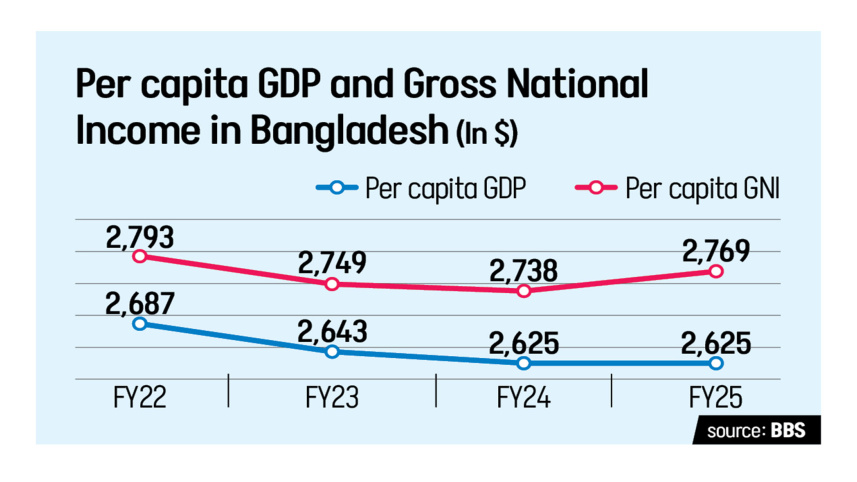
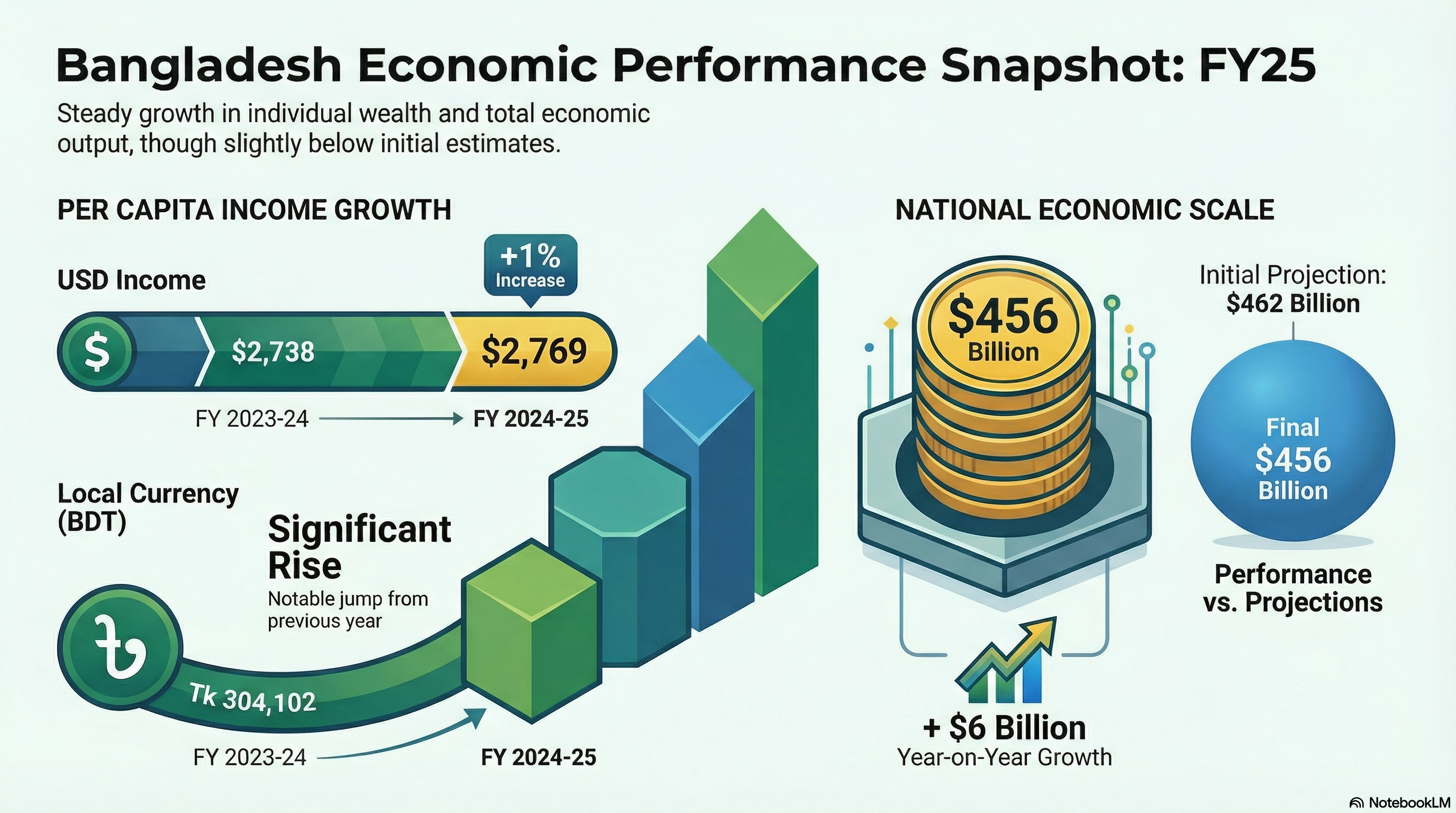
The size of the economy reached $456 billion, up from $450 billion a year earlier. Per capita income edged up to $2,769 from $2,738.
Sluggish growth is expected to continue into the current fiscal year. The International Monetary Fund projects 4.7 percent expansion in FY26, the World Bank 4.6 percent, and the Asian Development Bank (ADB) 4.7 percent -- all below Bangladesh’s pre-pandemic trend.
The ADB trimmed its projection from 5 percent in September, citing weak investment ahead of the general election and slower export growth.
Economists said the FY25 slowdown is owed to a combination of deep-rooted internal weaknesses and persistent external shocks.
“This is certainly due to both internal and external factors,” said Prof Selim Raihan, executive director of the South Asian Network on Economic Modeling (Sanem). “One of the biggest reasons was the political transition. Because of that, and the related developments in the banking sector, business confidence dropped sharply.”
He noted that the erosion of confidence discouraged fresh investment while banks turned cautious on lending. “Credit growth declined considerably. Altogether, this reflects a downward shift in investment.”
Exports also underperformed, even weakened, he said. “Only remittances have performed somewhat consistently.”
Describing the macroeconomic picture as unusual, the Sanem executive director noted, “The economy is depressed, while inflation remains high.”
High inflation has eroded purchasing power, weakening consumer demand across all components of GDP – household consumption, public spending, investment and exports, he explained.
Although a new government has taken office, Raihan warned that FY26 may follow a similar pattern and that recent turbulence at the Bangladesh Bank could further dampen investor sentiment. “I do not expect a major surge in investment at this moment.”
The economist noted that public spending has remained subdued.
 For all latest news, follow The Daily Star's Google News channel.
 “February has already ended, and only about four months remain in the fiscal year. It is unlikely that public spending will pick up significantly within this period,” Raihan said.
“Even if investor confidence begins to return, it will take time for that to be reflected in actual economic indicators,” he added.
Md Deen Islam, a professor of economics at the University of Dhaka, said businesses and investors may delay commitments until they see how policy priorities evolve.
Such caution, he warned, could weigh on short-term activity. “That can slow economic activity in the short run, even if the government implements sound policies.”
He stressed that clarity and stability will be critical going forward.
“To support stronger growth, policy clarity, macroeconomic stability, and investor confidence will be essential. This means steady fiscal management, predictable regulatory frameworks, and efforts to improve credit flow and export performance,” he said.
“If these areas are strengthened, growth could accelerate in the medium term. Conversely, if uncertainty persists, growth may remain subdued despite changes in political leadership,” he added.
To revive growth, Islam stressed the need to restore macroeconomic stability and rebuild investor confidence.
There are tentative signs of a pickup. The economy expanded 4.5 percent in the first quarter of FY26, up sharply from 2.58 percent in the same period a year earlier, driven mainly by industrial and agricultural activity.
Comments