


Chinese footprint widens in Bangladesh’s economic landscape

China has spent several decades building roads, bridges, tunnel and power plants across Bangladesh. Now, its focus is expanding.
The strongest evidence suggests it has, and the clearest sign is foreign direct investment (FDI).

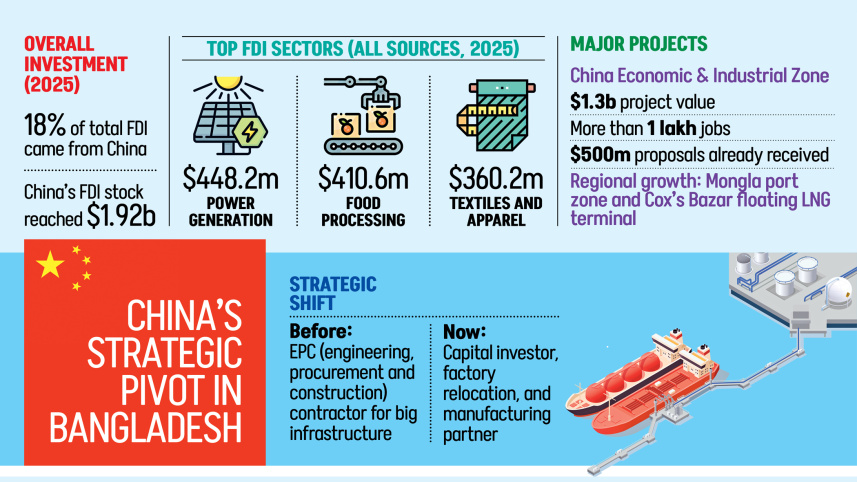
China became Bangladesh’s second-largest source of net FDI in 2025, accounting for more than 18 percent of total inflows, according to Bangladesh Bank data.
That means nearly one in every five investment dollars entering Bangladesh came from Chinese businesses. Chinese FDI reached a six-year high, while cumulative investment approached $2 billion last year.
In 2025, power attracted the largest share of FDI, receiving $448.18 million, followed by food processing with $410.62 million and textiles and apparel with $360.16 million.
Banking, telecommunications, chemicals and pharmaceuticals, agriculture, leather and information technology also drew substantial investment.
For years, Chinese companies were best known in Bangladesh as engineering, procurement and construction contractors rather than long-term investors. They built landmark projects such as the Padma Bridge Rail Link and the Karnaphuli Tunnel.
Now BB data show their role is changing.
China is increasingly directing capital towards industrial investment, relocating manufacturing and embedding itself more deeply in Bangladesh’s production base.
That change is becoming visible across a series of developments which, taken together, point to a new phase in China-Bangladesh economic relations.
The most significant is the long-awaited start of construction of the China Economic and Industrial Zone (CEIZ) at Anwara in port city Chattogram.
First proposed during President Xi Jinping’s visit to Bangladesh in 2016, the project remained largely dormant for years despite land acquisition and planning. Following Prime Minister Tarique Rahman’s first foreign visit to Beijing in June, it regained momentum.
Designed to attract around $1.3 billion in investment and create more than 1 lakh jobs, CEIZ will be China’s first dedicated industrial zone in Bangladesh. More importantly, it marks a shift from delivering infrastructure to establishing industrial production.
Chinese interest is also expanding outside Chattogram.
During the prime minister’s visit, Dhaka and Beijing signed an agreement to develop the China-Bangladesh Mongla Port Economic Zone in Mongla, an area that had previously featured in India’s industrial cooperation plans.
At the same time, Chinese involvement has widened to include port infrastructure, logistics and industrial development. While many of these projects are still at the planning or memorandum stage, together they suggest China is looking to build industrial ecosystems rather than deliver individual projects.
The timing is no coincidence.
As labour costs rise in China and geopolitical tensions reshape global supply chains, Chinese manufacturers are increasingly relocating labour-intensive production overseas. Vietnam and Cambodia have attracted much of that investment over the past decade.
Bangladesh is now positioning itself as another destination, offering competitive labour costs, preferential access to Western markets and a well-established garment industry.
The energy sector reflects the same trend. Chinese companies continue to pursue opportunities in power generation, renewable energy and liquefied natural gas infrastructure.
 For all latest news, follow The Daily Star's Google News channel.
 Last week, Bangladesh approved in principle the country’s third floating storage and regasification unit (FSRU), which will be built by China at Maheshkhali in Cox’s Bazar.
Chinese investment in textiles, apparel, furniture, plastics, chemicals, batteries and other manufacturing industries also shows this wider regional shift rather than an isolated bilateral development.
Bangladesh’s own investment policy has evolved alongside these global changes.
The Bangladesh Investment Development Authority (Bida) has introduced dedicated engagement mechanisms for Chinese investors. The agency says about 510 Chinese companies now run businesses in Bangladesh across manufacturing, power, textiles, construction and trading.
Mustafizur Rahman, distinguished fellow at local think tank Centre for Policy Dialogue (CPD), said China’s growing investment reflects a convergence of trade ties, industrial familiarity and changing global supply chains.
“China has been Bangladesh’s largest source of imports for years. That has given Chinese businesses a deep understanding of the market,” he said.
Mustafizur said Chinese companies also built confidence through years of involvement in infrastructure, power and construction projects before expanding into manufacturing.
Global supply chain realignment has further strengthened Bangladesh’s position.
“As China moves towards higher-value manufacturing and faces higher US tariffs, labour-intensive industries are relocating overseas,” Mustafizur said.
He said the China Economic and Industrial Zone in Anwara could become a major catalyst for industrialisation by attracting new manufacturers while increasing commercial use of the Karnaphuli Tunnel and Matarbari Port.
“Greater Chinese investment would create jobs, facilitate technology transfer, strengthen foreign exchange earnings and diversify exports,” he said.
Al Mamun Mridha, former secretary general of the Bangladesh China Chamber of Commerce and Industry, said China’s investment story has unfolded in stages.
Chinese firms initially entered Bangladesh as suppliers of affordable industrial machinery, often offering supplier credit unavailable from European or Japanese competitors. They later established operations in export processing zones before expanding into textile machinery, garments, backward linkage industries, power generation and major infrastructure.
The next stage, he said, is manufacturing.
“Chinese companies are now looking beyond construction projects. Many are relocating manufacturing to Bangladesh because of its competitive labour costs, preferential market access and growing domestic market.”
Lee Wai Choong, managing director of Vernon & Oliver Furniture Company Limited, a Chinese mattress manufacturer in the BEPZA Economic Zone in Mirsharai, Chattogram, said Bangladesh offers competitive labour costs, a growing industrial ecosystem and expanding opportunities for labour-intensive production.
As workers gain more skills, he said, the country could gradually attract higher value-added industries including electronics, chemicals, semiconductors and advanced manufacturing.
“BEPZA has set a good example of investor support and responsiveness. If other government agencies could match that level of efficiency, Bangladesh would become much more attractive to foreign investors,” he said.
Nahian Rahman Rochi, executive member of Bida, said the recent increase reflects years of targeted engagement rather than a temporary spike.
“Over the past year, Bida has established a dedicated pipeline and relationship-management mechanism for Chinese investors. We have identified high-potential companies, engaged with them regularly, and worked with relevant agencies to address specific bottlenecks as investors move from initial interest to actual investment,” he said.
The China Economic and Industrial Zone has already received investment proposals worth around $500 million and is expected to become a major platform for export-oriented manufacturing, he said.
Bida also plans to establish its first overseas office in Guangzhou and deepen cooperation with the China Council for the Promotion of International Trade (CCPIT).
“These initiatives will help us build a stronger and more sustainable pipeline of Chinese investment and, crucially, translate investor interest into projects on the ground,” said Nahian.
Comments