


Cattle farming offers some respite amid Covid fallouts
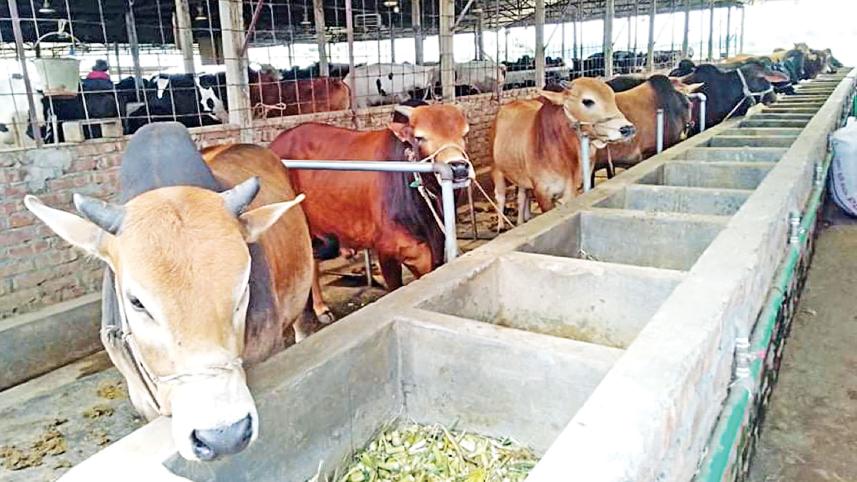
Arshad Uddin fell into a deep crisis when his indenting business in Dhaka took a turn for the worse soon after the coronavirus outbreak began in March last year.
Having completed his HSC in 1995, Uddin joined an indenting company in the capital in early 1996 before going on to start his own firm in 2020.

But after realising that the economic downturn would last for a while, Uddin moved his family back to their hometown of Rouha Niamotpur village in Karimganj upazila of Kishoreganj.
"Once home, I thought about my childhood devotion for cattle farming as I grew up in rural areas," he said.
"I started using an organic method of rearing after buying 20 cattle for Tk 30 lakh in the initial stage," Uddin added.
Now, his farm is home to 250 cattle, including 50 buffalo and 45 milking cows.
Besides, he has about 140 cows that are ready for sale as sacrificial animals in the upcoming Eid-ul-Azha.
Each cow will be priced between Tk 1.5 lakh and Tk 4 lakh, generating revenue of about Tk 5 crore in total.
Uddin has already sold some of his cattle this year, including his precious "Black Diamond", which sold for Tk 4 lakh to a buyer in Dhaka.
"Buyers from Dhaka and Chattogram visit the farm, named JC Agro, every day," Uddin said.
During his time working in the indenting business, Uddin travelled to some 15 countries in the EU and Asia, including Japan, Belgium, Malaysia, Korea, Singapore and Italy.
"I saw how organic feed is used for cattle farming in Japan and decided to apply it at my own farm," he said.
Using organic feed is comparatively cheaper than artificial products. Besides, the cattle raised organically have good demand despite their higher prices.
Natural animal feed products like grass, silage, straw, wheat bran, rice bran, molasses, bean bran, oilcake, and salt are considered organic.
"My venture was to rear cattle using organic food instead of different quick-fattening methods," he added.
Around one-and-a-half tonnes of cow dung is regularly produced at the farm and so, Uddin is now considering going for vegetable and crop cultivation using this organic fertiliser.
This presents him with an opportunity to farm on the vast tracts of lands in haor areas.
"My wife Umme Hani Akter Chadni, who also hails from a rural area, has a similar devotion for cattle farming and it is a great inspiration for me", he said.
Uddin has so far invested about Tk 5 crore with a long-term mission in cattle farming.
"I have to pay around Tk 5 lakh per month as salary for 30 employees and have a target to employ more workers if the farm gets larger," the 43-year-old added.
 For all latest news, follow The Daily Star's Google News channel.
 The success of his cattle farm has given him a much-needed back up amid the ongoing coronavirus crisis.
It is also a matter of satisfaction for locals that Uddin has created job opportunities for them at a time when the pandemic has left thousands of people out of work, said Shamsuddin Ahmed, a retired school teacher.
Praising Uddin's venture, Dr Shapan Chandra Banik, livestock officer of Karimganj upazila, said rearing cattle with organic food was profitable, low cost and healthy.
Of the farm employees, 15 were trained by the local livestock department.
"His venture will surely inspire many educated youths to go for cattle farming to be self-reliant and to enrich the country's livestock sector as well," Banik said.
Comments