


Bangladesh retains No 2 spot in US apparel exports

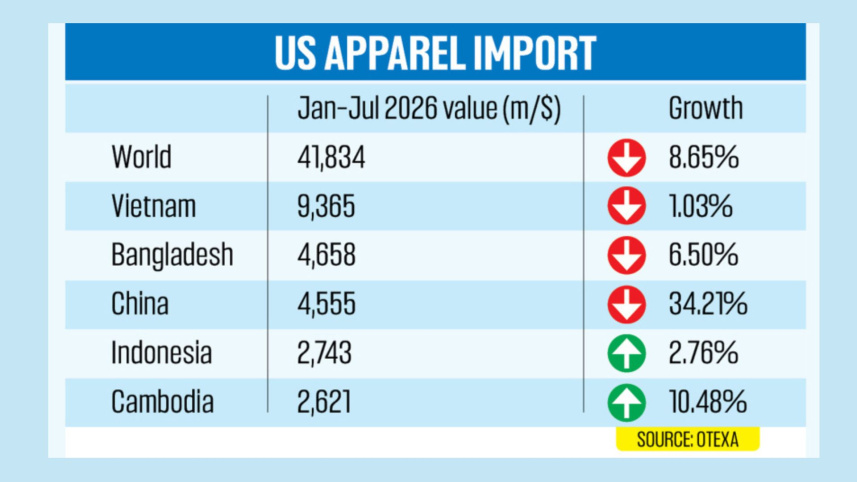
Bangladesh retained the second position in garment exports to the US in the January-July period as China’s apparel shipments to the American market recorded their steepest decline.
Bangladesh first overtook China in January-February as the Trump administration imposed higher tariffs on Chinese garment imports.

It retained the position in January-July despite a 6.50 percent year-on-year decline in garment exports to the US to $4.66 billion, mainly due to weaker demand for locally made apparel, according to data from the Office of Textiles and Apparel (OTEXA), the US provider of global apparel import data.
In July alone, Bangladesh’s garment exports to the US fell 10.73 percent.
Overall, US apparel imports declined 8.65 percent year-on-year to $41.83 billion in January-July.
China’s apparel shipments to the US fell 34.21 percent to $4.55 billion, while India’s declined 25.77 percent to $2.45 billion and Pakistan’s 5.60 percent to $1.26 billion.
Vietnam’s shipments fell 1.03 percent to $9.36 billion, while Indonesia and Cambodia posted growth of 2.76 percent and 10.48 percent to $2.74 billion and $2.62 billion, respectively.
Vietnam remained the largest apparel exporter to the US, followed by Bangladesh and China.
Bangladesh is in a relatively better position than some other apparel-exporting countries in terms of tariffs, which is helping boost shipments to the US market, said Shovon Islam, managing director of Sparrow Group.
“Although exports are in a good position, prices declined in January-July as local exporters had to bear part of the reciprocal tariff,” he said.
If the energy crisis is resolved, Bangladesh could perform even better in the US market, Shovon added.
“China is losing market share, and Bangladesh may be able to perform better in the future. In fact, Vietnam is taking more of China’s market in the US, while Bangladesh is taking a smaller share,” said Anwar Ul Alam Chowdhury Parvez, chairman and managing director of Evince Group, which ships a significant portion of its garments to the US.
However, Bangladesh’s ability to retain the position could be challenged by the ongoing energy crisis, he said.
“We are concerned whether Bangladesh can retain this position in the US market as the energy crisis persists in industrial units. Buyers are also well aware of the energy situation,” Anwar said. If the country can ensure adequate energy supplies, Bangladesh may sustain the positive trend, he added.
Mohammad Hatem, president of the Bangladesh Knitwear Manufacturers and Exporters Association (BKMEA), said Bangladesh could benefit further as China loses market share in the US, but sustaining growth will require lower production costs and reliable gas and power supplies.
Mahmud Hasan Khan, president of the Bangladesh Garment Manufacturers and Exporters Association (BGMEA), said the outlook for garment exports to the US was positive as work orders were rebounding following the finalisation of effective tariff rates for individual countries by the US government.
However, the industry’s focus should not be on export volume alone, but also on how much value local manufacturers retain, he said.
“Obtaining letters of credit from international buyers should not be the main target, as many exporters cannot make even a minimum profit because of high import costs for raw materials such as fabrics and chemicals,” Mahmud said.
Many exporters are also shipping goods below production cost in the hope of making profits later, he said. The BGMEA wants the industry to achieve a retention value of $20 billion if Bangladesh exports $50 billion worth of garments a year, Mahmud added.
The US is Bangladesh’s single largest garment export destination.
 For all latest news, follow The Daily Star's Google News channel.
 In February, Bangladesh and the US signed the Agreement on Reciprocal Trade (ART), which includes a textile clause. Under the clause, garments made in Bangladesh using US-sourced cotton and man-made fibres could qualify for duty-free access to the US market.
The provision could further strengthen Bangladesh’s competitiveness in the US market if implemented properly.
Comments