


Avoidable delays stall farm climate project

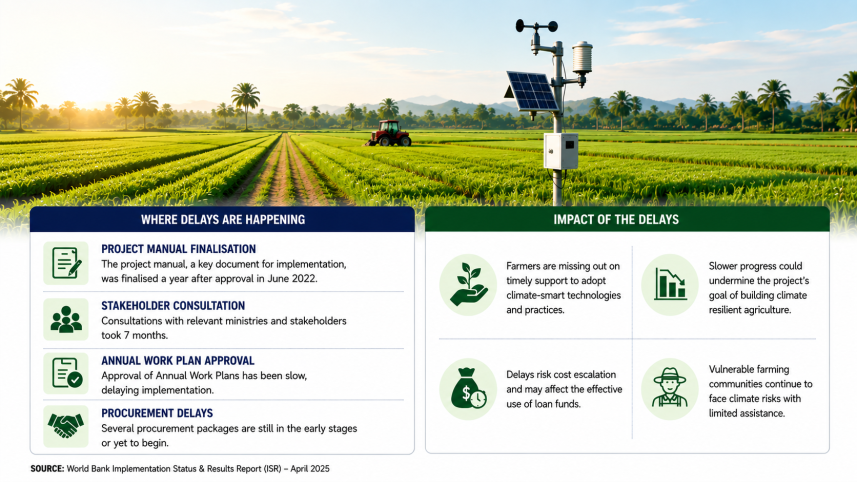
The Bangladesh Water Development Board (BWDB) has completed just 28.56 percent of its share of a nationwide project to modernise flood control, drainage and irrigation infrastructure and help farmers cope with climate shocks, forcing a two-year extension from the initial deadline of June 30, 2026.
The findings were revealed in an impact evaluation report of the project released last week by the Implementation Monitoring and Evaluation Division (IMED) of the planning ministry.

The report assessed the implementation progress of the Climate-Smart Agriculture and Water Management Project as of April 2026, when cumulative financial expenditure stood at just 17.22 percent of the approved cost of Tk 1,182 crore.
Of the total estimated cost, Tk 332 crore will be funded by the government and Tk 850 crore by the World Bank. The project was scheduled to run from 1 January 2022 to 30 June 2026 across 27 upazilas in 17 districts spanning all eight divisions.
However, with it being clear the project cannot be completed on schedule, the Project Steering Committee, at a meeting on 17 May 2026, recommended a two-year extension, said the report.
The project was approved by the Executive Committee of the National Economic Council (Ecnec) on 7 December 2021.
A revised implementation plan is being prepared, pushing the completion date to June 2028.
THE DELAY
According to the IMED report, during the initial phase of the project, the recruitment of consultants took approximately 2.5 years due to the World Bank’s approval process.
As a result, no civil works contracts could be tendered or awarded during this period, causing delays in the commencement of construction activities at the outset of the project, it mentioned.
It also said the implementation of construction works under the project has been delayed due to complexities associated with land acquisition.
In addition, the establishment of markets and residential settlements adjacent to the flood control embankments has significantly increased land values, making the acquisition of land and the sourcing of suitable earth for construction more difficult.
The IMED report also said under a service package, the project’s proposal stipulated that the procurement expert would be engaged on 8 March 2022.
However, the contract was actually signed on 12 February 2023, resulting in a delay of nearly one year before the expert was appointed, it said.
In the absence of an expert, the project office prepared the draft requests for proposals and carried out procurement evaluations during the first eleven months of project implementation.
As these documents did not fully comply with the World Bank’s procurement requirements and standards, the development partner repeatedly raised queries and requested revisions, significantly prolonging the procurement process.
Consequently, approximately 2.5 years were spent before the procurement process could be brought into compliance, it added.
DELAY WAS AVOIDABLE
The IMED report said the delay was avoidable.
It explained that the procurement expert should have been recruited at least three months prior to the invitation of bids for the first works package.
 For all latest news, follow The Daily Star's Google News channel.
 Moreover, while the recruitment of the design consultant was in progress, the project office could have utilised its own engineers or the implementing agency’s technical team to prepare draft standard procurement documents and pre-qualification criteria for the remaining procurement packages.
This would have enabled the procurement expert, upon joining in February 2023, to review and finalise the documents promptly, allowing the work packages to be tendered before 2024 and minimising delays in project implementation.
RISING COST
With the project’s two-year extension, the cost is now expected to rise as well.
Escalating prices of construction materials, higher labour wages, increased fuel prices, rising transportation costs, and overall market inflation will require additional financial resources to complete the remaining works, the IMED said.
Furthermore, as the project is financed through external loan assistance, the extension may result in additional financial and administrative burdens.
According to IMED, the two-year extension could result in higher commitment charges, front-end fees, loan management costs, administrative complications arising from delayed disbursements, and the risk of renegotiating or revising the loan conditions.
RECOMMENDATIONS
To sustain the project’s benefits long-term, the IMED recommends turning water management organisations into more effective and participatory institutions.
It also recommends strengthening the participation of local fishers, women, and smallholder farmers; establishing user-based operation and maintenance funds; providing training on gate operation and water management; and introducing digital water management systems.
To maintain the effectiveness of the re-excavated canals and rivers, the report recommends installing silt traps and implementing regular maintenance dredging programmes.
It also suggests introducing an IoT-based automated water control system to monitor river water levels and upstream flood flows in real time.
For riverbank protection works specifically, it calls for digital weighing devices to verify geobag weight, regular field supervision by engineers, proper curing of concrete blocks, and prompt repair of weakened embankment sections.
Comments