


From ash to toothpaste: Bangladesh’s oral care shift
to datun, charcoal and ash in the 70s

In her childhood, Anwara Akhter would begin the day by collecting mango leaves or cutting a neem twig. She would chew one end until it frayed into bristles, then use the fibrous tip to scrub her teeth.
In the 70s, that was a common practice. Many families relied on charcoal. Others used ash from burnt wood. Toothpaste was largely unknown outside a small urban elite. Akhter says she had never even heard of it until the 80s, when she moved to Netrokona city for college.

Until the 80s, charcoal, ash and toothpowder remained the norm for much of Bangladesh. Today, that world has all but vanished.
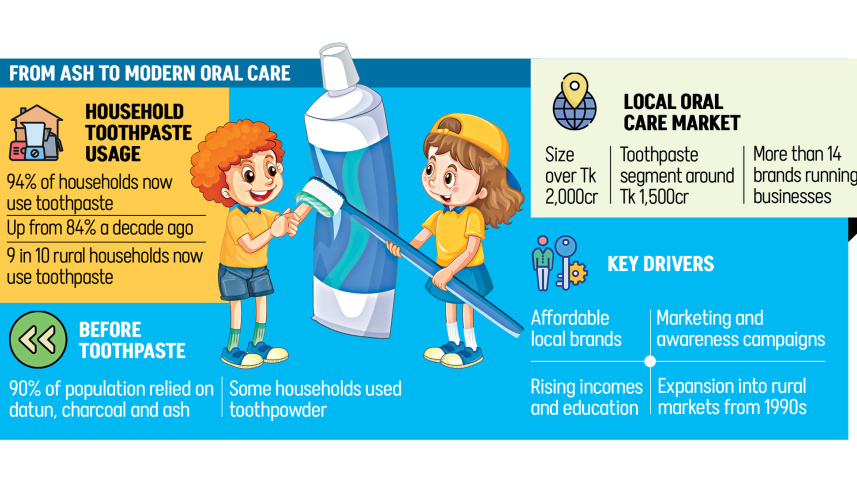
About 94 percent of households now use a toothbrush and toothpaste each morning, according to the latest industry estimates, as affordable local brands, rising incomes and greater awareness of dental health resulted in the toothpaste transformation.
Over the past decade alone, household toothpaste penetration has increased to 94 percent from 84 percent. Manufacturers say the market has moved from early expansion to a mature but still growing phase.
Syed Abdul Hamid, a professor at the Institute of Health Economics at Dhaka University, said commercial toothpaste first appeared globally around 1880. It reached this region between 1940 and 1950, during British rule and later the Pakistan period.
In those years, toothpaste use was basically limited to towns and cities. Rural communities continued to use datun or miswak. Many switched after moving to urban centres for study or work and encountering toothpaste in hostels or shared housing.
After independence, toothpaste gradually spread into rural areas, but the market began to gather pace in the 1990s. Advertising campaigns, expanding education and growing health awareness all played their part in changing habits, said Hamid.
Today, the market features a mix of multinational companies and domestic brands, with more than 14 players competing for share.
According to industry insiders, the current size of the oral care market stands at around Tk 2,000 crore, of which toothpaste accounts for roughly Tk 1,500 crore. Rural consumers generate nearly 65 percent of sales, while urban areas account for the rest.
Shamima Akhter, director (Corporate Affairs, Partnerships, and Communications) at Unilever Bangladesh Limited, which owns Closeup and Pepsodent brands, said toothpaste demand continues to rise due to demographic trends and improved awareness.
She said market growth has moderated, however, as penetration approaches saturation.
According to Akhter, urban areas once dominated demand, but rural Bangladesh now plays an equally important role. City dwellers adopted toothpaste earlier and tend to brush more regularly, while rural uptake lagged before accelerating sharply.
Jesmin Zaman, head of marketing at Square Toiletries Limited, which owns White Plus and Magic brands, said that the local oral care market has experienced steady growth over the past 15-20 years.
She said consumer interest in natural and herbal formulations is also rising strongly.
A senior official at Kohinoor Chemicals, which owns the AM PM Herbal Toothpaste brand, said their herbal segment is expanding steadily, though it still represents only about 5 percent of the local toothpaste market.
“Growth broadly mirrors the overall market rather than outpacing it. In neighbouring India, herbal toothpaste has gained far greater popularity and produced several strong brands,” said the executive.
A PRICE SENSITIVE SEGMENT
Unilever Bangladesh Director Akhter said a large chunk of local consumers are highly sensitive to price. Rural and low-income households often choose toothpowder because it costs less.
Regular brushing has yet to become firmly embedded in daily culture, especially outside cities, she said.
 For all latest news, follow The Daily Star's Google News channel.
 According to local manufacturers, toothpaste production depends heavily on imported raw materials. Fluoride compounds, sorbitol, flavour oils and much of the packaging are not produced locally in adequate quality and must be sourced abroad.
High inflation, such as in 2022 and 2023, pushed up input costs while eroding purchasing power. Although basic demand for toothpaste tends to hold up, companies saw volumes dip when prices surged, suggesting some households cut back under financial strain.
Square’s Head of Marketing Zaman said the market is moving beyond the traditional emphasis on freshness. Consumers increasingly seek specific benefits, from whitening and sensitivity relief to longer-lasting freshness and herbal gum care.
She said children’s oral care has emerged as a particularly promising segment. For those under five, fluoride-free toothpaste is essential because of the risk of swallowing.
Zaman said children aged six and above, however, require fluoride as their diets evolve. These specialised products are expanding quickly as parents become better informed and more families consult dentists.
ORAL HYGIENE NEEDS FURTHER IMPROVEMENT
ANM Nazmul Hoque, director (dental) at the Directorate General of Health Services, said charcoal and ash are highly abrasive and gradually erode enamel, the protective outer layer of the tooth. Once enamel wears away, teeth become sensitive to heat and cold.
Hoque said poor oral hygiene can also lead to gum diseases such as gingivitis and periodontitis, causing tooth loss and infection.
If left untreated, infections may enter the bloodstream and contribute to serious conditions, including endocarditis. People with diabetes are especially vulnerable because the disease severely affects gum health, he said.
Hoque added that oral cancer is now the second most common cancer in the country, often linked to poor oral hygiene, tobacco use and untreated gum injuries.
Ruman Banik, assistant professor of the oral and maxillofacial surgery department at Bangladesh Medical University, explained that in Bangladesh, most patients seek dental care only after experiencing pain.
“Untreated decay often leads to broken teeth, gum infections, and, in severe cases, significant tooth loss. Patients frequently complain of gum bleeding, sensitivity, halitosis, and, less commonly, cysts and tumours,” he added.
He attributed these conditions mainly to poor oral hygiene practices, including improper brushing techniques, irregular brushing habits and neglecting nighttime brushing, when bacterial activity is highest.
For individuals with limited resources, Banik suggested maintaining oral cleanliness through accessible methods such as miswak.
“Regular toothpaste is sufficient for daily use,” Banik assured.
Overall, he stressed consistent oral hygiene practices and routine dental checkups every three to six months as essential preventive measures.
Comments