


AC demand cools amid high inflation, frequent rain

Highlights
- Frequent rainfall and high inflation hit AC sales
- Affordable cooling brands outperform premium Japanese models
- Market hopes for recovery as temperatures rise gradually
Bangladesh’s air conditioner market is experiencing a subdued summer season this year. Frequent rainfall in April and May, coupled with fewer heatwaves than in previous years, has weakened demand for cooling appliances, according to industry stakeholders.
Sales remained below expectations during what is traditionally the peak period for AC purchases.

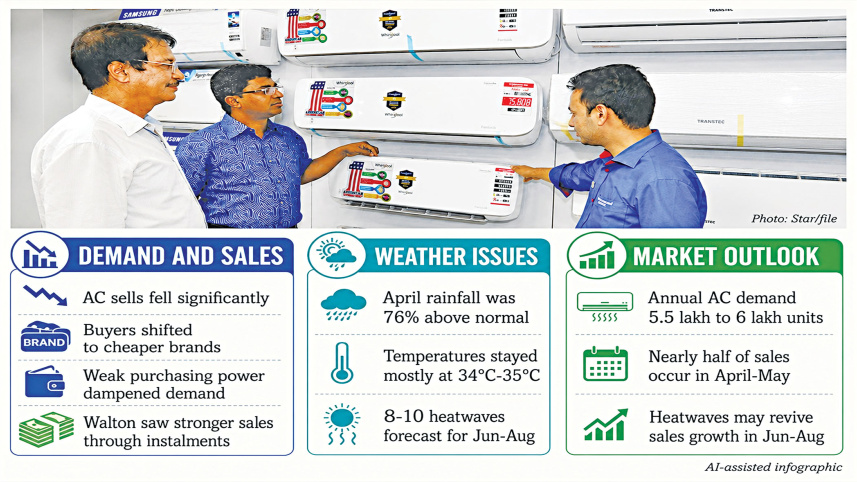
While demand persists, lower-priced brands have outperformed premium models as inflation continues to squeeze household budgets, market insiders said.
Nearly half of all annual sales are typically generated during the April-May period. Among household buyers, 1.5-tonne inverter AC units remain the most sought-after models
Demand rose modestly ahead of Eid-ul-Azha at the end of May, but the increase was insufficient to significantly lift overall market activity. Rising prices of essential goods have prompted consumers to curb discretionary spending on products such as air conditioners, they added.
According to Md Bazlur Rashid, a meteorologist at the Bangladesh Meteorological Department (BMD), temperatures during April and May remained below seasonal norms, while rainfall in April was more than 76 percent above the historical average.
However, he noted that elevated humidity levels made conditions feel considerably hotter.
Average temperatures this season ranged between 34°C and 35°C, the meteorologist said, which is not unusually high except in the Rajshahi region.
Frequent rainfall helped prevent widespread heatwave conditions, although temperatures have risen slightly over the past week. BMD officials also forecast 8 to 10 heatwaves over the next three months through August.
Industry estimates put annual AC demand at 550,000 to 600,000 units, with nearly half of total sales typically generated between April and May. Among household buyers, 1.5-ton inverter ACs remain the most popular choice, followed by 2-ton units.
“AC sales have fallen by around 30 percent this season compared with the same period last year due to unfavourable weather conditions and persistently high inflation,” said Md Nurul Afser, deputy managing director of Electromart.
Traditionally, AC sales surge between March and June, accounting for nearly half of annual demand, he said. However, frequent rainfall in April and May significantly dampened sales, particularly among first-time buyers.
Afser added that rising prices of essential goods have eroded the purchasing power of middle-income households, affecting discretionary spending.
Despite keeping prices unchanged from last year and offering discounts, sales have yet to meet expectations.
“If the monsoon is delayed, the market could still recover some lost sales this year. Otherwise, prospects for the industry will remain weak,” he said.
Mahmudul Islam Raz, brand manager at Rangs eMart, said sales increased slightly ahead of Eid-ul-Azha, but overall demand remained largely unchanged throughout April and May.
“Consumers are prioritising essential spending over discretionary purchases. If people struggle to meet daily expenses, they are unlikely to spend on products such as ACs,” said Salim Ullah Salim, director (marketing) of Jamuna Electronics & Automobiles Ltd.
Md Rashedul Islam, head of business at Transcom Digital, said AC sales during April and May exceeded 2025 levels but remained below those recorded in 2024.
Transcom sold around 4,500 units during the period, compared with 4,000 units a year earlier and 7,000 units in 2024. He attributed the improvement primarily to operational efficiencies rather than stronger underlying demand.
Inflation continues to weigh on consumer spending, while demand for lower-priced Chinese brands has outpaced that for premium Japanese brands as buyers become increasingly price-sensitive, he said.
 For all latest news, follow The Daily Star's Google News channel.
 According to him, many consumers who would normally consider premium brands are now opting for more affordable alternatives to manage household expenses.
Walton, however, reported a different trend.
“Demand for air conditioners has increased in recent weeks as temperatures have risen across the country,” said Md Tanvir Rahman, chief business officer of Walton Air Conditioner.
He said showroom footfall, online enquiries and orders have increased compared with the same period last year. Growth has been particularly noticeable among middle-income households, while instalment facilities have encouraged more consumers to make purchases despite broader economic pressures.
Rahman said flexible financing options have become an increasingly important factor in purchasing decisions, allowing customers to spread payments over several months.
As temperatures continue to rise, he expects demand to remain strong in the weeks ahead.
Comments