


Biman in talks to buy 10 Airbus planes after signing deal with Boeing
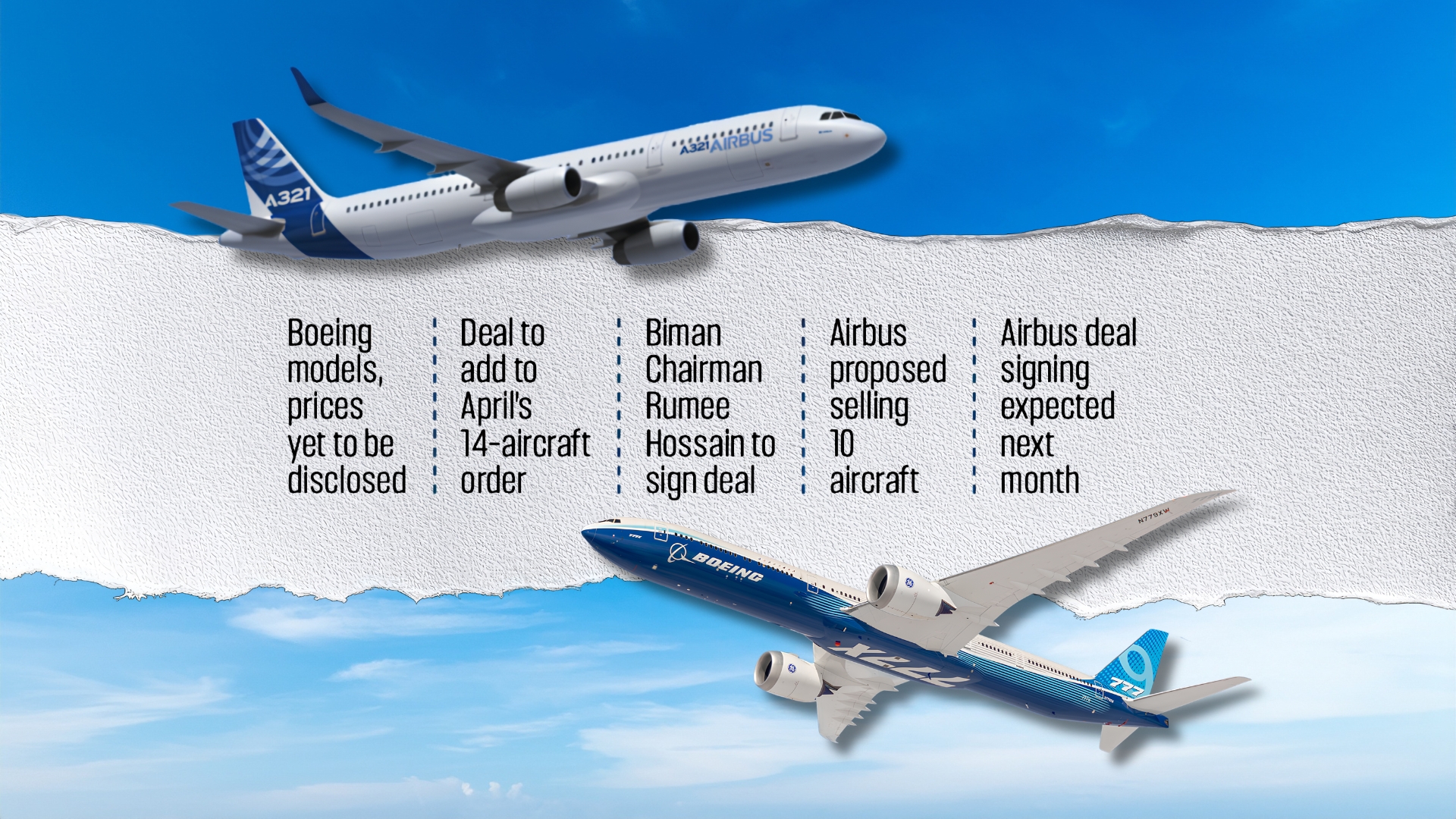
Biman Bangladesh Airlines is negotiating to purchase 10 Airbus aircraft as the government moves to build a mixed fleet and expand the national carrier’s share of Bangladesh’s air travel market.
The proposed Airbus purchase includes four A350-900 wide-body aircraft and six A321neo narrow-body jets, Civil Aviation and Tourism Minister M Rashiduzzaman Millat said today.

“We are working to build a sustainable mixed fleet,” he said, adding that there was “no geopolitical influence” behind the aircraft purchases.
The move comes after Biman signed a supplementary agreement with Boeing in New York on September 23 to purchase 11 more aircraft: five Boeing 787-10 wide-body jets and six Boeing 737-8 MAX narrow-body planes.

The agreement followed Biman’s April 30 deal to purchase 14 Boeing aircraft and was signed under a provision allowing the airline to buy additional planes.
Millat said the additional 11 aircraft would be purchased at the same price agreed under the April 30 contract.
With the latest agreement, Biman has contracted to buy 25 Boeing aircraft: two B787-9s, 13 B787-10s and 10 B737-8 MAX jets. Of these, 15 are wide-body and 10 are narrow-body aircraft.
The first aircraft is scheduled to be delivered in November 2031 and the last by 2035. However, the government has asked Boeing to deliver at least one aircraft by 2027-28, the minister said.
Millat said the number of wide- and narrow-body aircraft was determined based on Biman’s network and fleet planning, taking into account aircraft range and seating capacity, projected passenger numbers on each flight and weekly frequencies.
The wide-body aircraft would mainly be deployed on high-demand Middle Eastern routes, as well as long-haul services to Europe and North America.
The narrow-body aircraft would serve regional and short-haul routes and eventually replace Biman’s ageing 737-800 aircraft, he said.
Explaining the push for a much larger fleet, Millat said the government was following the Ethiopian Airlines model.
“Ethiopian Airlines has grown from a small legacy carrier to an airline with 167 aircraft, while our national carrier has only 19,” he said.
Bangladesh’s GDP is higher than Ethiopia’s and passenger demand at the country’s airports is also higher, he said.
According to the minister, Biman currently carries only a little over 20 percent of total passenger demand, while foreign airlines serve the remaining 80 percent.
The government therefore considered the aircraft purchases a timely initiative to address Biman’s fleet shortage, he said.
On financing the purchases, the minister said Biman, as a public limited company, would pay for the aircraft from its own earnings and through suitable financing arrangements.
As the aircraft would be delivered in phases, payments would also be made gradually, he said.
 For all latest news, follow The Daily Star's Google News channel.
 The procurement plan was prepared after considering Biman’s financial capacity, revenue from its routes and projections for future growth.
“Therefore, there will be no direct pressure on the budget,” Millat said.
Comments