


Companies are dodging price shock by cutting costs


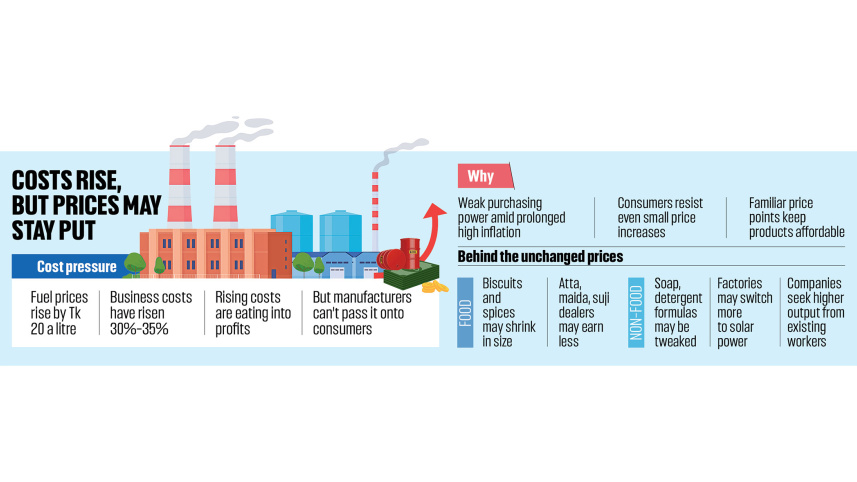
In the coming weeks, biscuits and spices may start arriving in slightly smaller packets, while dealers and retailers of atta, maida and suji may receive lower commissions on each packet sold.
Some companies may also tweak their recipes. Liquid soap and detergents, for example, could contain less active material while maintaining product performance. Inside factory premises, manufacturers may also increasingly turn to cheaper solar power and try to get more from their existing workforces.

All the changes are aimed at keeping retail prices unchanged even though the latest fuel price hike has raised production and transport costs. Local fast-moving consumer goods companies say they simply cannot pass on those costs to consumers as high inflation continues to erode purchasing power for years.
In the third week of September, the latest round of fuel price adjustments increased prices of diesel, petrol and octane by Tk 20 a litre, citing volatile global market rates and rising subsidies. The increase pushed up the prices of almost everything, from fresh vegetables, poultry and meat to basic grocery items.
Amid fuel and energy shocks that have raised overall business costs by around 30 percent in recent years, local conglomerates say they are absorbing the higher costs rather than raising product prices.
Ahsan Khan Chowdhury, chairman of industrial conglomerate Pran-RFL Group, said the company has not increased product prices after the fuel price hike. Instead, Pran is making gradual cost adjustments to cope with it.
He said local consumers tend to buy according to fixed price points. People have historically bought products at denominations such as Tk 1, Tk 2, Tk 5 and now Tk 10. Increasing the price of a product from Tk 5 to Tk 6 would be difficult because Tk 6 is not a convenient or commonly used price point in the market.
“So, we may have to reduce costs from certain areas. This could be gradually reducing packaging sizes or product weights,” said the chairman of Pran-RFL, the largest agro processor in Bangladesh.
Ahsan described this as a means of survival for the business.
He also said that, for some small products, supplying them in bulk and offering them as loose products can help companies save on packaging costs, while consumers can also save money if they are willing to accept it.
Super shop outlets such as Shwapno and Meena Bazar also said companies have not raised retail prices after the fuel price hike. Visits to a number of grocery stores in Dhaka found no supply shortages or delays in the availability of essential consumer products following the fuel shock too.
Neaz Morshed, assistant director of Category Management at Shwapno, said there had been no price revisions since the latest fuel price hike.
Meanwhile, Meghna Group of Industries, another major industrial conglomerate, said it has not increased product prices despite the fuel hike and higher transport costs. It has no plans to raise prices in the immediate future either.
Meghna Group Chairman Mostafa Kamal said higher vehicle fares and transport costs will affect businesses and consumers. The cost of sending a truck from Dhaka to Dinajpur, for example, has increased from Tk 20,000 to Tk 30,000.
With transport costs rising across shipments, there is hardly any margin left, he said.
“At some point, the situation may force us to reduce our profit margins. Retailers may face margin cuts and get less promotional gifts from us,” Mostafa added.
Companies pay commissions to dealers, wholesalers and retailers from their revenue.
Like Pran and Meghna, ACI Consumer Brands, which markets food items under the ACI Pure brand, said manufacturers could not increase prices overnight as they had to consider consumer behaviour and purchasing capacity.
“Price points are very sensitive. When prices increase suddenly, consumers tend to dislike the move and may avoid purchasing the products. This ultimately affects the business,” said Md Quamrul Hassan, executive director and chief operating officer of ACI Consumer Brands.
Quamrul said their profit margins have been under pressure for the past two years because of rising utility costs, while the latest fuel hike has added to packaging costs.
 For all latest news, follow The Daily Star's Google News channel.
 Luthful Kabir Shaheen, director of business development at City Group, another large local conglomerate, said the company is trying to absorb market pressures, support retailers and minimise the impact on consumers.
RN Paul, managing director of RFL, said the company’s profit margin has fallen from 3 percent to around 1 percent recently. “We sacrifice that 2 percent, but we cannot raise prices because consumers are not in a position to absorb the increase,” he said.
He said RFL has responded by cutting expenses, installing solar power and improving labour productivity.
Against this backdrop, business growth is likely to face greater pressure in the coming years.
“Suppose our business grows 10 percent, but achieving even 3 percent growth in profit now becomes a struggle,” Md Parvez Saiful Islam, CEO of Square Food & Beverage Ltd, said.
“We are now working hard just to maintain last year’s profitability,” he said.
Meanwhile, RFL’s Paul said he expects the company to grow by only 5 percent this year, compared with 15 percent previously.
Comments