


'Songs of Desire and Defiance' explores spiritual anatomy and womanhood
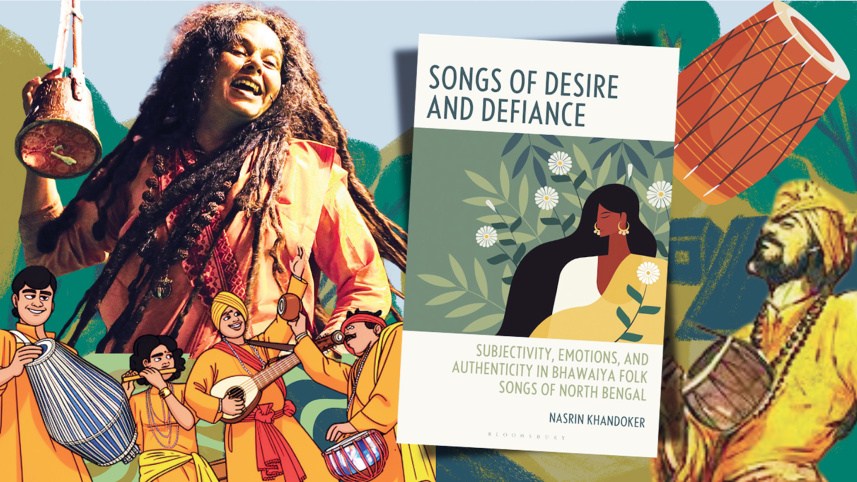
In the early 2000s, remixed versions of Bangla folk songs flooded neighbourhood corners during evening street matches and nighttime ceremonial events, which blurred the elusive nature of melancholia and yearning in the beats and celebration. This resulted in divided reactions as some debated the gentrification of pastoral identity and others applauded the defiance of conservative norms. Nasrin Khondoker’s Songs of Desire and Defiance is a deep dive into the Bhawaiya folk tradition of North Bengal; research ranging from studying the history of India to Bangladesh through ethnomusicology, feminist anthropology and cultural studies. The text brings space for illuminating the nature of Bhawaiya lyrics speaking for women’s desire, longing and dissatisfactions of conjugal life under the restrictions of the patriarch. The book revives Bhawaiya folk lyrics across chapters and amidst sections that make one reach out to their old playlist on YouTube.
While Bhawaiya belongs to the larger constellations of folk genres and shares
inclinations with Bhatiali and Baul music, its distinctiveness lies broadly with the articulation of subjectivity on womanhood. Popularized by Abbasuddin Ahmed, the Bhawaiya music is a blend of yearning and loss symbolized with the ebb and flow of river waves. The unsynchronized nature of the summer breeze presents an eco-centric resilience to the Bangla identity.
Dividing the book into four chapters, the author outlines her discourse centred around ethnographic research and lyrical analysis across Cooch Behar, Rangpur, Lalmonirhat, Kurigram, Ulipur, and Chilmari. The book asserts that the musicality of Bhawaiya sentiment is shaped less by geographical constraints and more by linguistics, history and cultural formations. She situates Bengal’s colonial and nationalist history whilst exploring Hindu mythological and theological metaphors in lyrics to navigate how identities are constructed and contested by placing women’s position at the centre of negotiations.
In the first two chapters, Khandoker combines colonial historical ideologies and Hindu mythological metaphors, aligning with the lived reality of women. The history of Bhawaiya is a foundation of Bengali nationalism and religious identity that traces with the emergence of bhadarolok culture. This Bengaliness later became a form of anti-colonial resistance through literature but excluded religious diversity with the birth of “Hindutva”. The othering of Muslim identity in the nationalist discourse emerged as a form of new Muslim identity, and under these romanticized formations, the elite Bengali literary class reinvented the “ghor/bahir” spheres. The men believed in adopting the
Western materialized identity for the public sphere, but the Eastern spiritual identity was to be protected in private by women. This “new woman” evidently became bearers of religious purity and the image of nationhood.
 For all latest news, follow The Daily Star's Google News channel.
Under surveillance of patriarchal control, the author questions whether love only existed in an arranged matrimony or whether it remained vigilant in the educated discourse for conjugal life. Folk products such as doggerel, poems and songs by Bhawaiya challenged such elite discourses of repressed desires of love. However, the folk expressions were derailed as low-class emotions, ultimately ‘othering’ the Bhadrolok sentiment. The resilience through Bhawaiya music continued as the public sphere became more inclusive towards the lower-class women.
After the 1947 partition, Bhawaiya entered the andarmahal of Hindu and Muslim elites through gramophone records and transcended the boundaries between the lower-class fields and the upper-class living rooms. Following this partition, the areas of Bhawaiya in North Bengal were also divided by religious sentiment. The text questions whose voice of desire the songs are presented as the discussion surrounding authorship becomes difficult to navigate. Locating various Bhawaiya scholars and musicians, the author traced the notion that the lyrics are an idea of “male fantasy of women” written by men, but following interviews with women Bhawaiya musicians, it was conclusive that whoever makes a Bhawaiya song, whether a man or a woman often tries to replicate the style of feminine struggles orientated around despair,
yearning and rage. Some lyrics written by women are sung as an homage to their mothers, sisters and friendships. The melodious metaphors in Abbasuddin Ahmed’s “O ki Ekbar Ashiya” is set on illicit affair of yearning for a lover while evoking the caged anxiety in a forcefully arranged marriage with a deeper narrative of societal subjugation of consent and lack of agency.
The author pictures the metaphor of the Hindu goddess, Lakshmi, who is known as the “ideal wife” from the Bhadralok’s perspective. She is an empathetic, all-forgiving, sacrificing deity whose image resembles an ideal nationalist spirituality. She is the Lokkhi, and any figure that would defy that image is an Alokkhi. The dangerous woman in Bhawaiya challenges the assumptions of “lokkhi”, a poor and voiceless soul. The deviant desire in Bangla folk makes the author ask one fundamental question that encapsulates her research objective: Is one a woman of Bhawaiya or do they become a woman of Bhawaiya? The author believes that it occurs when the listeners move beyond a gendered perspective and transform themselves into a temporal female subjectivity. It is not grounded in the emotional contact between the bodies; the singers and the listeners become the women of Bhawaiya in tune with the essence of its
beauty.
The remixed versions of Bhawaiya music produced by high-class composers create tensions with marketing when they supersede class confidentiality. The author quotes this as “a new form of old bhadralok” tension. These transformative pop folk versions have created a space for expressing defiant and deviant emotions, challenging middle- class perceptions of spirituality and decency. Somewhere along the line, it has also reduced the resilient empowering of female singers as invisible products.
In her final chapter, she discusses the interrelation and dilemma of navigating identity between political, religious, cultural and corporate phenomenon after careful calculation of the last three decades in Bangladesh. On the one hand, the nation-state’s choice of the “right” kind of folk music is a sentiment that attempts to authenticate the essence of nationhood, and on the other hand, corporate authorities seasonally advocate for the folk tradition according to the
market demand. The problem of defining music is not exclusive to Bangladesh. The texts states that, in post-war Bangladesh, the tension between the national, cultural and religious identities became even more evident through the contest of religion versus culture, ‘pro-liberation’ versus ‘anti-liberation’, Bengali versus Bangladeshi. The author refers to the 2011 Baul attack in the Rajbari districts where 28 Bauls were dragged to a mosque and forced to apologize for anti-Islamic practices. This reference now stands as a testament to political transitions and its impact on cultural spheres of Bangladesh; this
public humiliation and violent repercussions have almost become mob ritualistic.
Many folk musicians now sanitize their tone about sensuality and spirituality in order to drastically fit in with the current religious-political climate.
Nasrin Khandoker’s research is inspired by the subaltern studies and the nostalgic memories of her childhood that are etched with the subliminal tunes of Bhawaiya. The discourse of sensuality and romance is a timely burning issue in the scholarly investigation which her book intends to approach. This book creates a scholarly quest to deconstruct feminine agency and ‘deviance’ as a form of defiance. In a world where oppression is systemic and an easier option to choose for the powerful, it is through art that resilience stands as a protest that threatens those who ritualistically choose to
silence others.
Sumaiya Tasnim is a lecturer at the Department of English and Humanities, BRAC University.
Comments