


UK PM fights for survival
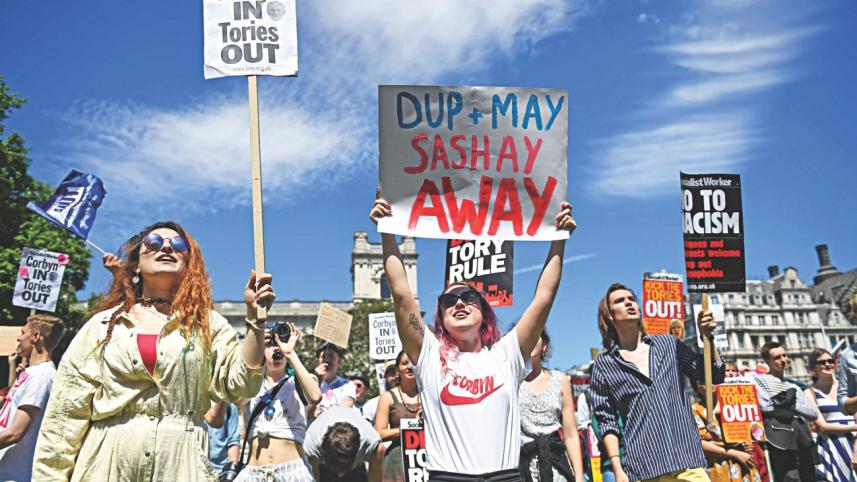
British Prime Minister Theresa May was fighting for survival yesterday after a failed election gamble undermined her authority and plunged the country into a major political crisis, days before the start of talks to leave the European Union.
May's bet that she could strengthen her hand by crushing what she believed to be a weak opposition Labour Party backfired spectacularly on Thursday as voters stripped her Conservative Party of a parliamentary majority.

The stunning outcome leaves May battling to unite different factions in her party and reliant on a handful of Northern Irish parliamentarians just nine days before Britain starts the tortuous process of negotiating its departure from the EU.
May's two top aides, Nick Timothy and Fiona Hill, announced they had quit yesterday, following sustained criticism of the campaign within the party.
Britain's typically pro-Conservative press savaged May yesterday and questioned whether she could remain in power, only two months after she started the clock ticking on the two-year EU divorce process.
The best-selling Sun newspaper said senior members of the party had vowed to get rid of May, but would wait at least six months because they feared a leadership contest could propel Labour leader Jeremy Corbyn into power.
"She's staying, for now," one Conservative Party source told Reuters.
The outcome risks upsetting the political balance in Northern Ireland by aligning London more closely with the pro-British side in the divided province, and increases the chance that Britain will fall out of the EU in 2019 without a deal.
May called the snap election to win a clear mandate for her plan to take Britain out of the EU's single market and customs union, so she could slash immigration.
But her party is deeply divided over what it wants from Brexit and the result means British businesses still have no idea what trading rules they can expect in the coming years.
The British pound tumbled against the U.S. dollar and the euro after the election result.
German Chancellor Angela Merkel said she assumed Britain still wanted to leave the European Union and that talks must start quickly.
But Elmar Brok, a German conservative and the European Parliament's top Brexit expert, told the Ruhr Nachrichten newspaper the talks would now be more complicated.
"May won't be able to make any compromises because she lacks a broad parliamentary majority," he said.
If she is to succeed in delivering the wishes of 52 percent of the public and take Britain out of the EU, she must find a way to secure the full support of her party to pass legislation preparing for and enacting the departure.
Anand Menon, professor of politics at King's College London, said her lack of a majority made it far more likely that Britain would leave the EU without a deal.
"Imagine she survives until autumn of next year," he told Reuters. "You will have a very fractious parliament. It is far from guaranteed to vote the deal through."
A failure to get legislation through parliament could eventually result in the need for another election.
Party insiders are placing bets on how long May will last, less than a year after Britain's surprise referendum decision propelled her into Downing Street.
"Theresa May is certainly the strongest leader that we have at the moment," lawmaker David Jones told the BBC.
 For all latest news, follow The Daily Star's Google News channel.
 When asked about her future, senior Conservative lawmaker Owen Paterson said "Let's see how it pans out".
The Times newspaper's front page declared "May stares into the abyss". It said Britain was "effectively leaderless" and the "country all but ungovernable". Its cartoon depicted May in a coffin with her feet sticking out and a speech bubble saying "Nothing has changed", a line she repeated several times as she reversed a key policy on social care during the campaign.
The Telegraph newspaper said senior Conservatives including Foreign Secretary Boris Johnson, interior minister Amber Rudd and Brexit minister David Davis were taking soundings over whether to replace May.
After confirming on Friday that her top five ministers, including finance minister Philip Hammond, would keep their jobs, May must name the rest of her team, who will take on one of the most demanding jobs in recent British history.
She said Brexit talks would begin on June 19 as scheduled, the same day as the formal reopening of parliament.
Senior EU officials and politicians have said May can postpone the June 19 date if she needs to, but with a final deadline for exiting the EU in March 2019, precious negotiating time would be lost if delayed.
Indeed, the prospect of a "hard" Brexit, by which the UK leaves with no deal, has shrunk with the Conservative majority, as it's a likely "red line" for the Democratic Unionist Party, the Northern Irish lawmakers May has turned to for support in Westminster.
The DUP backs the UK leaving the EU, but on the condition its border with EU member the Republic of Ireland, remains "frictionless."
To govern, she will need the support of the socially conservativeDUP, which won 10 seats in Northern Ireland.
One DUP lawmaker suggested support for May could come vote by vote, making the job of governing fraught with risk.
This is likely to pose an obstacle to the types of strict border controls advocated by those in the Conservative Party who support a "hard" Brexit.
A "soft" Brexit, by which the UK gets to stay in the single market and EU citizens can remain in the UK, now seems more likely but that will require a great deal of horse-trading.
Comments