


'Trump admin lied about me, the FBI'
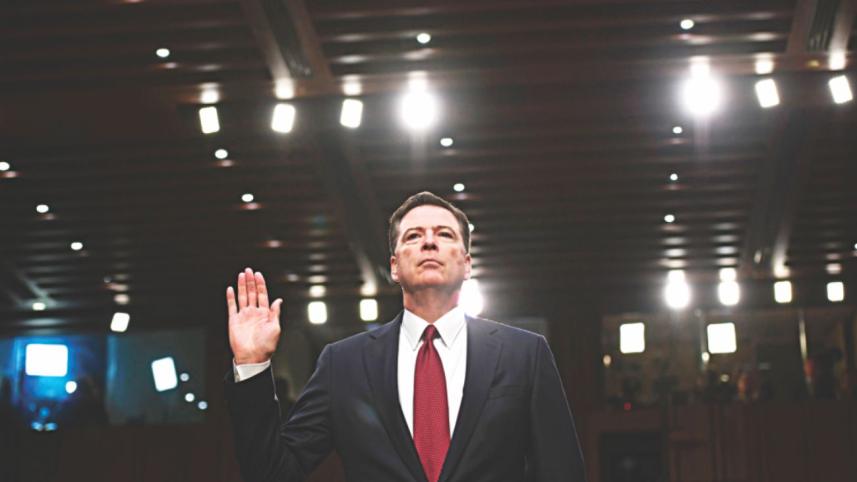
Fired FBI Director James Comey yesterday levelled a series of damaging accusations against the US President, testifying that Donald Trump pressured him to close a probe into a top former aide, fired him in an attempt to change the course of the larger Russia probe, and then launched a campaign of “lies” to discredit him.
In bombshell testimony to the Senate Intelligence Committee that could reverberate in Washington for months, Comey refused to say whether he believed the president himself colluded with Russian officials to meddle in the 2016 election, offering to speak about it privately with lawmakers, reports Politico.

And he provided some statements that could help the White House, including that Trump himself was not under investigation as of May 9, when Comey was fired, and that Comey was never explicitly asked by Trump or his aides “to stop” the FBI investigation into Russian meddling in the 2016 election.
But Comey also delivered damning statements. He said that he believed Trump gave him a “direction” in a private Oval Office meeting in February to “get rid of” the investigation into former national security adviser Michael Flynn, and that Trump fired him because he wanted to change the course of the Russia probe.
“It's my judgment I was fired because of the Russia investigation,” Comey said. “I was fired in some way to change -- or the endeavor was to change the way the Russia investigation is being conducted. That is a very big deal.”
In testimony being closely watched by Trump, his allies and leaders across Washington, Comey provided in sometimes painstaking detail his personal interactions with Trump that preceded his abrupt ouster.
Some of his harshest words came early in the hearing, as Comey suggested his surprise at his firing turned to anger as Trump and his aides offered a series of evolving explanations for the ouster.
“He had repeatedly told me I was doing a great job and he hoped I would stay,” Comey said, relaying a series of conversations with the president. “He told me repeatedly he had talked to lots of people about me including our current attorney general and had learned I was doing a great job and was extremely well-liked by the FBI.”
“It confused me when I saw the president on TV saying he actually fired me because of the Russian investigation,” he said. “I was also confused by the initial explanation offered publicly that I was fired because of decisions I'd made during the election… That didn't make any sense to me.”
Comey accused the White House of flatly lying when it said the FBI workforce was widely dissatisfied with his performance.
"Although the law required no reason at all to fire the FBI director, the administration then chose to defame me and more importantly the FBI by saying that the organisation was in disarray, that the workforce had lost confidence in its leader.
"Those were lies, plain and simple," he said.
The direct accusation was an extraordinary moment in a scandal that has engulfed Trump's presidency and threatens to consume even more of the administration's focus in the coming months, as Trump faces the question of whether he tried to obstruct justice.
Meanwhile, Marc Kasowitz, outside counsel for Trump, disputed key points of Comey's testimony, and said in a statement that a Senate hearing established that the president was not being investigated for collusion or obstruction, according to a Reuters report.
He said Trump did not ask Comey for his loyalty and did not direct or suggest to Comey that he stop investigating former national security adviser Michael Flynn.
"The president never, in form or substance, directed or suggested that Mr Comey stop investigating anyone, including suggesting that Mr Comey 'let Flynn go,'" said Kasowitz.
Comey has been a central player in the ongoing controversy about Russian interference in the 2016 presidential election, and his decision to probe potential collusion between Trump associates and Russian leaders irked the president.
Trump's move to oust Comey fuelled allegations that the president pressured not only the former FBI director but other top officials to intervene in the Russia probe.
The hearing could have significant repercussions for Trump's presidency as special counsel Robert Mueller and several congressional committees investigate alleged Russian efforts to influence the 2016 presidential election and whether Trump's campaign colluded with this.
Russia has denied such interference and the White House has denied any collusion.
 For all latest news, follow The Daily Star's Google News channel.
 RUSSIA ISSUE
The Russia issue has dogged Trump's first months in office, with critics saying that any efforts by him to hinder the FBI probe could amount to obstruction of justice.
Some legal experts said Comey's testimony could strengthen any impeachment case in Congress to remove Trump from office built on an allegation of obstruction of justice.
As Comey was testifying, a White House source said Trump disputes two key points in Comey's testimony: that he asked the FBI director to let go of the Flynn probe, and that he asked for Comey's loyalty.
Trump's son Donald Trump Jr fired off a series of tweets attacking Comey but the president himself stayed off social media while the drama played out in Congress.
Stocks were little changed as Comey's testimony kicked off, as investors continued to see as unlikely that Comey's testimony would lead to an end to Trump's presidency.
Comey testified that he kept notes after meeting with Trump because "I was honestly concerned that he might lie about the nature of our meeting, and so I thought it really important to document."
The White House has given shifting explanations on why Trump fired Comey. Trump has called Comey a "showboat" and a "grandstander" and said he was thinking of "this Russia thing" in dismissing him.
Russia has denied US intelligence agencies' conclusion announced in January that Russian President Vladimir Putin ordered an effort to help Trump win the 2016 election by discrediting Democratic opponent Hillary Clinton in part through the hacking and disclosure of damaging emails.
Comments