


Sangsad sees some positive changes
The current parliament witnessed some positive changes in terms of time spent on formulating laws, presence of MPs in the House, quorum crisis and participation of opposition MPs.
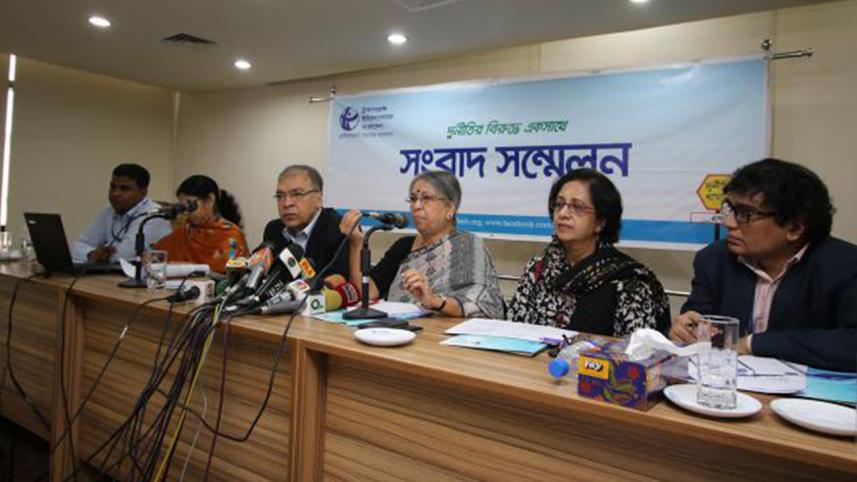
Transparency International Bangladesh (TIB) came up with the observation while disclosing findings of its study titled “Parliamentwatch-10th Parliament: 7th-13th Session” at a media briefing at its Dhanmondi office yesterday.

The Bangladesh chapter of the Berlin-based corruption watchdog said effectiveness of the current parliament was still questionable as main opposition Jatiya Party (JP) played a dual role both in the House and government.
Besides, the use of unparliamentary language by the ruling party and JP lawmakers to criticise their political rivals outside parliament was notable, the TIB study said, adding that the MPs used unparliamentary language at least 2,101 times.
The seventh to 13th session of parliament was between September 2015 and December 2016 with 103 sittings.
The BNP-led 20-party alliance boycotted the January 5, 2014, national election as its demand for holding the polls under a non-partisan election-time government was not met. This is for the first time since the restoration of democracy in 1991 that the BNP is not either in treasury or in opposition bench.
The TIB study said average quorum crisis was gradually decreasing when 8th, 9th and 10th parliaments were compared.
According to the study, parliament experienced an average 28 minutes of quorum crisis on each working day of the seven sessions (7th to 13th). The average quorum crisis was 33 minutes during the same sessions of 9th parliament and 39 minutes during the same sessions of 8th parliament.
A total of 48 hours and 26 minutes was wasted due to quorum crisis in the seven sessions, which is 12 percent of the total time of these sessions.
Referring to the estimated cost of conducting the sessions, the study said an average of more than Tk 1.62 lakh is needed per minute to conduct sessions. On the basis of this estimate, Tk 47.20 crore was wasted due to quorum crisis in the seven sessions.
Drawing a comparison between the same seven sessions of 10th and 9th parliaments, the study showed the average attendance of lawmakers was 67 percent in 10th parliament, up from 63 percent in 9th.
The attendance of the leader of the House is 84 percent in current parliament, which was 76 percent in previous parliament.
The attendance of the opposition leader is 83 percent in 10th parliament, which was only two percent in 9th parliament.
The main opposition staged walkouts four times in the seven session of this parliament.
A total of 66 government bills were passed in the House and an average of 31 minutes was spent to pass a bill following its placement in parliament.
On average 25 minutes was spent to pass a bill in 9th parliament, down from 39 minutes in 8th parliament, it noted.
Each sitting lasted for an average of 3 hours and 22 minutes in current parliament. It was 3 hours and seven minutes in 9th parliament and 3 hours and nine minutes in 8th parliament.
To make the parliament more effective, TIB made an 11-point recommendation, including formulation of a law on the code of conduct of MPs and strong role of Speaker to run the House in line with rules of procedure of parliament.
According to the study, MPs used unparliamentary language 2,101 times aimed at their out-of-parliament opponents, and 433 times at their rivals in parliament.
They used such language spending 15 percent of the total time of the sessions, which is violation of the section 270 (VI) of the Rules of Procedure of parliament, it said.
 For all latest news, follow The Daily Star's Google News channel.
 In most cases, the Speaker played a silent role when MPs used such language, the study added.
Contacted, Speaker Shirin Sharmin Chaudhury said she always warns MPs whenever they use indecent language. " And if needed, I expunge those from the parliamentay proceedings."
On the role of the main opposition, TIB Chairperson Sultana Kamal said, “We still cannot say that this parliament has been more effective. Had the parliament been more effective, the voice of the opposition would have been considered more importantly.”
About the activities of parliamentary standing committees, the study said 47 committees had a total of 337 meetings during the seven sessions, and three committees did not hold any meeting at all.
According to rules of procedure, every committee shall hold at least one meeting every month.
Comments