


Russian metro blast a possible suicide attack
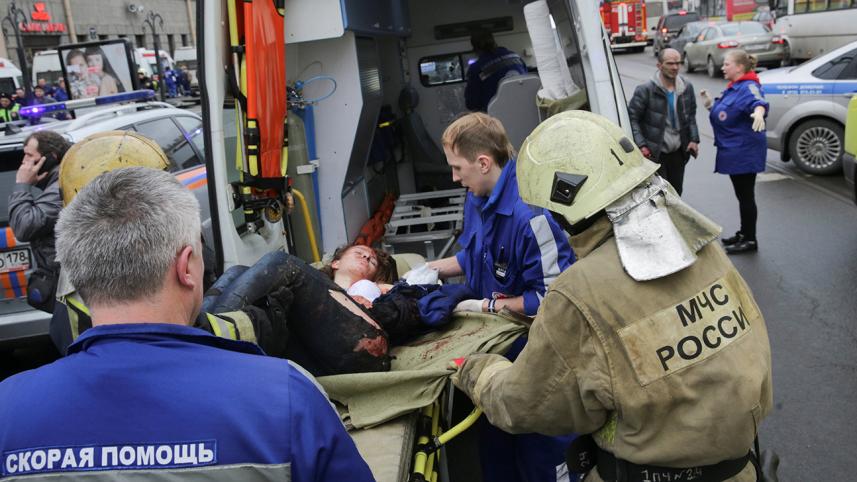
The St Petersburg metro explosion was caused by a bomb possibly detonated by a man whose body parts were found on the train, Russian investigators said yesterday.
The blast between two metro stations on Monday killed 14 people and injured 49.

Kyrgyzstan's security service named the suspect as Akbarzhon Jalilov, who was born in the Kyrgyz city of Osh in 1995 and had obtained Russian citizenship.
His name was later confirmed by Russian investigators, who said he also planted a second bomb that did not explode.
The perpetrator had radical Islamist links, Russian media cited law enforcement officials as saying, raising the possibility the attack could have been inspired by Islamic State, which has not struck a major city in Russia before, reported Reuters.
Russians laid flowers and tributes at memorials and a three-day period of mourning has begun yesterday.
The explosion took place between the Sennaya Ploshchad and Tekhnologichesky Institut stations at about 2:40 pm on Monday. Photographs from the scene showed bandaged and bloodied bodies being carried from the station where the train came to a stop.
Others showed bodies lying by the train itself at Tekhnologichesky Institut as the station filled with smoke.
KYRGYZSTAN LINK
No group has claimed responsibility for the attack, which led to the shutdown of the city's metro system. Russian Prime Minister Dmitry Medvedev described it as a "terrorist act."
Erlan Abyldaev, the Kyrgyz Foreign Minister, said the bomber's motives were unclear.
"Regarding the link with Islamic radicalism, we have to wait to know more until the investigation yields its full results," Abyldaev said at a press conference with Russian Foreign Minister Sergey Lavrov.
Kyrgyzstan is a Muslim-majority nation in Central Asia of around six million people. It is formerly part of the Soviet Union and remains a close ally of Russia.
Russian President Vladimir Putin was in St Petersburg for a media conference the morning of the attack. At a press conference yesterday, reporters asked Kremlin spokesman Peskov whether he thought the President may have been a target.
"Of course the fact that the terror attack happened when the head of the state was in town is a food for thought and is subject to analysis by the special services. Any terror attack that happens in the country is an attack on every single Russian citizen. Including the head of state," he said.
Analysts have speculated that the bomber could be affiliated with either a Chechen separatist group or IS. The bombing of a Russian MetroJet flight over the Sinai desert in Egypt, which killed all 224 people aboard, was claimed by IS.
Another possibility, says former CNN Moscow Bureau Chief and Woodrow Wilson Center Global Fellow Jill Dougherty, is a hybrid Chechen rebel-IS attack.
Many Chechen fighters have gone to fight in Syria, she said, and it has long been feared that they could bring their battlefield expertise back home.
However, former FBI special agent Bobby Chacon says that to stay silent after an attack goes against the IS modus operandi.
"The first thing that's missing from an investigator's perspective is the claim of responsibility," he told CNN.
"Last year when two IS operatives attacked police officers on the outskirts of Moscow... one of the first things that was released was the video where they claimed allegiance to al Baghdadi, the IS leader and IS itself and that's a hallmark, as we've seen in San Bernardino, of an IS attack."
 For all latest news, follow The Daily Star's Google News channel.
Comments