


Reap benefits of peaceful nuclear technology
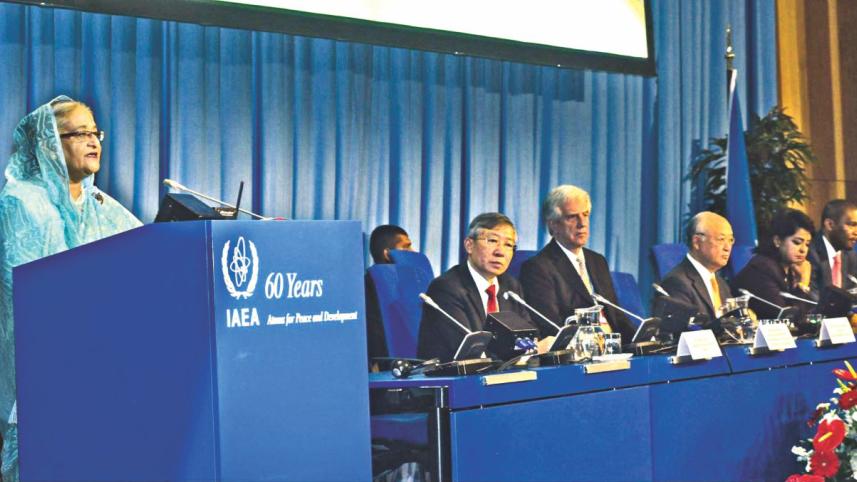
Prime Minister Sheikh Hasina has called upon the developing countries to forge greater cooperation to draw maximum benefits from the peaceful use of nuclear technologies through the IAEA expertise.
“Bangladesh remains committed to working with IAEA and other international partners in ensuring due diligence of the peaceful use of nuclear technology. The capacity-building and transfer of technologies are much needed by the developing countries to achieve the Sustainable Development Goals,” she said.

The premier was addressing the international conference on the “IAEA Technical Cooperation Programme: 60 Years and Beyond - Contributing to Development” in the Austrian capital Vienna on Monday.
She said Bangladesh was solidly anchored at its principled position on nuclear disarmament and non-proliferation.
Hasina also called for stepping up efforts by the International Atomic Energy Agency (IAEA) to assist the member states, particularly the LDCs and developing countries, to implement the SDGs.
The PM greeted IAEA Director General Yukiya Amano for his leadership and the agency for its dedicated efforts in promoting peaceful use of nuclear energy under its motto “Atoms for Peace and Development” in the last 60 years. “I also thank IAEA for its support to Bangladesh in its development over the last 45 years.”
Recalling that Bangabandhu Sheikh Mujibur Rahman decided to establish an atomic energy research establishment with the aim to transform the war-ravaged country into a prosperous Golden Bengal, she said a small research reactor had been running successfully at the centre for over 30 years for research, radioisotope production, education and training purposes.
“We regard nuclear energy as a safe, environment-friendly and economically viable source of electricity generation to meet the ever-increasing demand of electricity of the country's 160 million people. It will thus unlock our development potentials through enhanced productivity and sustained growth.”
Hasina said Russia-supported Rooppur Nuclear Power Plant would produce 2,400 MW electricity with two reactors. “Our aim is to generate at least 4,000 MW from the nuclear source by 2030.”
Bangladesh, she said, enjoyed an excellent collaboration with the IAEA as it successfully completed 138 national projects under technical cooperation and participated in 111 regional projects under the Regional Cooperative Agreement.
Bangladesh Institute of Nuclear Agriculture (BINA) developed high-yielding, high-nutritive, short-duration, salt- and flood -tolerant and climate-resilient mutant varieties of crops using nuclear technology, radiation and other advanced techniques, the premier told the programme.
Bangladesh already developed 92 improved varieties of 13 crops. The BINA was awarded with the “Outstanding Achievement Award” in 2014 by FAO-IAEA for its contribution towards the achieving food security, Hasina added.
The PM said the number of people who can afford diagnostic medical care in Bangladesh increased 10 times over the last 20 years as the country expanded and stepped up its nuclear medicine services.
“Fifteen public and six private nuclear medicine institutes in the country carry out over 4,00,000 nuclear medicine procedures each year in the areas of medical treatments.”
She said the uses of most recent nuclear technologies in cancer treatment were a real help to the people of Bangladesh.
“Science, technology and innovation played a major role in our achievement. A group of Bangladeshi scientists deciphered the complete genetic code of jute with a great success. We've also devised science diplomacy to ensure partnership for sustainable economic development through knowledge generation and sharing,” the PM added.
IAEA Director General Yukiya Amano, President of Mauritius Ameenah Gurib-Fakim, President of Uruguay Tabare Vazquez and the chairman of the IAEA Board of Governors also spoke at the programme.
 For all latest news, follow The Daily Star's Google News channel.
Comments