


Left out in the cold
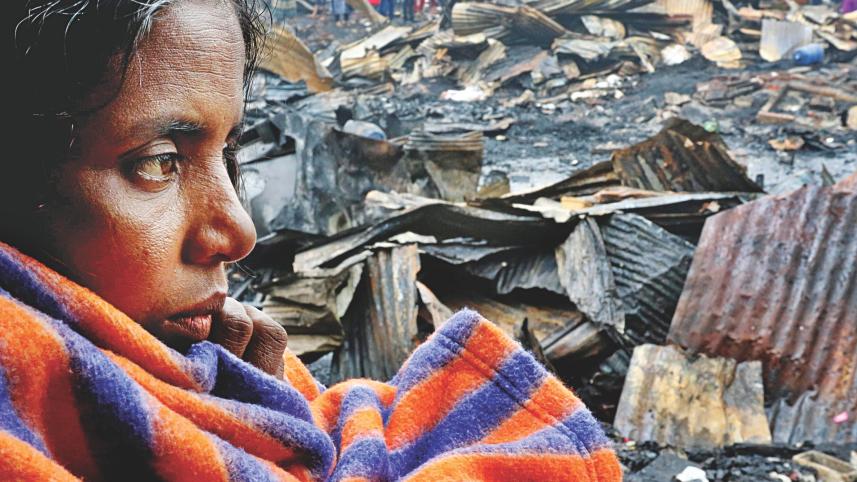
Ash-blackened bare feet and thin, shivering people shuffled about on the premises of Ananda Niketon Model School as a fire blazed through Bauniabandh slum early yesterday. The residents fled with just the clothes on their backs.
The fire, which broke out around 12:45am, gutted 87 homes and 17 shops, and left at least 350 people homeless.

Eleven fire engines doused the flames around 1:50am, said Ershad Hossain, duty officer at Fire Service and Civil Defence Headquarters.
While homes and livelihoods were burnt to a crisp, the people were left freezing as the mercury dipped to 12 degrees Celsius.
Shahana and her brother Ratan Miah waited in line to get their names registered as victims. Both were barefoot. Ratan had a thin military-issue blanket wrapped around him, while Shahana shivered in just her cotton sari.
“We are originally from Kishoreganj. We lived in the same shanty. It had two rooms that housed each of our families,” Shahana told The Daily Star.
They both pull garbage carts around the neighbourhood. They have no relative in Dhaka they could seek help from. The cold concrete floor of the school is their only refuge as long as the authorities allow them to stay there.
Beside them, 2-year-old Jannatul, exhausted from the night’s happenings, dozed off. She wore just a thin shirt and a pair of cotton shorts. Her grandmother Bokula tried to shield her tiny legs with a corner of her scarf.
“We’ve been in Dhaka for about two years. I work at a scrap-metal recycling shop…I have lost all my belongings in the fire,” lamented Bokula.
Almost everybody interviewed said that they had moved to the Dhaka in the past few years for a better life. They had slowly saved up enough to buy furniture.
A child named Zakir walked around the ruins of what was once his home, trying to collect scrap metal to sell. He waded through the pools of water left behind by the firefighters and stuck his hands deep into the wet mulch to dig out knick-knacks. “I found a knife we used to own,” he showed. None of the other objects he found were discernible.
How much will what he salvaged sell for, he was asked. “Twenty taka,” he replied quietly, fiddling with a burnt and splintered yo-yo.
Mohammed Zilani and Mosammat Rahima Begum were also digging around the ruins of their house trying to collect scrap metal. They both work as sweepers. They have been married for four and a half years, and had painstakingly saved up enough to buy a bed, a refrigerator and a TV. “You’re actually standing on my refrigerator,” she ironically pointed out, while listing out all that she had lost.
Cash losses were also rampant. Most of the residents, who saved part of their earnings, kept the cash at home.
Rahima lost Tk 45,000 that she intended to send to her village home. Sixteen-year-old Jharna’s family lost Tk 1.5 lakh they had saved to send her to Jordan as a migrant worker.
“My father is paralysed and my mother has to look after my younger siblings. I am the only one who has a full-time job. I had thought of going to Jordan because the garment factories there pay more than my factory here,” she said.
A dairy cow and her calf were burnt to death.
Abdul Fazal Miah, the owner lamented, “The cow used to give us 10 litres of milk each day. I tried several times to unchain her and get her out but failed.”
 For all latest news, follow The Daily Star's Google News channel.


Comments