


Colombia Mudslide: Rescuers race to reach survivors
missing; state of emergency
declared to speed up aid ops
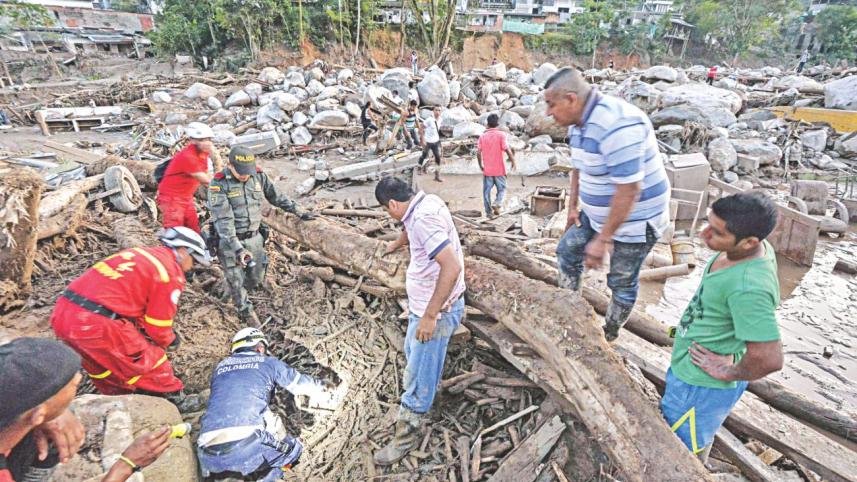
A grim search for the missing resumed at dawn yesterday in southern Colombia after surging rivers sent an avalanche of floodwaters, mud and debris through a small city, killing around 254 people and leaving many more injured and homeless.
People pried through piles of rocks and wooden planks that entombed homes. Streets were covered in thick sand, mud and tree limbs from the rivers and rainforest that surround the town of Mocoa.

At the Vatican, Pope Francis said he was "profoundly saddened" by the disaster, which struck the town with little warning late Friday after days of torrential rains that caused flooding of three area rivers.
"I pray for the victims and want to assure those who weep for the missing of my closeness to them," the pope said in a statement.
The Colombian army said in a statement that 254 people were killed, 400 people had been injured and 200 were missing. More than 1,100 soldiers and police officers were called in to help dig people out in 17 affected neighborhoods, reported Reuters.
The Pacific rim of South America has been hard hit in recent months by floods and mudslides, with scores killed in Peru and Ecuador as well.
President Juan Manuel Santos was scheduled to return to Mocoa yesterday along with cabinet ministers to supervise rescue efforts in the heavily forested region.
The president met with rescuers and survivors in Mocoa on Saturday, and declared a public health and safety emergency to speed up rescue and aid operations.
NATION IN MOURNING
"Dear God, I don't want to even remember that," said street vendor Marta Ceballos, who survived the mudslide.
"To see how some people screamed, and others cried, ran, tried to flee in cars, on motorcycles, and how they were trapped in the mud. It's all too, too difficult," she told AFP.
Ceballos said that she lost all of her material possessions. "The only things I fortunately did not lose were my husband, my daughters and my nephews," she said.
Putumayo Governor Sorrel Aroca called the event "an unprecedented tragedy" for the area.
There are "hundreds of families we have not yet found and whole neighborhoods have disappeared," he told W Radio.
Carlos Ivan Marquez, director of the National Disaster Risk Management Unit, told AFP the mudslides were caused by the rise of the Mocoa River and tributaries.
Some 130 millimeters (5 inches) of rain fell Friday night, Santos said. "That means 30 percent of monthly rainfall fell last night, which precipitated a sudden rise of several rivers," he said.
"Our prayers are with the victims and those affected," he added.
RESCUE EFFORTS
One thousand emergency personnel, including soldiers and local police, were deployed to help the rescue effort. Mocoa was left without power or running water, and there were reports of people looting stores searching for bottled water.
"There are lots of people in the streets, lots of people displaced and many houses have collapsed," retired Mocoa resident Hernando Rodriguez, 69, said by telephone.
"People do not know what to do... there were no preparations" for such a disaster, he said.
Several deadly landslides have struck Colombia in recent months. A landslide in November killed nine people in the rural southwestern town of El Tambo, officials said at the time.
 For all latest news, follow The Daily Star's Google News channel.
 Climate change can play a big role in the scale of natural disasters, such as this one, a senior UN official said.
"Climate change is generating dynamics and we see the tremendous results in terms of intensity, frequency and magnitude of these natural effects, as we have just seen in Mocoa," said Martin Santiago, UN chief for Colombia.
Comments