


Gold medal, FOMO, and everything in between

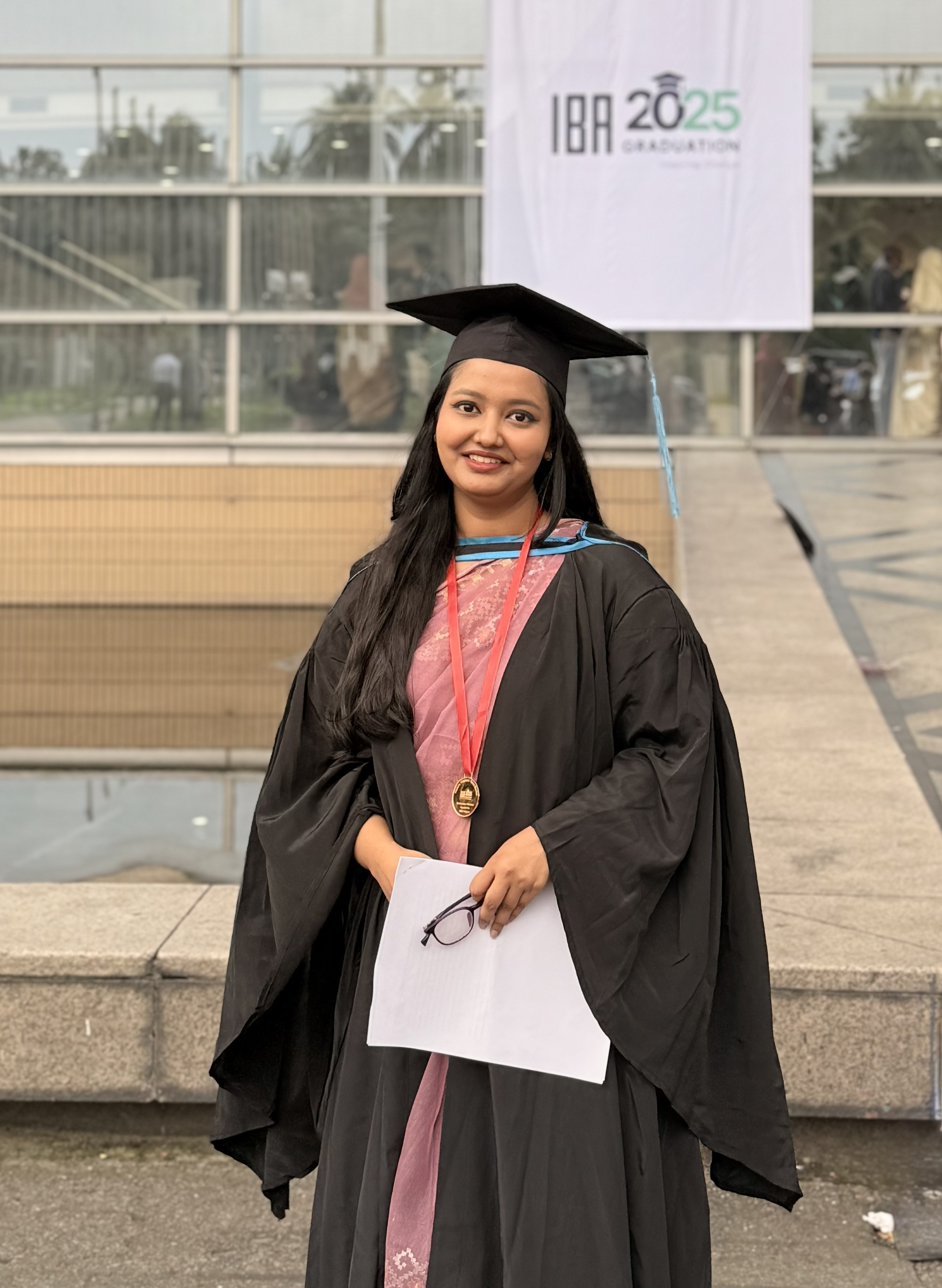
When I joined the Institute of Business Administration (IBA) at Dhaka University (DU), I thought success would be relatively straightforward. I arrived with a mind full of curiosity and a loose checklist of things I wanted to achieve. Four years later, I graduated as the Gold Medalist of my batch with a CGPA of 3.96, majoring in finance with a minor in economics. Along the way, I was fortunate to win the HSBC Business Case Competition and BizMaestros, represent Bangladesh internationally, and gain experience across research, journalism, and product management before beginning my professional journey as a management trainee at Unilever.
Yet, if there is one lesson that became clear early in my time at IBA, it is that success here is rarely defined by academics alone.

IBA’s greatest challenge is navigating an environment where opportunities seem endless and where the people around you constantly inspire you to do more. Before joining the institute, I had heard countless stories about it. IBA spent more than six decades building a reputation as one of Bangladesh's premier business schools. Its alumni have led multinational corporations, founded startups, shaped public policy, headed financial institutions, and built successful careers worldwide. This speaks to the institution's enduring reputation and the influence its graduates have had across industries.
The students who eventually make it to IBA are often among the highest achievers from their respective schools and colleges. Yet, once classes begin, everyone finds themselves surrounded by equally capable peers. This reality can be both inspiring and intimidating. The environment creates a unique kind of pressure. Not necessarily the pressure to outperform others, but the pressure to make the most of the opportunities available.
From the outside, people only see the public milestones, like winning business competitions and securing internships or roles at leading organisations. What they do not always see are the late nights, overlapping deadlines, and constant pressure that often accompany those accomplishments. IBA is not difficult because students are incapable of understanding the coursework. It is difficult because everything happens at once. Assignments, presentations, quizzes, reports, group projects, internship applications, competitions, and networking opportunities all compete for the same limited hours in a day. There were weeks when multiple deadlines collided, nights when sleep became negotiable, and semesters when it felt like every faculty member had secretly agreed to schedule major assessments in the same week. What I learned early on was that academic capability alone is rarely enough. Time management becomes a survival skill. So does learning when to say no. Unfortunately, saying no was never one of my strengths.
Because the ecosystem demands so much of your time, maintaining a near-perfect academic record requires a fundamental overhaul of how you study. Many of us enter university believing that intelligence alone determines grades. In reality, academic success often depends on small habits and consistency.
One of the simplest but most effective academic habits I developed was maintaining a detailed calendar of quizzes, assignment deadlines, presentations, and examinations. It sounds obvious, but many academic setbacks occur not because we lack ability, but because we underestimate the importance of organisation.
Furthermore, surviving a dense business curriculum requires mastering active engagement inside the lecture hall. The goal must be to utilise classroom hours so effectively that the need for heavy revision during exam weeks is fundamentally eliminated. You could also reverse-engineer your course outlines in the very first week of the semester.
By breaking down the exact mathematical weightage of quizzes, class participation, midterms, and final presentations, you can allocate your mental energy strategically. If a faculty heavily weighs class participation, make a calculated effort to contribute meaningfully within the first fifteen minutes of every session. If unannounced quizzes are a major factor, establish a rolling, thirty-minute weekly review system.
Most academic setbacks at IBA occur not because students lack capability, but because they are caught off guard by a sudden accumulation of continuous assessment deadlines.

This tactical approach is particularly critical when dealing with technical majors. In fields like finance and economics, students often fall into the trap of memorising formulas and mathematical shortcuts. This is a fatal mistake when professors design exams to test deep conceptual application. True academic mastery requires focusing entirely on the underlying logic and mechanics. You need to understand what a financial metric actually indicates about a company's health, rather than just how to plug numbers into an equation.
To solidify this knowledge, you should lean heavily on peer instruction. I often found that volunteering to explain a complex macroeconomic theory, an options pricing formula, or a corporate valuation model to a friend was the single most effective way to expose the gaps in my own understanding. If you cannot explain a concept simply to a peer without hiding behind dense jargon, you do not actually understand it well enough to ace a rigorous final exam.
I think the true litmus test of academic mastery at IBA is how well you can transplant textbook theories into the chaos of the real world. For me, a massive portion of my undergraduate journey took place precisely at this intersection of theory and execution, extending far beyond the traditional classroom. I worked as a business analyst for a Canadian firm, later joining Intelligent Machines and becoming a product lead. I also worked as a research assistant, stayed active in journalism, participated in business competitions, and explored the development sector. Looking back, I probably took on too much at times. But at IBA, seeing alumni excel in startups, research, leadership, and international arenas made it hard not to be inspired by their ambition.
For aspiring IBA students, my advice is simple: do not measure your university experience solely through grades. Work hard academically, because your CGPA matters after all. But also explore. Join competitions, take internships, meet new people, and try things that may not work out. University is one of the best times to experiment, learn from mistakes, and discover what truly interests you. The goal isn’t to do everything; it’s to find what matters.
The most surprising part of my journey is that I never entered IBA aiming to become a gold medalist. The achievement was the result of countless small decisions over four years – showing up, meeting deadlines, supporting teammates, and embracing new challenges. Each experience built the confidence to navigate unfamiliar situations and keep learning.
 For all latest news, follow The Daily Star's Google News channel.
Comments