


Youth voices in Radio Padma

The year is 2017, the month is May, Cyclone Mora is just afoot, and the people of the southern region of Bangladesh are in great danger. But to the rescue come seven community radio stations, which continuously broadcast programmes centred on storm preparedness in coastal districts. To help communities prepare for Cyclone Mora, they air interviews with disaster response officials, public service announcements, and weather bulletin updates every 15 minutes.
According to the Community Radio Policy 2017, the principle of community radio rests on the notion that it is a non-profit, community-owned, managed, and operated broadcasting medium that serves a specific geographical community sharing common socio-economic and cultural attributes.

Community radio policy was formally enacted in Bangladesh in 2008. According to the Bangladesh Community Radio Association (BCRA), the Ministry of Information has so far issued licences for 32 community radio stations across the country. Currently, 18 stations are broadcasting, while the remainder are still in the process of doing so.
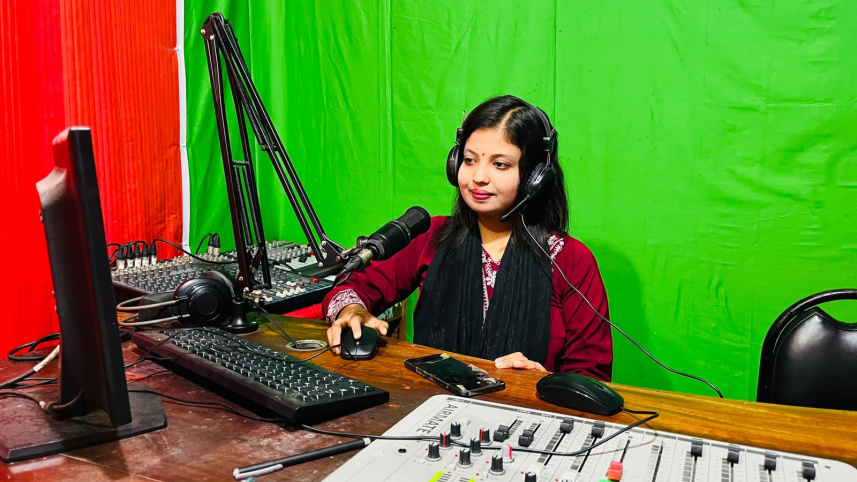
The first community radio station was Radio Padma (99.2 FM), launched in 2011. Radio Padma is a core initiative and the broadcasting wing of the Centre for Communication and Development (CCD Bangladesh). Most importantly, the youth have been a part of it since the very beginning.
Being a media student myself (Azra), whenever I have the opportunity to mingle with students outside Dhaka, I hear one particular predicament raised over and over again. The opportunities are concentrated in Dhaka, so media students elsewhere are always at a disadvantage. However, after speaking to the co-author, Tahmida, it was fascinating to learn how students, despite facing centralisation as a persistent hurdle, are contributing to their local communities by working at community radio stations, especially Radio Padma.
As the third model of broadcasting beyond government-run and commercial media, it gives a voice to grassroots people. Md Mehedi Shahed and Anindita Pragna, both presenters and master's students at Rajshahi University, were drawn to Radio Padma for the same reason. Mehedi says, "Community radios work with people in the community. Working at Radio Padma means bringing the joys and sorrows of underprivileged and marginalised communities, along with local problems, to the public. This motivated me to join as a presenter." He explained that his work is made meaningful by highlighting the rights, education, health, agriculture, and culture of local communities.
Anindita shares the same sentiment in her own words: "Deep down, I always felt a strong pull towards the idea of my voice reaching a large audience. I realised that if I could work at a community radio station, my voice would reach marginalised people. They would value my words, become more aware, and be motivated to apply those positive changes in their own lives."
Tahmida first became involved with community radio through a project run by CCD Bangladesh. This project focused on mobile journalism training for 30 young women reporting on the physical health impacts of climate change on women. It required frequent visits to the radio station to edit reports and record voiceovers.
The station offers internships in which students are taught the specific delivery style of the house. After a training process of six to seven months, she began working as a news presenter and eventually joined the station's multimedia news portal to work on scriptwriting and video editing.
Alongside professional experience, they also learn skills that help them throughout their academic lives. Fahria Sultana, a final-year student at Varendra University and a junior presenter at Radio Padma, explains, "My experience at Radio Padma has enriched my confidence, communication ability, and sense of social responsibility and has also helped me understand my academic studies far more easily."
For Mehedi, working at Radio Padma has helped him in his personal life as well. "Talking to local people, conducting interviews, and hosting live programmes have broken down my inhibitions about speaking and have increased my communication skills manifold. " Like Fahria, while creating programmes on agriculture, health, education, and law, he has gained detailed, in-depth knowledge of those subjects, broadening the scope of his education.
Anindita elaborates on how Radio Padma has enriched her professionally: "Working here enables me to deliver impactful, fluent presentations at seminars and training sessions. Moreover, engaging with local communities has trained me to be data-driven and factual. Delivering authentic, accurate information is vital, and I have mastered the skills of credible data collection and verification." Mehedi added that creating content, editing audio, and learning to use digital platforms equip them with the skills and capabilities of a competent media professional.
Community radio stations are mostly funded by the government and by the non-governmental organisations that run them. The scope for securing advertisements is also limited under government policy. Hence, they rely on student volunteers who are eager for experience and willing to work for a modest honorarium. This arrangement is mutually beneficial: students gain vital professional experience, while the radio stations are able to grow and survive on very low budgets while continuing to reach their communities effectively.
Regarding the medium's relevance, community radio remains vital in Bangladesh because it speaks for those who are unable to access the internet and social media. In regions like Rajshahi, advertising is scarce, so these institutions focus on providing essential information — such as agricultural advice or news relevant to Dalit and Harijan communities — that mainstream media often overlook. For Anindita, forging a profound connection of love and trust with grassroots people is the ultimate reward of her journey in community radio.
Mehedi firmly believes there is no better alternative than community radio for reaching urgent messages to remote and underserved areas. Through the active participation of the local community, community radio reflects the community's thinking, values, and cultural life, while promoting education, health, agriculture, women's development, environmental awareness, disaster management, and other development issues.
Head over to Radio Padma's website, and you can listen in real time to what is currently happening in Rajshahi through the youth voices of the communities. As a small touch of whimsy, the website plays a song automatically the moment you visit.
To various extents, the internet and social media are slowly making their way to communities on the fringes of society. As such, community radio must increasingly transition towards online-based platforms. By changing the platform while keeping their core philosophy of serving the marginalised intact, these stations can continue their important work in a modern context, and youth voices can help lead that shift.
It is worth stressing, then, that special attention should be paid to the youth voices who form part of community radio stations, precisely because of the persistent lack of opportunities outside Dhaka. Students have been part of Radio Padma and other community radio stations across Bangladesh since the very beginning because they want to give back to society while gaining experience along the way. It is fascinating to witness how students from different universities are making the most of their opportunities to help their local communities and, in doing so, inadvertently becoming the voice of the voiceless.
References:
- Government of the People’s Republic of Bangladesh (February 8, 2018). Community Radio Installation, Broadcast and Operation Policy 2017.
- The Daily Star (June 15, 2017). Community radio: Helping save lives during Cyclone Mora.
Azra Humayra is a sub-editor at The Daily Star – Campus
Tahmida Nasreen Kanak is a master’s student majoring in Journalism at the University of Rajshahi
 For all latest news, follow The Daily Star's Google News channel.
Comments