


The things we lose but can’t come back to
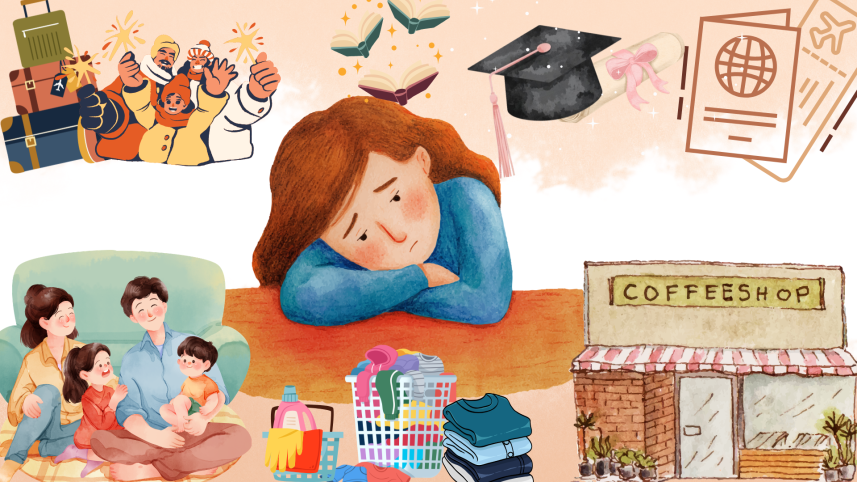
Many people have distinct experiences to share after moving abroad for a degree. We bid them farewell and ask them often what life is like alone in a foreign nation away from home. They only ever get to visit when a break is long enough. Most don’t move back in the near future. For those who do – a few years down the line with a degree – life tends to be quite different. It’s not all bad, of course. I did, however, encounter a reverse culture shock. Though I returned to the same place, it wasn’t necessarily the one I had left behind.
The paradox of moving away is that you belong somewhere in the middle of two homes, each with its own version of you, neither of which knows the other well enough. A lot prepares you for the grief of leaving everyone behind, but not much prepares you for the grief of coming back and finding that you miss the very place that kept you far from home. So much pulls your soul to the home you’ve created away from home, the life you’ve made as you transitioned into adulthood – new relationships, comforts, experiences, and a semblance of belonging.

As an international student, each time you visit from wherever you’ve gone for higher education, home seems different. People move on, and their lives continue to change without you. It’s a bittersweet experience; everyone you love is just a little bit older, while you are just a little different from the version they left at the airport seasons ago. Having moved away to America, Arpita says, “It’s like you're connected to everything, but not truly attached to anything or anyone.”
No matter where you go, culture shock is expected – even when you come back to a place you knew years before. The friends you’ve left have built their own bubbles, ones that can be entirely foreign to you. The little hangout spots have been replaced, the girl at the cart has moved away herself, and the local restaurant you frequent has no familiar waiter. Suddenly, all the birthdays, holidays, weddings, and ceremonies you’ve missed out on catch up to you. Where have you been all this time? Surely it can’t have been such a long time; has everybody else changed, or have you?
The answer is that both are true. Everyone else seems to have a better sense of belonging, a support system they’ve nurtured with their shared struggles and experiences. Amongst it all, you might sometimes feel like a bystander. You shouldn’t dwell on this feeling, though. After all, chances are you have accomplishments and experiences of your own. In any case, what you have gained at the expense of your disconnection will only ever be as worthy as you make it.
What nobody prepares you for is the restlessness. Not having to actively look after yourself in your childhood home, no groceries for one, no pile of dirty dishes and no overflowing laundry or comforting solitude. Material comforts at the expense of an odd sense of loss. In conversation with Anika, who moved back some three years ago from Japan, she feels most affected by the lack of control over her day-to-day. With most tasks at home being done for us, there lies a certain suffocation in the normalised lethargy of our routines here, where responsibility is removed through house help.
From living alone and being forced to adopt a more present role in taking care of yourself, sometimes the removal of these critical chores is replaced by an unease. But you must know what a privilege it is to miss the mundane and to cherish memories of living alone – an experience we don’t get to replicate here.
All the while, you sit here with the degree that begs to be proved worthwhile, a hint of grief and a mountain of job applications. No matter how many times you visit or how connected you are to home, the irrefutable truth is that you were not here. This is something that becomes increasingly obvious the more you settle into your first weeks. If you’re lucky, you might get a job pretty quickly with your “international degree”. If not, it’s even more humbling to have the degree that's supposed to make you a better candidate and yet have no job to show for it. Consolations are monotonous; it’s not you – it's the job market. But somewhere along the way, you find yourself questioning if all the money that’s been spent and time away were worth it.
In conversations with friends who have moved back, sentiments are mutual. There is a complexity in feeling both content to have achieved what you set out to do and being back home where you belong, while also feeling an inexplicable loss. Sometimes this takes form in the loss of your independence and freedom; sometimes it’s the room you spent all that time in or the neighbourhood you can’t just take a cab to revisit. Humaira, who just came back from Malaysia, says that it’s difficult to explain these feelings to her friends and unfair to expect them to relate. It seems especially cruel to speak of these feelings to the same people who finally have their friend home after all these long years apart. It leaves you conflicted and guilty to harbour such emotions instead of gratitude.
And there exists a myriad of experiences here with the privilege of being home again, the taste of your mother's cooking, sharing a roof with your annoying siblings who tugged at your heart with every birthday you missed, and your grandparents, for whom the passage of time is most cruel. A few more years, and you would have lost the chance to hold your family close. There will, inexplicably, come a day when you have outgrown the walls of your childhood home. All the things that you would have never known, and the memories you now have the chance to make.
Perhaps there is something you could have done differently: stayed more connected, come back more often or done something to juggle your two lives. Regardless, a choice would have been made. You can’t have been at two places at once, and you gain nothing from doubting and resenting yourself. Everyone is a mosaic of all their experiences. However humbling it might feel now, yours are the colours of a life lived here and there. You’ve survived leaving everyone you know behind; surely you must survive this unknown.
Faiza is overcompensating for her approaching quarterlife crisis - reach her at: faiza.atcorp@gmail.com
 For all latest news, follow The Daily Star's Google News channel.
Comments