


US, Chinese diplomats clash in Alaska meet
-
US says China threatens rule-based order, global stability
-
China says US abuses national security
The first high-level US-China meeting of the Biden administration got off to a fiery start on Thursday, with both sides leveling sharp rebukes of the others' policies in a rare public display that underscored the level of bilateral tension.
The run-up to the talks in Anchorage, Alaska, which followed visits by US officials to allies Japan and South Korea, was marked by a flurry of moves by Washington that showed it was taking a tough stance, and by blunt talk from Beijing.
 For all latest news, follow The Daily Star's Google News channel.
 "We will ... discuss our deep concerns with actions by China, including in Xinjiang, Hong Kong, Taiwan, cyber attacks on the United States, economic coercion of our allies," US Secretary of State Antony Blinken told his Chinese counterparts in a highly unusual extended back-and-forth in front of cameras.
"Each of these actions threaten the rules-based order that maintains global stability," he said.
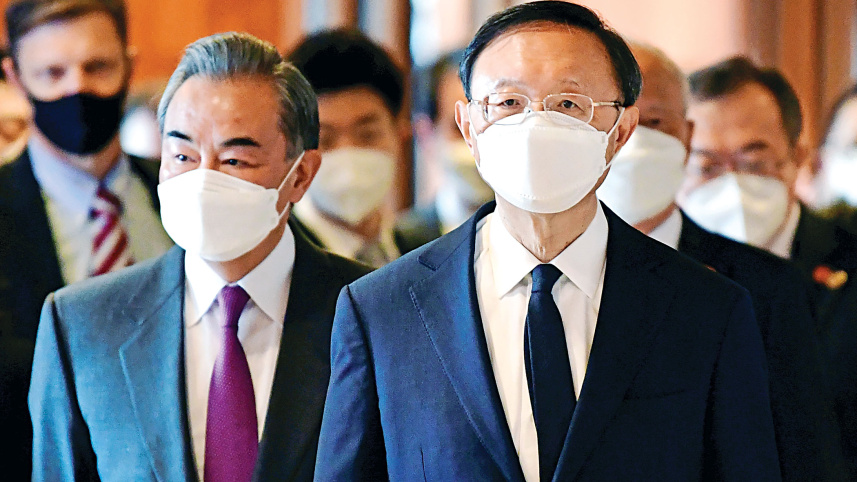
China's top diplomat Yang Jiechi responded with a 15-minute speech in Chinese while the US side awaited translation, lashing out over what he said was the United States' struggling democracy, poor treatment of minorities, and criticizing its foreign and trade policies.
"The United States uses its military force and financial hegemony to carry out long-arm jurisdiction and suppress other countries," said Yang. "It abuses so-called notions of national security to obstruct normal trade exchanges, and incite some countries to attack China," he added.
What is typically a few minutes of opening remarks in front of journalists for such high-level meetings lasted more than an hour, and the two delegations tussled about when media would be ushered out of the room.
Afterwards, the United States accused China of "grandstanding" while Chinese state media blamed US officials for speaking too long and being "inhospitable".
Both sides accused the other of violating diplomatic protocol by speaking too long in opening remarks.
Adding to tensions, China on Friday tried a Canadian citizen on espionage charges, in a case embroiled in a wider diplomatic spat between Washington and Beijing.
Comments