Is democracy dying?
SEOUL – We assume that we are living in a democratic society. However, what if it is merely a delusion, and in fact, we are living in an authoritarian, totalitarian society where democracy is falling apart? Indeed, we are now witnessing a worldwide crisis of democracy.
Recently, scholars of political science have diagnosed the decline of democracy as a global phenomenon. They argue that in the past, it was either military coups or tyrannical rule that threatened and crushed democracy. Today, however, they say that democracy is waning silently before we become aware of it, even under lawfully elected governments.
What, then, are the factors that make democracy decline these days? In his book, “The Crisis of Democracy,” Weixiong Li argues that democracy today is threatened by socialism, populism, polarization, ideological brainwashing, teachers’ unions and government debts. Granted this definition, democracy is vulnerable in any country that is divided by mutually antagonizing ideologies or ruled by leaders who adopt political or economic populism.
Indeed, we are now living in a polarized society where extremism is rampant, and democracy is deteriorating and disappearing.
Some experts perceive the following as the reasons for the recent downfall of democracy in Korea: extremism, rule by law, no transparency, political vengeance, election manipulation and fabrication of data to deceive the public. Others add the following: no separation of powers, weakening of judicial independence, manipulating the National Assembly, and seeking a single-party system by ignoring or eliminating the opposition party.
Indeed, we are now living in a polarized society where extremism is rampant, and democracy is deteriorating and disappearing. We are also living in a deceptive, vindictive society where fake news and lies are ubiquitous, and political vendettas are constantly recurring. In such a society, we are subjected to a “rule by law” that denounces democracy. We know that “rule by law” effectively means politicians are using legislation as a tool for political revenge and control.
The problem is that the crisis of democracy is so subtle and clandestine that we do not even realize it until it has ruined our country completely. In the US TV drama “Homeland,” US President Elizabeth Keane addresses the American people. “When we think of democracy dying, we think of revolutions, of military coup d’etats, of armed men in the street,” she says. “But that’s less and less how it happens anymore. Democracy now dies when we’re not looking, when we’re not paying attention. And the end rarely comes in an instant, but arrives slowly, like twilight. At first, our eyes don’t notice.”
As Keane says, people do not notice it, even though democracy is dying in their country. Indeed, we do not realize it, even though our political leaders defy democracy to control people and stay in power. We do not feel the crisis because such a phenomenon happens in subtle and inconspicuous ways and because we have elected our politicians through fair elections.
In fact, democracy can be threatened by many factors. Undoubtedly, populism is one of them. To mobilize supporters, political leaders always use populism to undermine democracy. Both left-wing and right-wing populism can irreparably damage the foundations of democracy. For example, left-wing populism may damage not only a country’s economy, but also its democracy by using “people power” for political gain, antagonizing economic elites and distributing money in the name of social justice.
Right-wing populism, too, can cause the decline of democracy by pursuing ultranationalism. Political commentators have noted that right-wing populism usually targets cultural elites and ethnic minorities who they say stand in the way of a monocultural and homogeneous national identity.
Of course, democracy has its own downsides, too. For example, democracy’s “rule of the majority” may end up being another type of dictatorship by suppressing minority rights, even though it is a cornerstone of democratic decision-making. It can also contribute to electing dictators or incompetent political leaders because voters can be irrational or ignorant and thus easily manipulated by propaganda. Democracy also may inadvertently create extreme divisions, polarization, and chaos because it allows different opinions and factions.
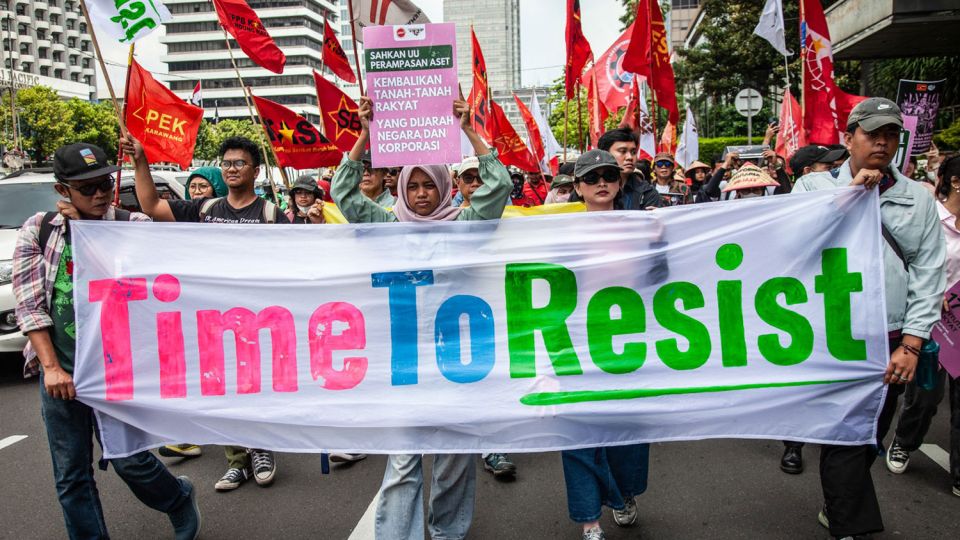
Still, however, democracy is the best option available to us because the opposite of democracy is tyranny or dictatorship. Unfortunately, these days we encounter many dictators who are disguised as democratic leaders because they are elected through free and fair elections guaranteed by democracy.
Perhaps that is why some political commentators have expressed the pessimistic viewpoint that democracy is at the end of its life now. When and if democracy is at stake, we are likely to end up living in a tyrannical society. We will not let it happen because we cannot bequeath such a stifling society to our children. If democracy has exhausted its possibilities, we should resuscitate and replenish it and then protect and defend it.
Watching the unprecedented crisis of democracy, we cannot but worry about the future of mankind. What kind of world is waiting for us in the future? We can only hope that it is a democratic world, not an authoritarian or totalitarian one, donning the mask of democracy.
This article was first published in The Korea Herald, an ANN partner of The Daily Star, on March 25, 2026.
Kim Seong-kon is a professor emeritus of English at Seoul National University and a visiting scholar at Dartmouth College.
Send your articles for Slow Reads to slowreads@thedailystar.net. Check out our submission guidelines for details.
Can Bangladesh bring its hilsa back?
Can the new strategy achieve Bangladesh’s renewable energy targets?
André Wink speaks / What we get wrong about the Indo-Islamic world
Bengali Muslims and the ghosts of India's citizenship politics
Bangladesh’s solar growth: Will the incentives be enough?
The missing link in Bangladesh's innovation economy
Dhaka’s battery rickshaw problem is economic, not just about traffic
The staircase between our mothers and care
Is Bangladesh prepared for the next food shock?