


Putin ‘in a corner’ with options narrowing
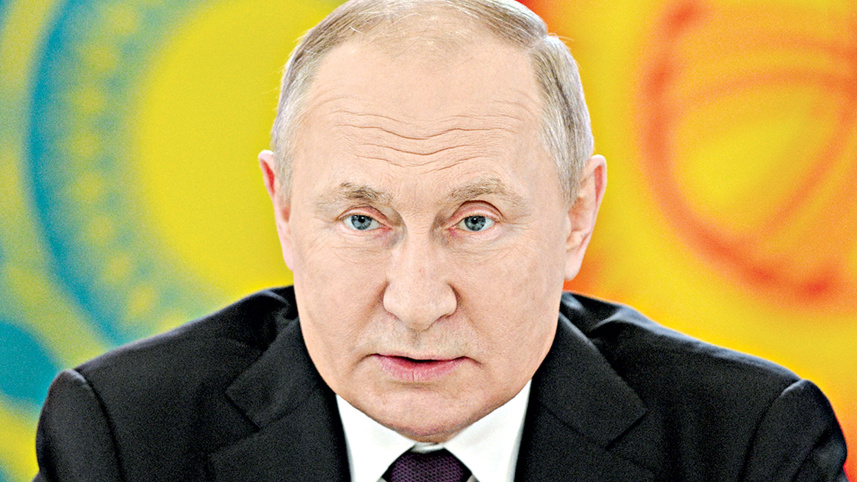
US President Joe Biden admitted this week that American diplomats still did not know how Russian President Vladimir Putin could bring an end to his faltering war in Ukraine and save face. Western analysts see no good options.
The question of Putin's "off-ramp" -- or decisions that allow him to end the fighting without admitting defeat -- has exercised Western policymakers and foreign policy experts since the very start of the war in February.

"Where does he find a way out?" Biden asked on Thursday while talking in New York. "Where does he find himself in a position that he does not, not only lose face, but lose significant power within Russia?"
A French diplomat, talking recently on condition of anonymity, stressed that European allies were no closer to reading Putin's thinking, other than his desire to secure what appears to be an increasingly unlikely military victory.
"There's a war that he is not managing to win, but what would satisfy him? We don't have the answers," the diplomat said.
Instead of looking for a negotiated climbdown, Putin has escalated in recent weeks, formally annexing four regions of Ukraine on September 30 and approving a partial mobilisation of up to 300,000 men for the war.
On Friday, he said Moscow was "doing everything right" in its nearly eight-month invasion of Ukraine despite a string of embarrassing defeats against Kyiv's forces. In the latest sign of embarrassment for him, Kremlin-installed officials in the southern Kherson region, which Russia annexed, urged residents to leave as Kyiv said its soldiers were advancing on the oblast's main city.
"What is happening today is not pleasant. But all the same, (if Russia hadn't attacked in February) we would have been in the same situation, only the conditions would have been worse for us," Putin told reporters after a summit in the capital of Kazakhstan.
"So we're doing everything right," he insisted.
Putin said there was no need for further massive strikes against Ukraine at present and claimed the Kremlin did not intend to destroy its pro-Western neighbour.
He spoke days after Russia unleashed a wave of missile strikes on cities across Ukraine that left at least 20 civilians dead. Putin said the strikes were in retaliation for the explosion on the Crimea bridge, which he has described as a "terrorist act".
"He may think the battlefield situation isn't great but things will settle down during the winter, that Ukrainian offences will come to an end, that they'll be able to mobilise," Eliot A Cohen, a military historian and former US State Department adviser, told AFP.
"I think he's mistaken. I think the Russians are in a serious world of hurt," added Cohen, an expert at the Center for Strategic and International Studies at the US-based Johns Hopkins University.
The Ukrainians are continuing to win back occupied territory in the northeast and south, while the Kremlin's mobilisation has led to rare dissent in Russia amid evidence that many recruits lack adequate weapons and kit.
"Russia's behaviour is irrational," wrote Joris van Bladel, a fellow at the Belgian Royal Institute for International Relations think-tank. "The only 'rational' element the Kremlin is counting on is time."
"Russia tries to buy time in the hope that the European countries will collapse before Russia's downfall," he added.
Putin's escalation on the ground has also been accompanied by new rhetoric about the possible use of nuclear weapons which is directed at Western countries.
Some analysts see it as a bluff and others as a sign of desperation.
Western nations have signalled that they would feel compelled to react in some way if Russia crossed the nuclear threshold, raising the risk of direct conflict between the Nato military alliance and Moscow.
"It's a very, very dangerous moment," former US secretary of state John Kerry said late last month.
 For all latest news, follow The Daily Star's Google News channel.
 Putin is "more in a corner than anyone would like him to be because that's not good for anybody", Kerry told MSNBC on September 28.
Kerry's comment has been echoed by Belarusian President Alexander Lukashenko, a key ally of Russia.
In extracts of an interview with the American TV channel NBC released by Belarus's state news agency, Lukashenko said: "The most important thing is, don't drive your interlocutor and even your opponent into a corner. So you mustn't cross those lines - those red lines, as the Russians say. You can't cross them."
"As for nuclear weapons, any weapon is a weapon created for something," Lukashenko was quoted as saying.
"Russia has clearly outlined its position: God forbid there will be an attack on the territory of the Russian Federation; in that event, Russia can use all types of weapons if necessary."
Comments