


The rising stakes of cooling


The sweltering heat of the Bangladeshi summer has historically been a seasonal challenge, but in recent years, it has transformed into a primary driver for one of the country’s most dynamic consumer electronics sectors. Once considered a luxury reserved for the elite, the air conditioner (AC) has rapidly transitioned into an essential household appliance for the middle class. Driven by rising urban temperatures, increasing disposable income, and a robust local manufacturing ecosystem, the AC market in Bangladesh is currently undergoing a significant technological and structural shift.
A market gaining momentum

The trajectory of the AC market reflects the broader economic growth of Bangladesh. According to data from the Bangladesh Bureau of Statistics (BBS) highlighted in recent reports, the penetration of ACs in households has seen a remarkable jump. A 2022-2023 survey revealed that the proportion of households using refrigerators and ACs has grown significantly as incomes rise. Specifically, AC usage, which stood at a mere 0.4% in 2013, has expanded to nearly 4.5% in 2023.
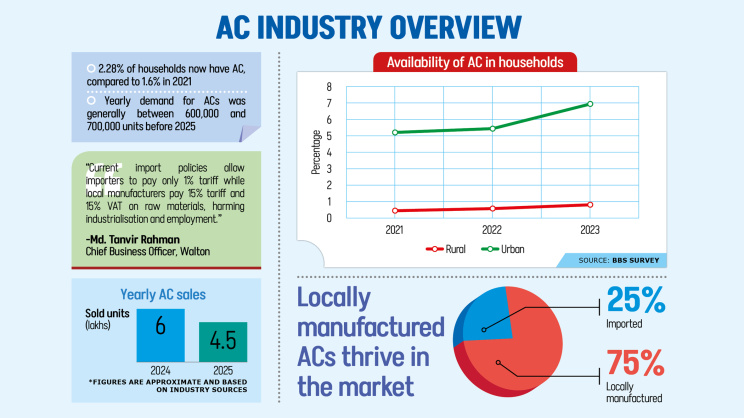
In terms of production, the “Made in Bangladesh” tag has become a dominant force. In 2023, local manufacturers and assemblers met nearly 80-90% of the domestic demand, a stark contrast to a decade ago when the market was almost entirely import-dependent. However, the journey hasn’t been without its cooling-off periods. But, last year saw a temporary dip in demand. Unprecedented rainfall and relatively mild temperatures during the peak summer months led to a “cooling off” of sales, with many retailers reporting stocks remaining on shelves longer than anticipated. However, 1-tonne unit now costs Tk 60,000 to Tk 65,000, up from Tk 50,000-Tk 55,000 a year ago, while in order to get premium brands one needs to count Tk 1.2 lakh. Despite this weather-induced fluctuation, the long-term outlook remains transparent, with annual demand estimated between 500,000 to 600,000 units in a standard year.
The Inverter Efficiency Edge
As electricity prices undergo periodic adjustments, the Bangladeshi consumer has become increasingly “energy-conscious.” This shift has pushed inverter technology from being a premium feature to a market standard. The primary appeal of inverter ACs lies in their ability to regulate compressor speed based on the room’s cooling requirements, rather than the “all-or-nothing” approach of non-inverter models.
According to technical insights from industry leaders like Haier, inverter technology can lead to substantial cost savings. By avoiding the high energy spikes associated with frequently starting and stopping the compressor, these units can reduce electricity consumption by up to 60% to 70% compared to traditional fixed-speed units. Over a three-to-five-year period, the savings on utility bills often exceed the initial price difference between an inverter and a non-inverter model.
Md Tanvir Rahman, Chief Business Officer at Walton, emphasises that while the future is undoubtedly inverter-driven, the market still maintains a niche for traditional models. “Inverter technology has quickly become the preferred choice due to its superior energy efficiency and long-term cost savings,” says Rahman. “However, non-inverter air conditioners still have a place in the Bangladeshi market, particularly in specific commercial or temporary use scenarios. Small retail shops, temporary workspaces, and certain institutional environments often prioritise lower upfront investment rather than long-term electricity savings. That said, the overall market trend clearly indicates that inverter technology will dominate the market in the coming years.”
AI-Powered Smart Cooling
Beyond energy savings, the new frontier for the AC market in Bangladesh is Artificial Intelligence (AI) and health-centric features. As consumers spend more time indoors, the demand for “Smart ACs” that offer more than just cold air is rising.
Electromart, the marketer of the globally renowned Gree brand, has recently introduced features that take personalisation to a new level. The launch of the Gree ‘Airy’ inverter AC series marks a shift toward AI-driven climate control. Md. Nurul Afser, Deputy Managing Director of Electro Mart group explained that this series integrates AI-driven sensors that analyze room temperature, humidity levels, and occupancy patterns to optimise compressor performance automatically. This intelligence translates directly into the wallet; customers can expect an additional 10–15% energy savings compared to conventional inverter models by reducing unnecessary compressor loads.
Moreover, in a post-pandemic world, air quality has become a non-negotiable feature. The Airy series features a “Cold Plasma” sterilisation system. This technology helps neutralise airborne bacteria, viruses, and allergens by breaking down harmful particles at a molecular level. “In densely populated urban environments with dust and pollution concerns, this feature significantly improves indoor air quality,” Afser noted. Laboratory testing has shown that the system eliminates up to 93% of bacteria and viruses, making it a critical addition for households focused on health and hygiene.
Policy Hurdles and Growth
While the consumer side of the market is flourishing with smart tech, the manufacturing side faces structural challenges that could dictate the future of local industrialisation. Bangladeshi manufacturers have proven they can produce world-class appliances, but they are now calling for a more level playing field in terms of taxation and tariffs.
Walton, a pioneer in local AC manufacturing, has pointed out a significant discrepancy in the current policy framework. Md. Tanvir Rahman highlighted that while the government encourages local production, certain tariff structures favor importers of heavy industrial cooling systems over local makers.
“There are policy barriers for local manufacturers which need to fix urgently,” he stated. “For example, importers can import VRF (Variable Refrigerant Flow) and Chiller paying only 1% customs tariff while manufacturers have to pay 15% customs tariff and additional 15% VAT on raw materials. This is heavily affecting local industrialization and employment along with raising the import cost.”
Addressing these disparities is crucial for the next phase of the industry’s growth. The transition from home cooling to large-scale industrial and commercial cooling solutions. If the tariff barriers are addressed, local manufacturers believe they can significantly reduce the country’s reliance on imported heavy machinery, further boosting the economy and creating high-skill jobs.
The Bangladeshi AC market is at a crossroads of innovation and policy evolution. With the rise of AI-integrated and smart features, the massive energy savings offered by inverter technology, and a growing consumer base, the industry is poised for long-term expansion. However, the stability of this growth will depend on how well the industry navigates weather-related volatility and whether the government provides the necessary policy support to protect and promote local manufacturing. For the consumer, the message is clear: the modern AC is no longer just a box that blows cold air rather it is a smart, health-tracking, energy-saving investment for a more comfortable future.
 For all latest news, follow The Daily Star's Google News channel.
Comments