


Love, Marriage and Cow Dung

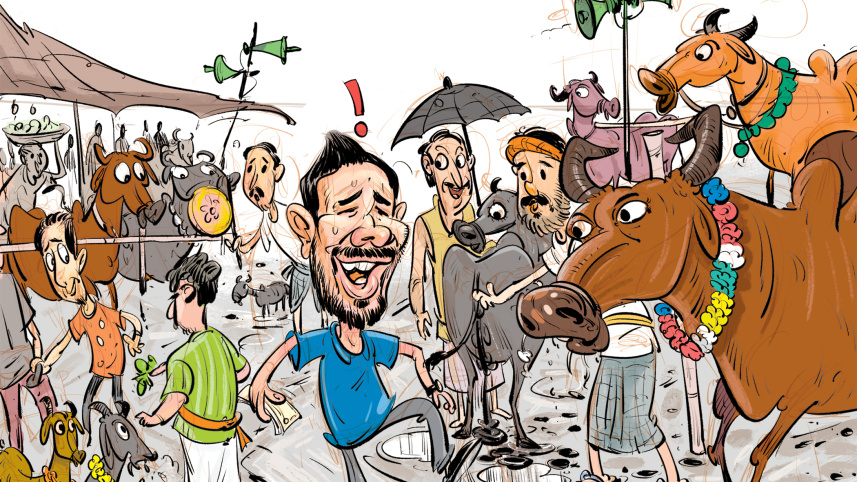
The first thing that greets you at a cattle haat is the smell. Not the cows. The smell arrives first, shakes your hand, and moves into your respiratory system permanently. Now, I grew up around farms as a child. We had cows. Twenty or thirty at a time. But there is a major difference between “farm” and “several thousand cows gathering for what feels like a digestive convention.”
There are people who genuinely love going to the cattle haat before Eid. They wait for it all year. They discuss cows with the intensity of stock market analysts and willingly spend entire evenings ankle-deep in mud, sweat and airborne bacteria.

I have long believed these are the same people who eat pufferfish despite knowing it could kill them. Some human beings simply need danger in their lives.
My one and only trip to a cattle haat happened shortly after I got married. Back when Bangladesh still had visible treetops. In fact, now that I think about it, there were no trees at all. Tops, bottoms, branches—all connected beautifully before flyovers arrived and blocked out the sky like unfinished homework.
I was persuaded into going by my brothers-in-law. Or possibly lured. To this day, I cannot tell whether they genuinely enjoyed cattle markets or just wanted to see the new son-in-law get trampled by livestock. Either way, they seemed unusually excited.
The first thing that greets you at a cattle haat is the smell. Not the cows. The smell arrives first, shakes your hand, and moves into your respiratory system permanently. Now, I grew up around farms as a child. We had cows. Twenty or thirty at a time. But there is a major difference between “farm” and “several thousand cows gathering for what feels like a digestive convention.”
The math changes.
So does the ground.
Calling it mud would be unfair to mud. This was a living ecosystem made of rainwater, soil and digestive ambition. Every step produced sounds usually associated with pulling wet slippers out of a drain.
Still, I entered confidently. Newly married men cannot afford to look squeamish in front of in-laws. Everything becomes a test of masculinity. How you sit. How loudly you greet relatives. Whether you can inspect a cow seriously without looking like you are searching for the exit.
Blood, I can handle. Injuries, no problem. But I still prefer biological substances to remain inside whatever container nature originally assigned them to. Human-shaped or cow-shaped.
Within fifteen minutes of entering the haat, I realised humanity perhaps was not for me. Outwardly, I nodded thoughtfully at cows and pretended to understand cattle pricing. Internally, I was ready to move into a cave and communicate only through handwritten notes.
There are also rules to surviving a cattle haat. You cannot wear anything fancy because the mud fears no brand. You cannot walk around waving your phone carelessly. And under no circumstances should you speak in an accent suggesting you had friends in English medium schools. The slightest hint of affluence gives sellers hope, and hope is not something Bangladeshis can afford to give each other anymore.
We spend most of our lives crushing hope professionally. Car owners hope roads will improve. Instead, they get taxes, traffic, and a point-based licence system while buses continue operating like escaped wildlife. People hope customer service will help them. Telecom companies answer with flute music and emotional damage. Entire generations hope housing prices will become reasonable before retirement.
Hope has a terrible survival rate here. So no, you do not walk into a cattle haat looking financially comfortable.
What fascinated me most were the experts. Every haat has them. Men who slap a cow twice squint into the distance and announce its weight with astonishing confidence.
“Ten mon.”
Immediately, another man objects.
“Impossible. Eight and a half.”
The cow itself stands there chewing thoughtfully, perhaps wondering why strangers are conducting a public symposium about its body.
 For all latest news, follow The Daily Star's Google News channel.
 Then comes the bargaining. Nobody wants the real price. The entire thing is emotional theatre. Buyers pretend to leave dramatically. Sellers clutch their chest in betrayal. Someone swears on three generations of ancestors that this is the final price.
It never is.
At one point, a seller described a cow to me with the seriousness of a marriage proposal. Healthy. Calm temperament. Strong build. Good appetite. I expected him to mention GPA results next.
And somehow, despite the smell, the chaos and the near-constant possibility of falling face-first into history, people genuinely enjoyed themselves.
I understood why by the end of the night. The cattle haat is one of the few remaining places where Bangladeshis gather without filters. No curated social media posts. No air-conditioned shopping malls. Just sweat, bargaining, noise, and survival instincts.
It felt real. I still never went back.
Comments