


From piles to cancer: Breaking the silence around colorectal health

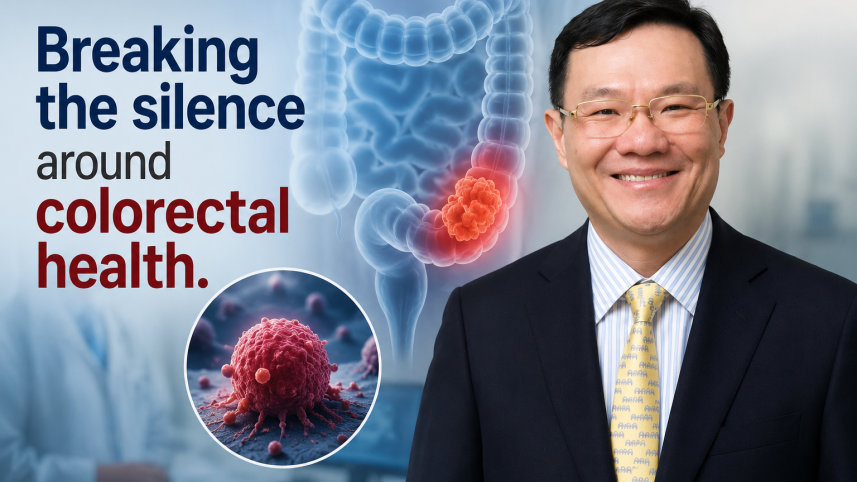
Colorectal diseases remain among the least discussed health problems in South Asia, despite affecting millions of people. Fear, embarrassment, and social stigma often prevent patients from seeking medical help early, allowing conditions such as colorectal cancer to progress silently. According to Singaporean colorectal surgeon Prof Emile John Tan Kwong Wei, this delay in seeking care is one of the biggest challenges doctors continue to face.
During his recent visit to Bangladesh, Prof Emile — Head, Department of Colorectal Surgery and a Senior Consultant Surgeon & Oncologist at Singapore General Hospital (SGH) — spoke to The Daily Star about colorectal cancer, piles, inflammatory bowel disease, minimally invasive surgery, and the growing role of artificial intelligence in modern medicine.

One of the most concerning aspects of colorectal cancer, he explained, is that the disease often produces no warning signs in its early stages. By the time symptoms become obvious, many patients may already have advanced disease.
“The difficulty is that early colorectal cancer may have no symptoms at all,” he said. “That is why screening becomes extremely important.”
When symptoms do appear, they should never be ignored. Bleeding during bowel movements, persistent changes in bowel habits, unexplained weight loss, or feeling an abnormal lump can all be warning signs. However, Prof Emile pointed out that many people mistake these symptoms for minor problems and delay consultation.
At the same time, not every case of rectal bleeding means cancer. Conditions such as piles, fissures, and fistulas are far more common. Yet these diseases also carry considerable stigma, causing many sufferers to remain silent for years.
“Actually, the most common cause of bleeding is piles, not cancer,” he explained. “But people are often too embarrassed to discuss these conditions openly.”
He noted that obesity, chronic constipation, and prolonged straining are common contributors to piles, while fistulas are more common among obese individuals and those with excessive body hair. The encouraging news, however, is that treatment options have evolved dramatically over recent years.

Traditional surgery for colorectal conditions once meant large incisions, severe pain, and lengthy recovery periods. Today, minimally invasive techniques — including laparoscopic, robotic, and laser-assisted surgery — have transformed patient outcomes.
According to Prof Emile, in advanced centres such as Singapore General Hospital (SGH), around 90 to 95 percent of colorectal cancer surgeries are now performed using minimally invasive techniques. Even many advanced and recurrent cancers can now be treated without large open operations.
“These techniques mean smaller cuts, less pain, faster recovery, and earlier return to normal life,” he said.
Laser procedures are also increasingly being used for piles, fistulas, and pilonidal disease. These methods reduce tissue trauma and allow many patients to recover within one or two weeks.
Beyond cancer and anorectal diseases, Prof Emile also highlighted the rising global burden of inflammatory bowel diseases (IBD), including ulcerative colitis and Crohn’s disease. Although the exact causes remain complex, lifestyle factors appear to play an important role.
Smoking, he warned, significantly worsens Crohn’s disease. Obesity, diabetes, processed foods, and difficult-to-digest diets may also aggravate intestinal inflammation.
“Food that forces the digestive system to work harder can worsen inflammation in people with IBD,” he explained.
Treatment for IBD has also advanced rapidly in recent years. Modern biologic therapies — specialised medications that regulate immune activity — are helping many patients avoid major surgery. For ulcerative colitis patients who require surgery, surgeons can now create an internal pouch using the patient’s small intestine, allowing bowel function without the need for a permanent external stoma bag.
Screening remains another major focus in preventing colorectal cancer. In Singapore, routine screening is generally recommended from the age of 50, while some countries such as the United States now begin screening at 45 due to increasing rates of early-onset colorectal cancer. People with family histories of colorectal cancer, genetic bowel disorders, or inflammatory bowel disease may require earlier screening.
While colonoscopy remains the gold standard, Prof Emile acknowledged that many people avoid it because of fear or discomfort associated with the preparation process. As a result, Singapore widely uses Fecal Immunochemical Tests (FIT) — simple stool-based screening tests — as an accessible first-line tool.
He believes awareness is equally important for conditions that deeply affect quality of life but are rarely discussed publicly, including pelvic floor disorders and faecal incontinence.
“People should know they do not have to suffer in silence,” he said. “Public awareness helps patients realise they are not alone and that effective treatment is available.”
 For all latest news, follow The Daily Star's Google News channel.
 Looking ahead, Prof Emile sees artificial intelligence becoming an increasingly valuable assistant in colorectal care. AI-assisted colonoscopy systems are already being used to help doctors detect small polyps and suspicious lesions more accurately during procedures.
“These systems work through pattern recognition,” he explained. “They help improve detection, especially for younger or less experienced surgeons.”
Still, he stressed that technology cannot replace clinical judgement. AI may assist doctors, but decisions ultimately remain in human hands.
As colorectal diseases continue to rise globally, experts say the biggest challenge may not simply be medical technology, but overcoming fear, stigma, and silence. Early screening, open discussion, and timely medical consultation could save countless lives — long before symptoms become impossible to ignore.
Comments