


Thriving in purgatory: The state of football’s most romanticised formation

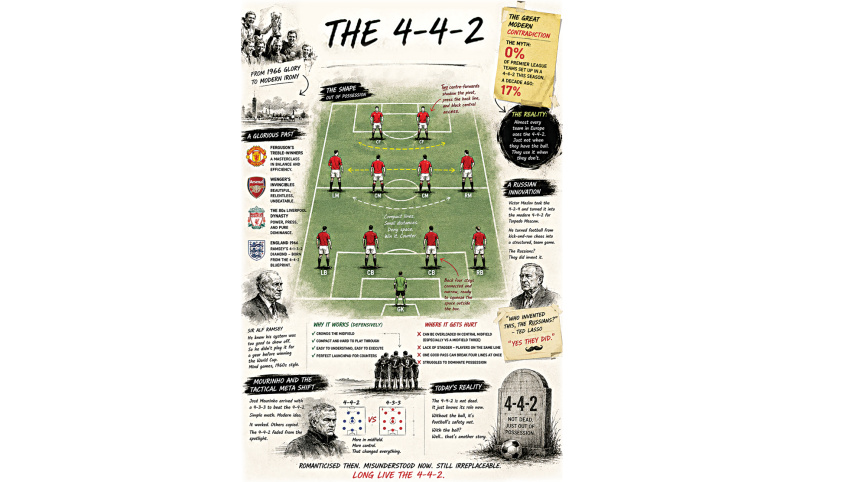
Two banks of flat fours with two centre-forwards leading the line. What is there to not get? Simple, isn’t it? Most may agree with that verdict about football’s most romanticised formula -- the 4-4-2 formation -- which brought upon tidal shifts and was the way to play for the best part of four decades, offering some of the most iconic sides in world football. From England’s 1966 triumph against West Germany in the FIFA World Cup final to some of the greatest club teams ever assembled, including Sir Alex Ferguson’s treble-winning Manchester United, Wenger’s Invincibles, the 1980s Liverpool dynasty, Diego Simeone’s Atletico Madrid, and the AC Milan dynasties -- the 4-4-2 was a renaissance of its own.


But as glorious as its reign was as an in-possession structure or as a traditional way of setting up for matches, its decline into obsolescence has been just as sharp. Officially, no Premier League side deployed a classic 4-4-2 this season. A decade ago, nearly a fifth of the league still flirted with it. Today, on team sheets at least, it has become football’s equivalent of a retired rockstar -- spoken about with nostalgia, occasionally wheeled out for charity matches, and treated like a relic by tactical purists who insist the game has evolved beyond it.
However, there is a catch, and it is a massive one. Because despite its apparent extinction, the 4-4-2 is still very much alive. In fact, it is thriving. While teams no longer build entire identities around the system in possession, nearly every major team in Europe morphs into a 4-4-2 when defending. The formation that supposedly “died” has become the default defensive shape of modern football. Pep Guardiola uses it. Mikel Arteta uses it. Arne Slot uses it. Diego Simeone never really stopped using it because, well, Simeone probably dreams in two compact banks of four.
Even at the 2022 FIFA World Cup, the system quietly shaped some of the tournament’s best defensive structures. Most notably eventual champions Argentina relied heavily on it during transitions. The US used it to compress central areas and spring counters. Canada, despite their adventurous reputation, also retreated into a 4-4-2 shell whenever defensive organisation became paramount.
So perhaps the 4-4-2 was never truly buried. It merely found a new address in football’s tactical purgatory -- too outdated to be fashionable, too effective to disappear.
The Russians really did invent it
There is a rib-tickling moment in the popular Apple TV series Ted Lasso where the coaching staff start discussing the 4-4-2 and Ted jokingly asks: “Who invented this, the Russians?” The punchline, rather inconveniently for the joke, is yes. They actually did.
The roots of the modern 4-4-2 can be traced back to Russian manager Victor Maslov, who adapted the older 4-2-4 into a more compact and structured system during his time with Torpedo Moscow and later Dynamo Kyiv. Football at the time was still transitioning away from archaic structures like the 2-3-5 and the WM formation, systems that belonged to an era where positional discipline often took a backseat to chaos and individualism.
Maslov’s innovation changed everything. Instead of relying on football as a glorified kick-and-run exercise, the 4-4-2 created spacing, balance and collective structure. It allowed teams to move together, defend together and attack together. Suddenly, pressing traps existed. Passing lanes mattered. Defensive compactness became a tactical principle rather than an accidental by-product. It was football industrialised. And once the machine started rolling, everyone wanted a piece of it.
By the 1970s and 80s, the system had become football’s universal language. Arrigo Sacchi transformed it into an art form at AC Milan with synchronised pressing and an impossibly high defensive line. Ferguson weaponised it at Manchester United with flying wingers and devastating transitions. Wenger’s Invincibles perfected its fluidity. Liverpool’s dynasties weaponised its intensity.
And then there was England before that.
Alf Ramsey’s 'negative' revolution
By packing the midfield area, prioritising defensive stability and looking for ways to win the ball back, Sir Alf Ramsey, who coached England into the 1966 World Cup, was accused of taking the joy out of football.
Newspapers branded him negative. Critics scoffed at the lack of traditional wingers. England, they argued, were becoming too mechanical.
Naturally, Ramsey ignored all of them. What he had discovered was essentially football’s first cheat code.
England’s World Cup-winning structure in 1966 was often described as the “Wingless Wonders”, a system that evolved from a traditional 4-4-2 into something resembling a 4-1-3-2 diamond. Ramsey trusted compactness over flair. He believed controlling central spaces mattered more than entertaining romantics who still thought wingers should spend entire matches glued to chalk.
The most fascinating part was that Ramsey was so convinced by the system that he stopped regularly using it before the megaevent so opponents would not fully understand what England were preparing.
In the final against West Germany, the tactical battle became deeply psychological. Helmut Schon tasked Franz Beckenbauer with man-marking Bobby Charlton, effectively neutralising England’s primary creator. But in trying to erase Charlton, West Germany unwillingly opened spaces elsewhere.
That was where Martin Peters and Alan Ball -- the two flanks in the diamond -- became decisive.
England’s “wingless” midfielders constantly overloaded spaces, carried the ball forward and sustained attacking pressure and the Germans were often at their wits end as players struggled to decide who would mark who.
Why the 4-4-2 worked so beautifully
There is something aesthetically comforting about two perfectly aligned banks of four. Defensively, it offers clarity that modern systems sometimes sacrifice in favour of tactical complexity.
 For all latest news, follow The Daily Star's Google News channel.
The two centre-forwards shadow-block passing lanes into opposition pivots while pressing outward towards the centre-backs, forcing play away from central areas. Behind them, the midfield four shuffle across the pitch as a single compact unit.
The system is often so simple that any coach, from the grassroots to elite level, can implement it with ease and suss out the strengths and weaknesses of his players on the field. It is a great starter, a foundation to lay and build one’s tactics upon. And this is precisely why the formation has refused to die.
Modern football is obsessed with the centre of the pitch and the 4-4-2 is about denying central progression.
Positional play -- or Juego de Posicion if one wishes to sound sufficiently tactical on social media -- revolves around creating triangles and numerical superiority between lines. Every elite attacking structure today is designed to manipulate central spaces. The 4-4-2 counters that philosophy with remarkable efficacy, compressing the middle and killing passing lanes. It forces teams wide. And once possession is forced toward the touchline, pressing traps begin to emerge from which teams can spring counter attacks. The supposed dinosaur suddenly starts looking rather intelligent.
Mourinho broke it
But of course, no tactical empire lasts forever. The first great collapse of the 4-4-2 came with Jose Mourinho’s arrival at Chelsea.
English football at the time was still heavily attached to flat midfield fours and traditional strike partnerships. Mourinho arrived from Porto and essentially informed the Premier League that everyone had been doing mathematics incorrectly. His solution was devastatingly simple. If opponents had two central midfielders, he would play three.
By implementing a 4-3-3 with a midfield triangle, Mourinho created a constant three-versus-two advantage in central areas. Claude Makelele anchored behind Frank Lampard and either Tiago or Michael Essien, allowing Chelsea to dominate possession, recover second balls and bypass traditional midfield battles altogether. The tactical arithmetic became impossible to ignore. Suddenly, the classic 4-4-2 looked vulnerable.
Teams realised that against a midfield three, two central midfielders could be dragged around endlessly.
At the same time, football’s relationship with wingers changed.
Wide players stopped behaving like traditional wingers and began functioning as inverted forwards. Managers increasingly placed right-footed players on the left and left-footed players on the right so they could cut inside onto stronger feet.
Why rely on two centre-forwards attacking deliveries when wingers themselves could become primary creators and goalscorers?
The old strike partnerships gradually disappeared. One striker became enough. Sometimes even that felt excessive.
And thus the classic 4-4-2 slowly faded from elite football’s attacking imagination.
However, like many things in life, football often adores irony and hence the resurrection of the 4-4-2 in defence is now very much in the meta. And this is why elite managers continue to rely on it.
Arteta’s Arsenal often defend in a 4-4-2. Guardiola’s Manchester City frequently shift into a narrow version of it out of possession. Slot’s Liverpool press in similar patterns.
The objective is always the same. Compact distances. Central congestion. No breathing room.
The system still demands discipline, athleticism and coordination to function consistently at the highest level. But perhaps that is also part of its romance. Because unlike some modern systems that rely on endless automatisms and hyper-specialised positional roles, the 4-4-2 still feels strangely human. It relies on collective sacrifice, spatial awareness and timing rather than pure tactical choreography.
Thriving in purgatory
Perhaps nowhere else does the modern game feel more nostalgic in relation to the 4-4-2 than when Simeone’s sides line up in a traditional 4-4-2 on TV because while almost no elite team in world football still uses it in possession, nearly all of them quietly retreat back into it once they are forced to defend without the ball.
So where exactly does the 4-4-2 belong today?
Not in heaven. The formation is no longer football’s ultimate attacking blueprint. Few elite sides build entire identities around it anymore. But it is not in hell either because despite all the obituaries written about it, the system continues appearing every single weekend at the highest level of the sport.
It survives in defensive blocks, pressing schemes and transitions. It lives in moments when teams need compactness more than spectacle. And perhaps that is why the 4-4-2 remains football’s most romanticised formation. Even after modern football tried desperately to evolve beyond it, the game still cannot quite let it go. Like all great romances, the 4-4-2 refuses to die gracefully. And if nothing else, that stubbornness alone feels wonderfully football.
Comments